The recovered paper market has seen better days, but recyclers who have been in the market for decades know even the high times don’t last too long. When the paper market took off in 1995, setting all-time records for prices, it was inevitable that the situation would attract new players. Now, with the market down to near record lows and lumbering along, it seems that many processors are opting to abandon the ship instead of waiting for the forces of supply and demand to get in sync.
But as some companies are leaving the market as fast as they entered it, prolonged slumping prices and tough market conditions can test the mettle and commitment of even the most efficient and loyal paper recyclers. Through these times, many companies attempt to pump up their volumes to squeeze out extra profits. Although this seems logical in a fixed-cost environment, Balcones Recycling, Dallas, operates on the premise that this approach can be flawed and even dangerous to the market if quality is not maintained.
REBIRTH OF A COMPANY
Balcones had its beginnings in 1976 as All Waste Paper Recycling when Richard Getter, who starred in the Texas Baseball League in the 1950s and 1960s, decided there was an opportunity in recycling high-grade paper. At the time, the Dallas area was growing as a major base for commercial printers in the Southwest. Today, metropolitan Dallas is reportedly the fifth largest printing city in the United States, and the largest in the Southwest.
AWPR grew through the rest of the 1970s and into the 1980s. By the end of the 1980s, Getter’s sons, Rusty and Kerry, who also worked for the company, saw an exit opportunity for their father.
"We wanted to cash in to set him up for retirement," says Rusty Getter, president of Balcones. "And it just happened that Waste Management Inc. was interested in buying. We had grabbed the attention of the big haulers during 1988 and 1989 when the paper market had a significant uptick in prices. We were the first ones to start a high-rise office recycling project in Dallas, and we were starting to hammer away at the revenues of the haulers. By 1990, we had grabbed about 50 percent of the paper market of downtown Dallas." Today, Balcones claims to own closer to 70 percent of that market.
In 1991, WMI purchased AWPR with the condition of letting the Getter brothers manage the business. In theory, the game plan was to let Kerry and Rusty grow the WMI recycling structure throughout the Southwest. But after a while it began to seem that WMI had no such intentions, according to Rusty. "They told us that they wanted us to lead the way for them, but after three years we realized that they had no intention to really grow us," he says.
His brother Kerry left WMI in 1993 and started a new operation in Austin, Texas, with a group of investors. The company was christened Balcones after a dominant geological fault line in Texas. The Balcones fault defines the eastern boundary of the Texas hill country just west of Austin; "balcones" is Spanish for "balcony" or "overlook."
Around the same time, WMI began selling some of its recycling operations, according to Getter. "Kerry felt that maybe WMI would be receptive to his investment group buying the Dallas facility back," he says. "They were bidding against companies like Weyerhaeuser, but they won the bid, bought the company back in 1994 and brought it under the Balcones umbrella."
Soon thereafter Balcones bought Greenrock Recycling, Little Rock, Ark. The company also moved its Dallas operations into a new 100,000-square-foot building during that same year. The new facility currently gets raves from those in the industry as being an especially clean and modern plant.
"This is one cleanest facilities in the U.S. – you could eat your lunch off the floor in there," says John Mayne of Mayne Machinery, Waco, Texas, which installed the baling equipment in the facility.
Others in the industry who have visited the Dallas plant attest to the outstanding layout of the building and the overall upkeep that they say makes it a jewel.
THE COLOR OF RECYCLING
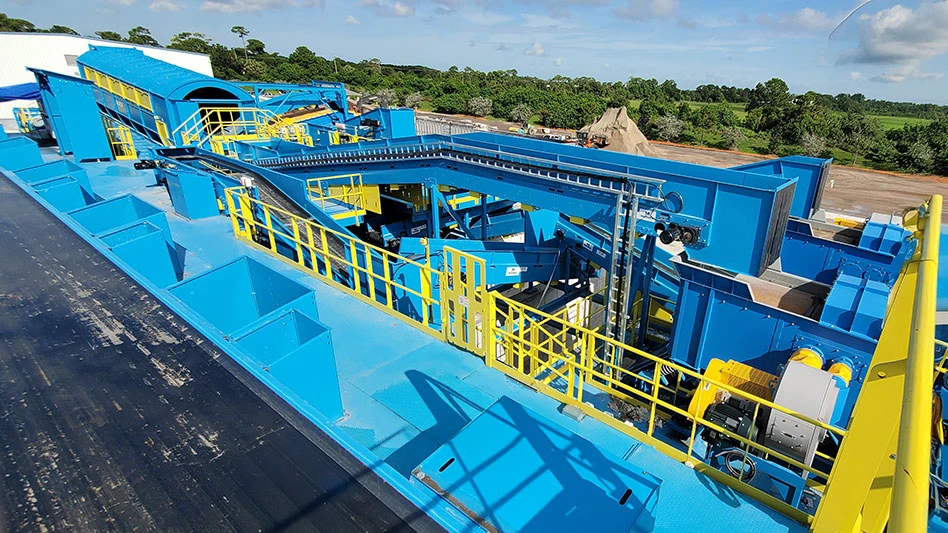
Balcones’ Dallas plant, which Getter claims is the largest high-grade recycling plant in the South, is unique in several respects. First, it was built using a sustainable building design; second, it handles mainly high-grade paper stock; and, third, it has a custom setup of modern conveyors, balers, walking floors and staging areas that increase efficiency and performance of the plant.
"We convinced our equipment manufacturers to abandon the status quo," says Getter. "At first they thought we were crazy, but now we are first on their tour stop when they take their potential customers around to show off their equipment and how it works."
The design is actually very simple, he adds. Material arrives in an enclosed staging area that uses three Keith walking floor systems that move the material to conveyors, sorting stations and two American Baler Co. balers. Using the walking floor system, the Dallas facility is now able to run 40 to 60 bales of material at a time instead of only a couple. "Efficiency has gone way up," says Getter. Ptarmigan Machinery, San Antonio, Texas, installed about 90 percent of the equipment at the plant and was the lead design contractor.
Visitors to the plant will notice something else besides the cleanliness that Getter attributes to handling mainly high grades of paper, and that is the dynamic color scheme of the plant. The company commissioned a design artist to come in and paint the balers purple and red, the poles teal and blue and the doors yellow. "It just makes it a fun place to work," he says. "For God’s sake, let’s do something different in this industry!"
In addition, the facility was constructed out of recycled-content materials, and has ecological design features such as multiple skylights, high-efficiency lighting, and energy-efficient heating and cooling systems. The building even uses recycled furniture.
The Austin and Greenrock facilities also include some of these same ecological building design features.
WHY QUALITY COUNTS
While everyone in the recycling industry talks constantly about quality, Getter says that mills are not doing enough about it. "We could solve many of the mills’ problems if they insisted on quality material, but they don’t," he says. "Most mills do not employ an empirical method for measuring raw material quality."
He says that if mills spent a few more dollars up front for better quality feedstock, they could save thousands of dollars down the road in operating costs and reduce rejected or off-spec finished product.
Getter attributes much of the problem to material recovery facilities that deliver poor quality material to mills. "Anything that says MRF scares me," he says. "When you compare what we do to what the MRFs do, it’s like night and day. We feel that the key to outstanding quality is at the source level, and that’s where we concentrate all of our energy and efforts."
Speaking at last year’s Wastepaper VII conference in Chicago, Getter proposed that mills conduct periodic quality sweeps of their suppliers. "We believe that the mills really don’t know what they are getting, and they pay everyone the same price," he says. "So those of us that are delivering exceptional-quality material are not getting rewarded. In fact, it’s the processors who are delivering the poorer quality bales that are being rewarded because they are getting the same price for less desirable material."
Getter proposes that at several announced times during the year, mills thoroughly check for quality of feedstock. "It doesn’t matter if the processor knows about an impending inspection, because everyone will know, and everyone will do their best to increase quality," he says. "So it will all be relative anyway. What it will do is pit everyone’s best effort against each other, and will help determine who is actually doing the best job at maintaining quality in our segment of the industry."
According to Getter, the average daily outthrows from Balcones overall operations is only 2.6 percent of the total tonnage processed. This low contaminant level is mainly attributed to education of account personnel and the people that work at the account, says Getter. Balcones personnel spend up to six months preparing a commercial account for recycling through education.
"We don’t just go in and say ‘Okay, start recycling your paper,’" he says. "We take time with each account and make it perfectly clear what they need to do in terms of recycling and sorting."
Getter says that spending this time to properly educate the office worker at his or her desk can really go a long way to vastly improving the quality of material that eventually comes into Balcones’ facilities.
In addition, Balcones eases customers’ fears about the handling of confidential material that office managers might not want to release to a recycler. "We have a controlled, enclosed facility that is monitored 24 hours a day by surveillance cameras," says Getter. "And as part of the recycling program, we can offer document destruction."
Balcones markets its overall paper recycling program under the title of "Anything That Tears."
Getter also has borrowed a lesson he learned from watching waste haulers transport material from one site to the next. "We have installed compactors in the basements of high-rises and teach the janitors how to use them, so that when we send a truck to pick up material, we can load a lot more material per run," he says. "It is definitely more efficient than transporting smaller containers of material."
Balcones also has several accounts set up with commercial printers. In larger accounts, the company leases a dedicated baler to the printer and arranges for the bales to go directly to a mill in Mexico. For its services, Balcones gets a cut of the payment for the material to cover the cost of leasing the baler and a little extra for profit.
The mill that Balcones has been partnering with for the last 10 years is Grupo Copamex, Monterrey, Mexico, and it has been a critical part of Balcones’ business. "They have been a very sound purchasing partner," says Getter. Grupo has a tissue mill in Monterrey and a deinking mill in southern Mexico.
Grupo Copamex uses the finest quality raw materials and is better than many U.S. mills at fostering a Japanese-style partnership philosophy, according to Getter. "I applaud them for their efforts," he says. "We get paid in 30 days, and I can’t say enough about their reliability and business ethics."
In addition, the opening of the border under the North American Free Trade Agreement and the recent strength in the Mexican economy has helped business. "Because of NAFTA, Grupo Copamex can stage trailers at printers in Dallas, then send material directly to their mill," says Getter. "It’s a three-way-win situation."
Overall, Getter says that the Mexican market has buoyed the market in the southwest U.S. about 5 percent to 10 percent relative to the rest of the country.
SURVIVING THE MARKET
While Balcones is maintaining its high standards with high paper grades, Getter admits that the market has been a drag. "We had the best year (in 1995), and then the worst year (in 1996)," he says. "The market has not substantially picked up yet in 1997, but it is heading in an upward direction. Pricing is anemic here like it is everywhere else."
Because of the continued poor market conditions, Balcones has had to put any possible ideas of expanding further by merging with or acquiring other recycling operations on hold. "Our goal is to remain the largest independent high grade paper recycler in the Southwest," adds Getter. "And even if the market swings back up we are not going to grow just for the sake of growth."
Right now, Balcones is focused on growing methodically, and plans to ride out the market and wait for the ideal time to make its moves.
"Like most everyone else, we have trimmed our workforce to the bone, and have kept our overhead low," says Getter. "And I think it’s times like these that really favor the independents. We do not have any outside costs that dock our profits and we do not have huge overhead costs. I also think that companies like us work harder than the big public ones, since our livelihood really depends on the business."
In tight times, many paper recyclers try to move more material to squeeze more profits in a fixed cost structure, and Balcones is attempting that strategy, too. "But it has to be profit volumes," says Rusty. "We could run like gangbusters, but the quality would suffer. In times like these, accounts just seem to fall in our laps, but you can’t take them all. We are very surgical in the way we ramp up volume. We are very careful with choosing new accounts, and how we are handling are overall growth strategy."
Currently, Balcones processes about 7,000 tons of recovered fiber per month, but Getter says he wants to increase this amount to about 20,000 tons.
"I would consider us a mid-sized operation right now," says Getter. While most of the paperstock is high-grade material, Balcones also handles lower-grade paper due to the nature of the business.
"We have to handle the low grades in order to completely service our accounts," adds Getter. "Ideally, we would rather not handle that type of material, but it is just part of doing business in the paper recycling market today."
Balcones is also looking for more close partnership arrangements with mills that recognize the company’s commitment to quality and dedication to service, according to Getter. "We want to continue to be scrutinized by the mills, because we know that we can provide material that consistently exceeds mill specifications."
The author is former managing editor of Recycling Today.
Latest from Recycling Today
- Greenwave raises revenue but loses money in Q2 2025
- Recycled steel prices hold steady
- EY says India’s need for scrap imports will continue
- Coming full circle
- Amcor, DCM introduce fertilizer packaging with 35 percent recycled content
- Comstock Metals gets closer to commissioning commercial-scale solar panel recycling facility
- Washington selects Circular Action Alliance as PRO
- Smurfit Westrock expands in Latin America