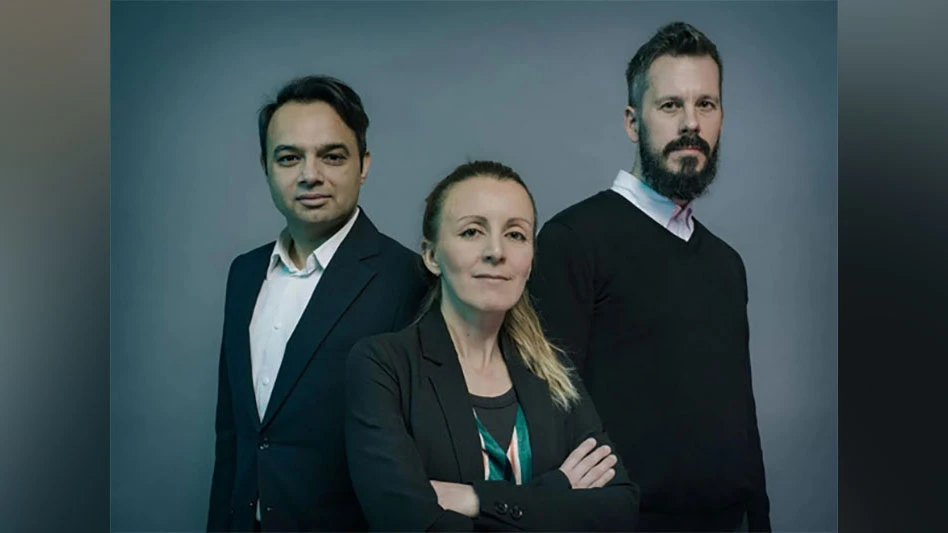
Photo by Felix Adler/SPRIND courtesy of Bioweg
German biotechnology company Bioweg, in partnership with Technische Universität Berlin (TU Berlin), has secured 1.5 million euros, or $1.76 million, from SPRIND, Germany’s Federal Agency for Disruptive Innovation, as part of the Tech Metal Transformation Challenge. The funding will support the development of Bioweg’s platform technology for water-based rare earth element (REE) recovery.
The Tech Metal Transformation Challenge’s goal is to develop and validate innovative processes for recovering critical metals from complex waste streams, including selective, water-based approaches that enable higher-purity outputs suitable for downstream use. The challenge also aims to drive the development of an end-to-end process by which recovered metals can be used directly as functional materials.
In addition to seven other teams, Bioweg and TU Berlin were selected by a jury of experts to take part in Stage 1, which will last for three years. Bioweg and TU Berlin competed against larger companies and research institutions in the selection process.
Bioweg, founded in 2019 by Prateek Mahalwar and Srinivas Karuturi, says it builds biotechnology platforms that convert industrial byproducts and waste streams into higher-value functional materials using fermentation and green chemistry. The fermentation systems that underpin the company’s bacterial cellulose ingredients for cosmetics and personal care also generate bio-based acids as a secondary output that can be directed into other applications using secondary fermentation.
The company operates a demonstration site in Quakenbrück, Germany, and a formulation, material science and applications lab in Monheim, Germany, on the Bayer Crop Science campus. Its product families include Micbeads (micropowders), RheoWeg (rheology control) and AgriWeg (seed and fertilizer coatings).
Despite REE demand surging in Europe as demand for electric vehicles, wind turbines and consumer electronics grows, the EU faces supply risks arising from geographically concentrated global production. Conventional REE recovery processes are highly energy-intensive, rely on solvents and generate large quantities of toxic waste, the company sats. These methods are also nonselective, environmentally harmful and economically unsustainable for widespread circular use in Europe. Bioweg says it has developed an alternative to the current high-energy, waste-intensive and nonselective recovery platform.
“The funding from SPRIND will allow us to accelerate the development of a sustainable and bio-based REE recovery platform in collaboration with TU Berlin,” Bioweg co-founder and CEO Prateek Mahalwar says. “It is built on Bioweg’s expertise of waste stream-based fermentation platform and green chemistry, extending the application of capabilities we already use at scale in bacterial cellulose production.”
The platform technology combines Bioweg’s expertise in bioacid production from waste streams for bioleaching with TU Berlin’s peptide-based separation technology using column systems. The process operates in water at ambient temperature, applying green-chemistry bioleaching without the use of solvents or high heat, according to a news release Bioweg issues about the grant award. The bio-based acids are generated as a secondary output of Bioweg’s fermentation platform, requiring no additional downstream processing, resulting in a low-energy process with a reduced overall CO₂ footprint.
Bioweg is collaborating with TU Berlin’s professor Juri Rappsilber, an expert in peptide chemistry and a representative of the UniSysCat Cluster of Excellence, on the project.
“This partnership allows us to bridge the gap between fundamental research within the UniSysCat Cluster of Excellence and industrial-scale application," Rappsilber says. "By leveraging the principles of Green Chemistry, we are combining our world-leading peptide innovation with Bioweg’s fermentation expertise to create a truly circular solution for Europe’s metals sector.”
Latest from Recycling Today
- NAW secures injunction blocking enforcement of Oregon’s EPR law
- WM opens 2 new MRFs in Ontario
- International Paper to close Washington box plant
- Cascades exits honeycomb packaging, partition business segments
- Customer focus drives Bantam Materials’ success
- ATI reports slimmer profits
- Papilo acquires Allwood Recycling in UK
- RecycleNation helps people find nearby recycling facilities