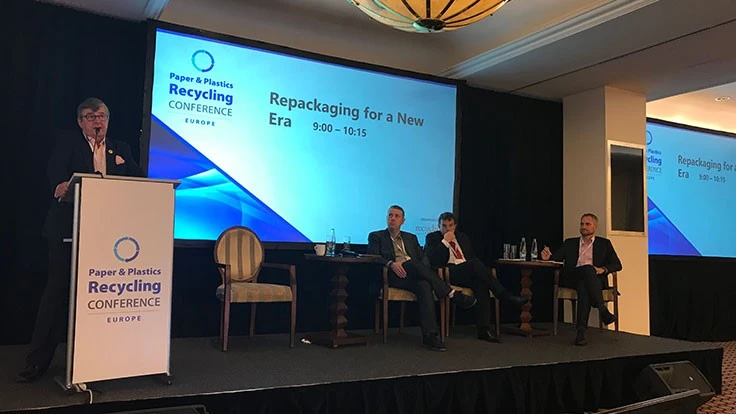
Pictured above, from left: Michael Baxter of RPC BPI Group, Stephan Kruger of Nest Corp.,
Dominic Cakebread of GlobalData Plc and Stuart Hayward-Higham of Suez
The speed at which regulation targeting single-use plastics has moved through the European Parliament demonstrates how plastics have driven up the political agenda, said Michael Baxter, external affairs director for RPC BPI Group, which is based in the United Kingdom. Baxter moderated the session Repackaging for a New Era at the 2018 Paper & Plastics Recycling Conference Europe, which was Nov. 6-7 in Prague.
Baxter said he didn’t think the proposed legislation would move as fast as it has, adding that it normally takes about three years to move through parliament.
The law targets 10 single-use plastic products most often found on Europe's beaches and seas: plastic cotton buds, cutlery, plates, straws, drink stirrers and sticks for balloons. Instead, they will have to be made from more sustainable materials. Single-use drink containers made with plastic will be allowed on the market only if their caps and lids remain attached.
Baxter noted that the Ellen MacArthur Foundation wants to reduce plastics in use by 50 percent, adding that he didn’t think that would ever become a reality.
One company that is embracing alternatives to fossil crude products is Finnish company Neste Corp. Stephan Kruger, business development manager, recycled feeds, said the company began adopting sustainability measures in the last 10 years, essentially transforming the oil company, which now has a renewable fuels portfolio. He said one-fifth of the company’s products are sustainable.
Kruger said Neste wants to find more sustainable solutions to fossil crude that could also mean going back into new plastics using pyrolysis or liquefaction.
Neste supports mechanical recycling, he said, adding that it is “always the No. 1 choice.” However, Kruger said mechanical recycling has limitations when it comes to low-quality films and multilayer plastics. Chemical recycling could offer a complimentary option to mechanical recycling and waste to energy in these instances.
He added that China’s ban on plastic scrap has brought a lot of pressure to plastics recycling, essentially eliminating 50 percent of recycling capacity. “Chemical recycling can help us to get back to recycling rates we want to achieve,” Kruger said. “The process can use low-quality material ad produce virgin-like plastics.”
He urged everyone in the plastics value chain to communicate with one another outside of their own boxes to make chemical recycling a reality for the industry.
Stuart Hayward-Higham, who works in the U.K. for Paris-based Suez, echoed the need for collaboration, saying it was necessary to think systemwide when new packaging is introduced. “One change in design has a big impact on [our] entire system,” he said, referencing the need to include green waste in industrial composting programs so that compostable plastics breakdown correctly.
Hayward-Higham said it can take 10 years to make the changes needed to contracts and vehicles for recyclers and communities to respond to new packaging.
He added that the hurdle of convenience also needed to be overcome, saying the public needs to understand why they do what they do: They need to know not just which bin to put their packaging in but also why it is important to do so.
“We all have a vested interest in getting the system to function efficiently and cost-effectively,” Hayward-Higham said. “The cost of collection usurps the value of the materials we collect unless we do single stream.”
He added, “Brands are asking [the recycling industry] to come up with answers. If we don’t, they will come up with them themselves.”
Dominic Cakebread, director of consulting – packaging for GlobalData Plc, based in the U.K., also mentioned the need for collaboration throughout the supply change and the importance of designing for recycling so the quality of the recyclate is better.
He said demographic change remains the fundamental driver of beverage and packaging consumption growth as per capita consumption of packaging increases with income. Cakebread added that packaging is a bellwether of the economy, making up 2 to 3 percent of a country’s gross domestic product (GDP) regardless of overall GDP size.
He said the trend in packaging has been toward more and smaller packs, with digital and mobile purchasing fragmenting markets and packaging types.
While Cakebread said bioplastics were becoming more commercialized, he added that he was skeptical they will become mainstream.
He added that the packaging industry is conscious of the need to consider end of life for its packs; however, Cakebread said upheaval seems unlikely because consumer trends are toward more complex packaging. He also said the extent to which plastics have penetrated packaging and the investment required to make small changes in packaging will impede progress.
The 2019 Paper & Plastics Recycling Conference will be Nov. 5-6 in Barcelona, Spain.
Latest from Recycling Today
- Greenwave raises revenue but loses money in Q2 2025
- Recycled steel prices hold steady
- EY says India’s need for scrap imports will continue
- Coming full circle
- Amcor, DCM introduce fertilizer packaging with 35 percent recycled content
- Comstock Metals gets closer to commissioning commercial-scale solar panel recycling facility
- Washington selects Circular Action Alliance as PRO
- Smurfit Westrock expands in Latin America