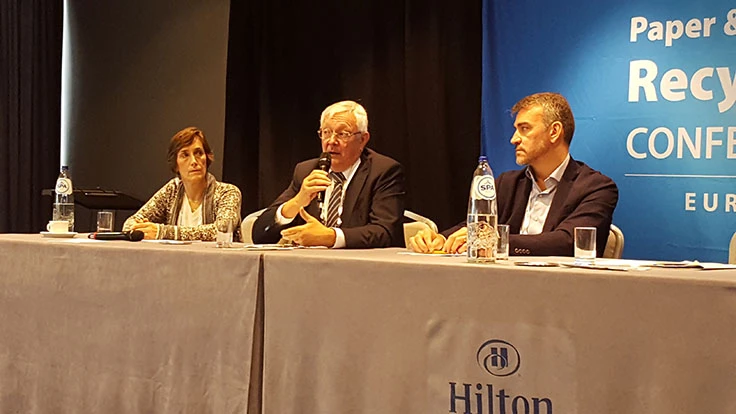
Pictured above, from left: Betsy Jordan, Jordan Trading; Jo Cox, Smurfit Kappa; and Marc-Antoine Belthe, Veolia Proprete France Recycling
During the opening session of the annual Paper Recycling Conference Europe, held in Rotterdam 2 November, a trio of speakers, representing the brokerage, environmental services and paperboard industry, discussed the key drivers for the market going forward.
In his remarks, Marc-Antoine Belthe, a senior manager with Veolia Proprete France Recycling, noted that the European paper industry is undergoing significant structural changes, most notably the decline in the graphic paper segment of the business (newsprint and writing papers). At the same time, Belthe pointed out, there has been increased demand for low grades, notably the conversion of paper mills from graphic paper to packaging grades.
This “evolution,” he noted, “is not without risks.”
The move toward packaging grades could result in an overcapacity throughout Europe, which can lead to pressure on margins. The result is a growing risk for some small packaging companies, he noted.
Another factor that is driving the paper recycling market has been the push for better quality, while at the same time there is a growing call for greater collection. This often creates a conflict between various parties as increased volumes of fiber are often of much lower quality
Another issue that is complicating the market, Belthe pointed out, is the changing composition of the paper stream, driven by the growth in municipally generated fiber. The result is more mixed paper entering the paper recycling stream. This is requiring all parties in the supply chain to adapt and install new equipment.
“There is a higher percentage of OCC (old corrugated containers) in the soft mixed paper due to online shopping,” Belthe pointed out. While more mills are “interested” in the grade, to reach the quality requirements for deinking is more difficult because there is more unwanted brown fiber in the material.
However, even with more sophisticated processing equipment, “There are higher proportions of nonfiber material due to more single-stream collections.”
Looking into the future, Belthe said that over the next five years there will continue to be a steady decline in the production of graphic paper. In France, he noted, the figures show that “We will have 130,000 tonnes per year less of graphic paper, which is a drop of 5% a year. However, the figure for 2015 was a decline of 10%. “
While cardboard will be stable to grow slightly due to an increase in packaging usage, “High grades will disappear gradually with the general decline in the graphic industry,” Belthe pointed out.
Jo Cox, a mill executive with Smurfit Kappa Group, discussed the growth in the circular economy and the impact it is having on the paper and paperboard sector in Europe.
While addressing the importance of recycling, Cox said that there still is an essential need for virgin fiber. “You need virgin fiber to make recycling work,” he stressed.
At the same time, he pointed out that paper recycling levels are reaching their maximum levels in many European countries. With some countries at around the 80% level, it will be far more difficult to further increase recycling levels in many of the most developed countries in Europe.
Cox also echoed Belthe’s mantra about working to improve the quality of the fibre being processed. “There is a high demand for quality. We have to improve our quality control. It is absolutely necessary.”
To address the quality issue, Smurfit Kappa has begun performing core drilling. “We take samples from one or two bales for random shipments. We look at the quality, moisture, etc.,” Cox pointed out.
As for the growing interest in the circular economy, Cox pointed out that industry is moving away from a linear economy where raw material is sourced and then thrown away to one where mills more fully embrace the concept of sustainability, “which is a key driver for innovation as well as cooperation.”
Betsy Jordan, the president of Jordan Trading, a Kingston, New York-based independent brokerage operation, addressed the growing concern with the shipping industry. “Ocean carriers have been losing money almost every year since 2008,” Jordan noted. “They (the shipping industry) have lost billions and billions of dollars.”
This has culminated in the bankruptcy filing of Hanjin, the seventh-largest shipping company. “A big shock to the industry,” she added.
With the uncertainty in the future of the shipping industry, she acknowledged that one change is that in the short term shipping rates have been increasing, with another announced increase scheduled for December,” Jordan said.
The increase in shipping rates also will likely be solidified by more mergers in the shipping industry, including the recently announced plan by three Japanese shipping lines to merge their operations. “The impact of mergers means less space and higher rates going forward,” she said. “People need to recognize the days of low shipping rates and plenty of space are generally going to be over.”
In addressing the Chinese paper industry, Jordan said that while it is fairly common knowledge that many smaller mills have been closing down, what is perhaps less known is that the Chinese government is forcing many smaller mills to consolidate. “They (the Chinese government) can tell mills that they won’t get credit unless they merge,” she noted.
Continuing on her analysis of China going forward, she said the concept that China would ease back the stricter policies of Green Fence will likely not happen. “China doesn’t want garbage. We will continue to see mills pressuring suppliers to make better quality paper. Mills can’t make paper out of garbage.”
The 2016 Paper Recycling Conference Europe was 2-3 November at the Hilton Rotterdam in the Netherlands.
Latest from Recycling Today
- Des Moines project utilizes recycled wind turbine blades
- Charter Next Generation joins US Flexible Film Initiative
- Vecoplan to present modular solutions at IFAT 2026
- Terex Ecotec appoints Bradley Equipment as Texas distributor
- Greenwave raises revenue but loses money in Q2 2025
- Recycled steel prices hold steady
- EY says India’s need for scrap imports will continue
- Coming full circle