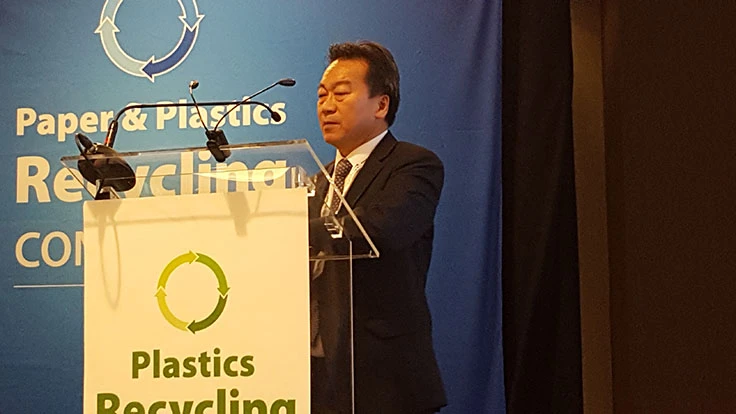
Film plastic has become one of the most heavily criticized plastics. Despite the negative press afforded the commodity, there are significant end markets for the material. During the recently concluded Plastics Recycling Conference Europe show, held in Rotterdam Nov. 2-3, Dr. Steven Wong, chairman of China-based Fukutomi Co. Ltd., discussed the opportunities for film plastic in China and Southeast Asia.
First off, while there are a host of polymer grades that are used to make plastic film, Wong noted far and away the most commonly used polymer is LDPE.
In his remarks, Wong noted that the most popular film plastic in Asia continues to be film from the agricultural sector. And, because of this, there are a plethora of issues that need to be addressed, most prominently the potential contamination of the material.
When film plastic recycling first started to gain traction in China the most popular end markets were to make products such as beach sandals and garbage bags. During this time, film used in agricultural applications was still not of the size that it is today.
While in the late 1980s and early 90s the overall supply of film was not abundant, the quality was good. Supply sources, including supermarkets and film blowing factories, provided a stable supply of material.
However, by the year 2000, plastic film generated from agricultural sources became a much more popular supply source. In China, many state-owned enterprises privatized and used recycled materials, including film plastic, to stay competitive, Wong pointed out.
As the interest grew, demand improved and margins for recyclers were good. “Sustained increases in demand made business more lucrative in those years,” Wong noted.
As the grade grew in popularity, more recyclers started entering the market, increasing the competition. With more recyclers chasing the material, production capacity slowed and margins declined, Wong noted.
The growth in the domestic infrastructure in China really took off due to the implementation of the Green Fence program. With so much film plastic, as well as other scrap plastic grades, being shipped to China failing to meet quality standards, more recyclers in China started to crop up. Local demand was stable, and growth was steady but slow.
However, more recently, with China’s economy slowing, there started to be a spread between the supply of material and the demand, even though demand continued to increase.
Also changing the dynamic for film plastic in China has been the efforts by the Chinese government to develop policies and regulations that created more stringent environmental controls. Along with the slowdown in the Chinese economy, the Chinese government started to put greater effort on improving its environment, which has driven up the costs for film plastics recyclers. While this has created some hardships for the plastics recycling industry, the net result has been more questionable plastics recyclers dropping out of the market, which has helped ease the competition for the material.
As the film plastic industry in China evolves, more challenges are arising, Wong pointed out. The supply of film plastics from the agricultural sector has increased, but the level of contamination also has grown. Factoring in the cost of the material, the cost for process and other fixed costs, Wong pointed out, recyclers would only turn a profit if they could get a yield level greater than 55 percent. “Whoever is able to raise the yield will be the winner,” Wong pointed out.
As successful as film plastics recycling has been in China, Wong also pointed out that there is a shift taking place, with more material moving to other Southeast Asian countries such as Malaysia, Philippines, Thailand and Vietnam. One of the biggest reasons for the shift is the significant difference in labor costs between China and other countries.
In his presentation, Wong pointed out that that at the present time the cost on customers to ship a container of 20 tons of film plastic to Malaysia may cost around $800, while that same load costs $1,600 in Vietnam and as much as $3,600 in China.
Continuing the disparity in costs between different countries, he noted that the labor costs in many Southeast Asian countries, compared to China, can be as low as 49 percent in the Philippines and 47 percent in Vietnam.
However, the lower labor costs also can result in low efficiency, which should be considered when shipping material.
Taking a different tack, Carlos Ludlow-Palafox, CEO of Enval Ltd., a U.K.-based company that has created a solution for recycling plastic aluminum laminates through the use of microwave induced pyrolysis, discussed the opportunities afforded with this new innovation.
Ludlow-Palafox noted that through Enval’s pyrolysis process, plastic aluminum laminates can be separated, ultimately unlocking the potential of high performance materials so that fast moving consumer goods companies (FMCGs) don’t have to choose between cost/performance and recyclability.
“Our microwave induced pyrolysis process is a world-first solution for recycling plastic aluminium laminates,” he noted. “The process is clean, efficient and economical for both post-consumer and industrial waste.”
The procedure championed by Enval addresses the lack of a recycling infrastructure available for this product. While the light weighting achieved by these plastic aluminum laminates proves beneficial for consumer brands and customers, up to now they have not been a recyclable material. The consequences, he points out, are that “many tonnes of low density waste are geographically distributed.”
Through the Enval process, both industrial scrap and post-consumer waste can be separated between hydrocarbons and aluminum, which ultimately reduces the amount of material shipped to landfills.
He noted that the industry has failed to invest in processes to boost recycling. The consumer products companies especially has failed to take a more active role in the recycling process. “I do think there is a need to think about dealing with this material in a different way.”
“My take on it the plastic industry has been rubbish in dealing with the huge amount of material coming out. Not just with the different kinds of polymers. The new technologies being developed to increase to deal with plastics is nonexistent. I believe there is a need to develop new technologies that do not rely on size for economies of scale,” Ludlow-Palafox said.
“We have not invested enough in technology that can work in small levels,” he added. Meanwhile, waste management firms are generally reluctant to adopt new technologies, he pointed out.
However, he concluded, “If you ask people to put the material in the recycling bin they will.”
Latest from Recycling Today
- England's Environment Agency extension provides stability for metal shredding operators
- Schupan names new chief financial officer
- NAW looks ahead to July hearing in Oregon
- Recycle Coach partners with Bartec Municipal Technologies
- EPA proposes abandoned tire cleanup plan with focus on energy recovery
- BIR welcomes new policy officer for trade & environment
- Global Recycling Foundation recognizes Recycling Heroes
- Recycling Today Media Group launches Paper and Plastics Recycling Conference webinar series