Mark Campbell Productions
Sustainable packaging design and innovation have ramped up in recent years as more brands and consumer packaged goods (CPG) companies commit to more environmentally friendly products.
Goals like reducing the use of virgin plastic, improving recyclability and incorporating more recycled content have prompted the introduction of new packaging types—some that have worked, and some that haven’t.
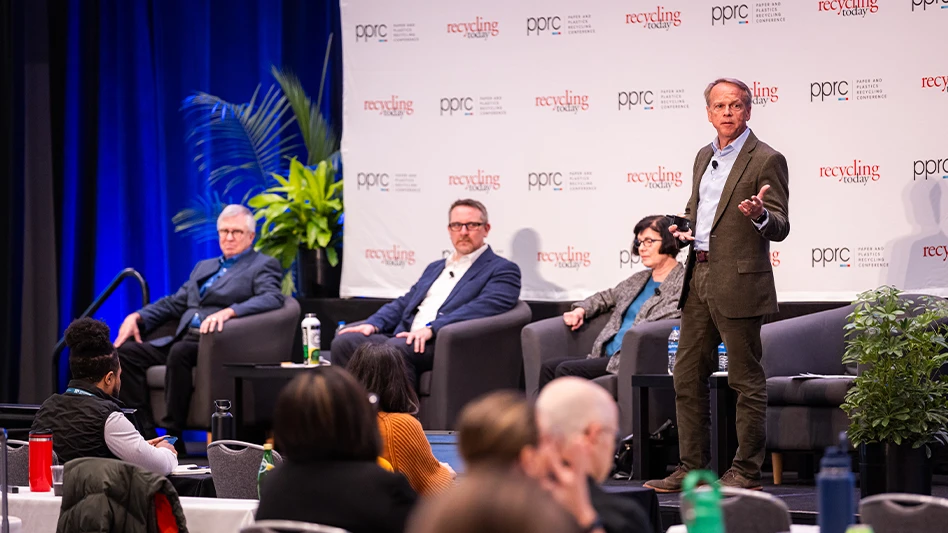
At the Paper and Plastics Recycling Conference (PPRC) in Chicago in mid-October, Bill Moore, president of Atlanta-based consultancy Moore & Associates, moderated a session called Trends in Packaging Innovation: The Challenge of Reaching Sustainability Goals, which included Cory Connors, sustainable packaging sales and marketing at Wilmington, North Carolina-based Atlantic Packaging; Susan Cornish, principal consultant at Insight and Action; and Michael Hodges, vice president of sustainability and communications at Finland-based Huhtamaki.
The group discussed trends, recent packaging innovations and why meaningful progress doesn’t always mean achieving lofty goals.
“What we’re doing can have a major impact on the world,” Connors said. “Any way we can help companies improve their packaging, we’ll look into it, and we’ve been able to do very good business that way by focusing on that. … We’re investing in the future of this industry.”
The challenge of innovation
One of the major factors that led to packaging innovation over the last six or seven years, according to Cornish, is around 2015 when photos of sea turtles with straws in their noses became the primary image surrounding plastic pollution.
“Within a few years after that, all the major CPG companies began publishing goals to make their packaging more sustainable, as well as other ESG [environmental, social and governance] goals,” she said.
RELATED: PPRC 2025: Tracking EPR's progress
Cornish presented data from the Ellen MacArthur Foundation comparing the five largest CPG companies’ packaging goals set in 2018 for 2025 and their actual progress as of 2023, revealing that most companies were not able to reach their original targets, but that some progress has been made.
The goals were:
- to reduce use of virgin plastics by 18 percent by 2025;
- to increase the share of postconsumer recycled (PCR) plastic in packaging to 26 percent; and
- to increase the share of packaging that is reusable, recyclable and compostable by 37 percent.
By 2023, the use of virgin plastics had decreased by 3 percent, the share of PCR plastic in packaging was 14 percent and the share of packaging that was either reusable, recyclable or compostable increased by 7 percent.
“It was turning out to be a bit more difficult than they expected to make these big changes,” Cornish said, noting that changing packaging substrates “isn’t as straightforward as you might think.”
She listed several obstacles to overhauling packaging composition, not the least of which were cost and quality. Other issues include having the proper equipment, needing time to market new materials to customers, testing and qualification of materials, legislative hurdles, environmental concerns regarding material transport and more.
Changing packaging substrates is particularly challenging for the paper industry, as it calls into question material availability as well as a potential major price increase for pulp that could make a conversion uneconomical.
“New brands that were brought out with sustainable packaging characteristics and even sustainable product characteristics, they have not all gone well,” Cornish said. “If the shift from plastic to paper was substantial, that would cause issues for the paper industry. If 10 percent of plastic beverage cups were replaced with paper, that would require a 20 percent increase in global cup stock when at any given year, there's a 3 or 4 percent increase that's planned. So, there are a lot of challenges, even for the paper industry, if we were to see a wholesale switch.”
Addressing challenges, making improvements
According to Hodges, packaging must have a good beginning-of-life story and a good end-of-life story—all with circularity in mind.
“At the beginning we want to make sure it's made with certified and renewable materials, [and] at the end of life, we want to make sure it's designed to be compostable and reusable or recyclable,” he said. “That's our purpose.”
While many of those lofty corporate sustainability goals had not been met by this year’s deadline, Hodges also emphasized the importance of recognizing the progress that has been made.
“Some of the big brand companies had some pretty aggressive goals and, perhaps, they recognize they were more assertive than they could get to,” he said. “What I would say is we've come a long way, baby, and I think we have to make sure we understand that, even though we may not be making that 100 percent goal by 2025 or 2030, we are making progress today.”
RELATED: PPRC 2025: Addressing plastic film challenges, advancements
However, in between a good beginning- and end-of-life story are a host of issues that confront sustainable packaging improvements, with Hodges listing extended producer responsibility (EPR) fees, eco-modulation and the general “cost of sustainability.”
“But what’s the option? Doing nothing? I don’t think so,” he said. “That’s not an option. We have to figure out what we’re going to do and how we do it next.
Connors presented several packaging alternatives to some more traditional, less sustainable options, including switching from poly mailers to paper mailers, bubble wrap and foam to fiber-based cushioning, plastic cable ties to fiber straps and plastic blister packaging to paper form.
“We want to look at it as a material reduction,” Connors said. “I think a lot of times we have customers that say, ‘We want to have higher postconsumer recycled material.’ That's great, but what if you use less packaging?
“I had a customer once that wanted to save 25 percent [and] I could not figure out a way to do that for them; we were at the bottom of the margin I was allowed to do. So, we went in there and we showed them how to use less material with paper void fill and they saved about 25 percent. So, there are other ways at looking at cost savings and material reductions.”
“It’s not going to stop,” Hodges added. “We're going to have to continue to figure out how we live within this new environmental legislation place we're in today. We have to figure out how to do it bigger and better. … We continue to look for ways we can challenge ourselves, so that as we look at EPR, we're using it as a guideline of how we can help our customers achieve the lowest EPR fees and help them eco-modulate to meet some of the other sustainability goals they may have.”
Latest from Recycling Today
- Fleetio launches AI capability to accelerate fleet maintenance approvals
- The Metals Agency receives approval for export credit insurance
- Recycle Ann Arbor extends drop-off station operating hours
- Sybilion seeks to help manufacturers confidently address volatility
- Rio Tinto, Prysmian partner on low-carbon aluminum solutions for data centers
- Unilever criticized for plastics approach
- USTR to study additional steel, aluminum tariffs
- Electrified Materials adds processing capacity