Mark Campbell Productions
Over the last year or so, the old corrugated containers (OCC) and mixed paper markets have brought most everything but good news.
Prices for both grades have plummeted in 2025. As of November, the U.S. average price for OCC was $44 per ton, down nearly 41 percent from $74 in November 2024, while mixed paper prices have been more than halved, coming in at $20 a ton this November compared with last year.
A seven-month stretch last year had OCC prices hovering between $101-$106 per ton, but the grade has otherwise not topped $100 or more per ton since 2022.
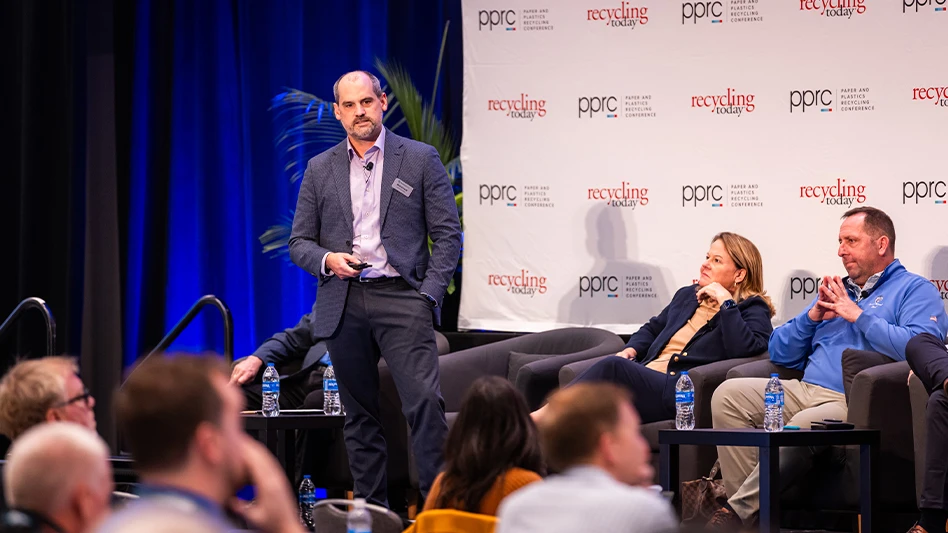
“[OCC] is all over the place. It’s one of the most volatile commodities ever, and this week … has been pretty scary,” Moore said during the Paper and Plastics Recycling Conference in Chicago in mid-October, referring to a new Chinese policy implemented Oct. 10 requiring recycled pulp importers to specific whether the material was produced using a dry or wet method.
“Mixed paper is right up there with OCC in terms of its volatility.”
Moore moderated a panel that included Matt Elhardt, chief revenue officer at Charlotte, North Carolina-based ResourceWise; Melanie Harman, director of mill fiber procurement at Fort Washington, Pennsylvania-based PaperWorks Industries; Matt New, vice president of sales at Sweden-based Ekman Recycling; and Todd Shumaker, president of commodities and brokerage at New York City-based Circular Services.
The group discussed the ever-present volatility in the OCC and mixed paper markets, and with China restricting imports of recycled wet pulp, painted a mostly gloomy picture when it comes to any potential market upswing.
Pandemic market aftermath
Containerboard is the largest segment of the recovered fiber industry and the largest that consumes OCC. Elhardt’s data show Asia is home to about 65 percent of global containerboard capacity, followed by Europe and North America, while North America uses more OCC as furnish compared with the rest of the world, which consumes a wider variety of grades.
“Whereas most of the rest of the world is fine using stuff other than OCC, North America writ large really doesn’t for the most part,” he said.
In 2022, after a spike brought on by the COVID-19 pandemic, U.S. containerboard slack capacity—the number of mills that didn’t have orders—reached about 9 million tons, which Elhardt said was a 25-year record.
“Put another way, 1 out of every 4 linerboard machines didn’t have an order going into 2023,” he said. “[There was] a very dramatic destocking that happened as a consequence. We saw a lot of mills closed.”
Since then, 4.6 million tons have come out of the market as companies closed older, inefficient and mostly virgin facilities.
“Virgin mills in North America take a staggering amount of money to maintain compared to recycled mills,” Elhardt said. “The industry saw very tough sledding in terms of operating rates. These companies rationalize their footprints, and predominantly that was virgin capacity that has come out.”
He noted that if box demand trends continue as they have over the last year—which analysts have largely agreed will happen—it wouldn’t be surprising to see more closures.
“The industry still has 4 to 5 million tons of capacity that we would say is generally nonviable in a downcycle,” Elhardt continued. “Our expectation is that you could have another mill or two close.”
What’s happening in China
According to Elhardt, China has added 25 million tons of containerboard capacity over a period in which the operating rates were consistently below 70 percent.
“That operating rate would essentially bankrupt most North American companies,” he said.
China also has so much unused or slack capacity that if its unused containerboard capacity was a country, it would be larger than every paper-making country’s containerboard capacity except the United States. Elhardt’s data show Chinese slack capacity is about 31 million tons, slightly lower than total U.S. containerboard capacity, which is about 36 million tons, while the next highest is India and Germany at about 11-12 million tons.
“National Sword stopped most OCC shipments in 2019, there was a repivot that, at the same time, China's been dramatically and aggressively investing in wood-based fiber-making,” he said. “[China] first started by importing wood chips from Australia, New Zealand, then Thailand, then Vietnam and Malaysia.
“But they've also been very aggressive at building their own forest base. This is part of a program called Made in China that came out 2025, and the most recent five-year plan was to aggressively invest in their own forest base to feed their own mills. Of course, the more virgin fiber China is consuming, the less fiber they need from the rest of the world, whether it's recycled or market pulp.”
Because of those dynamics, domestic consumption in China has “exploded.”
Meanwhile, when the country enacted restrictions on recycled pulp imports in early October, it immediately raised concern among North American recyclers.
“OCC demand has been down and the export market has been propping that up,” Bloomberg corrugated packaging market analyst Ryan Fox told Recycling Today at the time. “Now what?”
Inside box demand, pricing
The three main drivers of box demand are e-commerce, manufacturing and food and beverage. After the surge in e-commerce in 2020 and 2021, Elhardt said there was a hangover from that, and now we’re in “a new normal.”
According to his data, box demand as measured in tons is lower than it was in 2018.
“I have always watched operating efficiencies for whatever sector I’m seeing into—containerboard, paperboard, away-from-home tissue, and none of those are healthy right now,” Harman said. “When you see less than 90 percent operating rates, which I think we are all at 87-88 [percent] … it just means there’s no demand.
“It’s not just the U.S., it’s everywhere, and it is creating challenges for cost, it’s creating challenges for the consumer.”
How does that demand impact OCC pricing?
“Over the last seven years, you can see there's been times when demand increased, and as you'd expect, OCC prices increased,” Elhardt said. “And the converse is true. When demand decreased, OCC went down.
“What's really interesting about this particular commodity is about 30 to 40 percent of the time, prices do the exact opposite of what you'd expect. That's because we know there's an important supplier generation component to OCC prices.”
The other most component, he said, is unique to the recycled materials industry, as its supply is created by its own demand.
“Put another way, today's OCC that you collect was demand for corrugated about three to five months ago,” Elhardt continued. “Because of that, it's naturally set up for its structural feature that the industry always has imbalances of supply [and] demand—almost perpetual—and that's what leads to the to the volatility. … Containerboard demand versus collection … [is] never matched. It's because of that lead lag. There's never times that you're going to see that matched.
“OCC is one of those rare commodities that's self-producing. Its supply is a function of its demand, but with a lead in the lag and, moreover, the fact that it's not really valuable compared to maybe metals or rare earths or lithium. Inventorying it, which is the typical commodity strategy to dampen volatility, is not really feasible.”
Because of those dynamics, Elhardt said the industry should “expect volatility basically forever” unless a financial instrument is discovered to solve that problem.Latest from Recycling Today
- Nth Cycle signs offtake agreement with Trafigura
- WeSort.AI recovers critical raw materials from recycling plants
- ReMA provides economic impact report, industry update
- Collective Waste Solutions acquires Alcop Resource Recycling transfer station
- Volatility continues in nonferrous metals
- Neste chemical recycling plant is ready to scale up
- Indonesia’s nickel pig iron spigot reopens
- Ecore says study backs crumb rubber use on sports surfaces