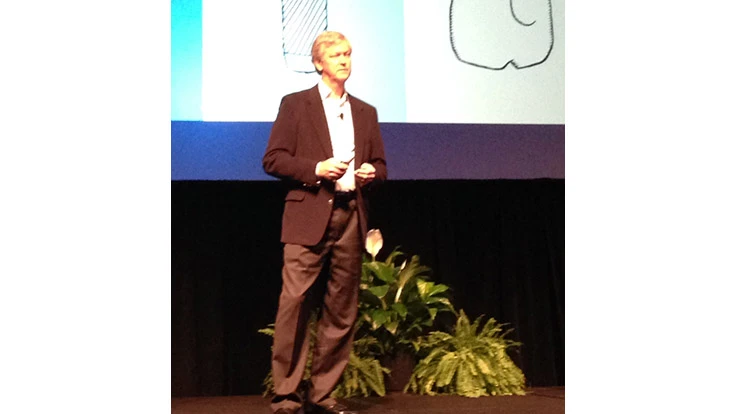
Pictured: Tison Keel of IHS.
A panel of speakers addressed resin markets and their potential effects on recycled plastics markets during a plenary session at the Plastics Recycling Conference, organized by Resource Recycling Feb. 1-3 in New Orleans.
Phillip Karig, managing director of Mathelin Bay Associates LLC, a St. Louis-based consulting firm that offers supply chain and technical consulting services to the plastics processing industry, began his presentation by detailing why clients seek out his company’s services. He said Mathelin Bay can help clients improve the value of commodity and specialty resins, compounds, colors and performance additives and the plastic products produced from them; improve their competitive position in the market by leveraging the company’s relationship with resin and recycled plastics suppliers, polymer pricing market makers and plastics processors; and increase their use of recycled resins.
He went on to detail the differences in the markets for polypropylene (PP) and polyethylene (PE) resins, noting that the shale Revolution left PP producers feedstock constrained, leading to high resin prices.
“The PP price went up in January though the oil price cratered,” Karig added.
This situation has created a multiyear seller’s market for PP, he said.
PE producers that are fully integrated to natural gas “are big winners in Shale Revolution,” Karig said, adding that a wave of North American PE capacity will be hitting the market this year.
PE buyers will gain leverage throughout 2016 and 2017 as a result, he predicted, adding, “It will be difficult for the PE market to maintain tightness through export plans.”
Regarding recycled plastics, Karig said, “A lot of scrap inventory plus sharp virgin prices drops can break a recycler.”
He noted that decreased price spreads between virgin and repro material place pressure on margins, especially as demands for “fixed price” material increase.
Karig said excessive competition was increasing scrap costs and “pinching” supply.
Recyclers also are facing potential liability from customers who expect recycled plastics to “not only run like virgin but to be virgin,” he said.
He advised attendees to hedge carefully by recognizing that resin prices are less correlated with energy costs than they used to be and, therefore, should not be used for hedging. He also reminded them that suppliers tend to offer fixed price deals when they expect the market to drop and that CME Group’s PP/PE futures could be a good alternative to physical inventory for reliable customers.
Karig suggested that recyclers sell their value by creating food-contact-grade PCR in specific colors rather than black repro. He also suggested helping customers understand that not all food or medical applications require the use of a certified resin.
“The closer and sooner you work with the scrap generator, the more potential value,” he said. “Start talking with them when they are designing the product; don’t wait until they are selling scrap.”
Tison Keel, director, PET, PTA and EO derivatives, IHS Chemical, said PET (polyethylene terephthalate) is in oversupply in North America, Asia and Europe. He added that he expected PET pricing to be constrained for several years in North America as a result of many factors, including competition that has contributed to shrinking margins for PET producers, which has prompted backward integration.
Keel said he anticipated the introduction of antidumping duties for PET as a result of the oversupply situation.
Rationalization is the “only solution” to the overcapacity situation, he said, adding that 2017 will be an important transition year.
He added that the low cost of virgin PET would test brand owners’ commitments to using recycled PET (rPET).
Joel Morales, a director for IHS Chemical’s North America polyolefins business, said the PE (polyethylene) market was shifting from a seller’s to a buyer’s market. He predicted that North American producers would have a cost advantage beginning this year.
More than 15 million tons of additional capacity have been announced for PE, Morales said, which is nearly double the 20 million tons of capacity available in 2015. This will result in an “global overbuild,” he said, placing pressure on suppliers in the U.S. and abroad.
Morales said that PP has been a “lousy business” historically, though it is now “making a ton of money.” He predicted PP pricing would be driven by tight markets, high operating rates and increased outages in 2016.
While North American producers of PP do not rely on export markets, Morales said PE producers in the region can’t ignore them. “PE has to respect arbitrage, PP does not,” he added.
Latest from Recycling Today
- Equipment from the former Alton Steel to be auctioned
- Novelis resumes operations in Greensboro, Georgia
- Interchange 360 to operate alternative collection program under Washington’s RRA
- Waste Pro files brief supporting pause of FMCSA CDL eligibility rule
- Kuraray America receives APR design recognition for EVOH barrier resin
- Tire Industry Project publishes end-of-life tire management guide
- Des Moines project utilizes recycled wind turbine blades
- Charter Next Generation joins US Flexible Film Initiative