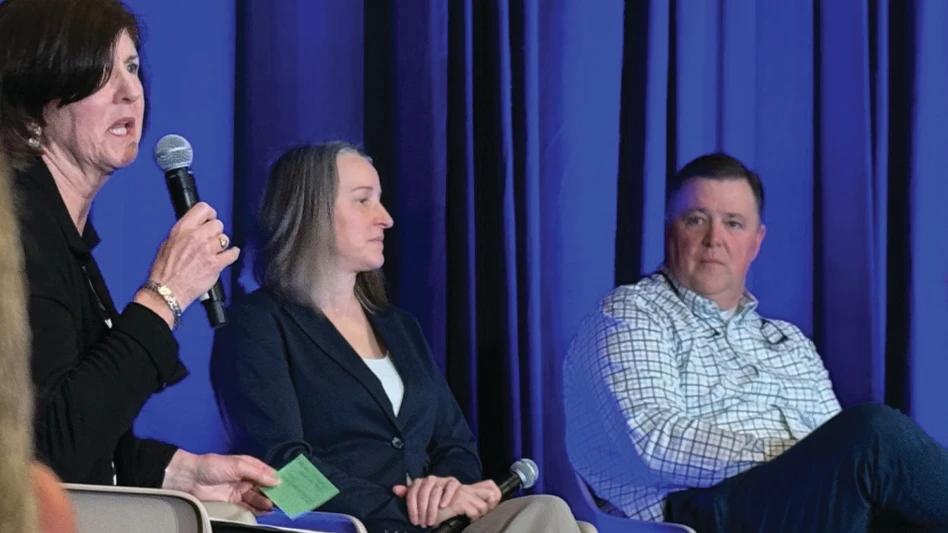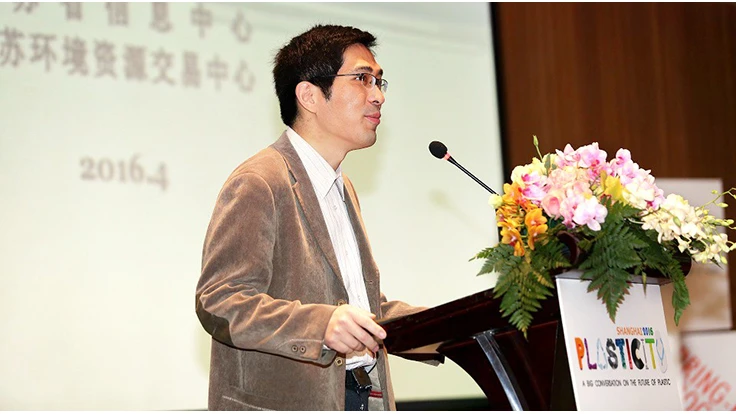
The Plasticity Forum wrapped up its fifth annual conference in Shanghai 27 April 2016, with more than 20 presenters providing insight, data, opinions and case studies of how to reduce the disposal of plastic and instead use the material to help drive the circular economy.
With a conference theme of “Material Solutions for Undervalued Resources,” more than 130 forum attendees heard presentations on emerging technologies, legislative and environmental initiatives and examples of organizations making progress toward reducing waste, reusing resources, creating business opportunities and improving their brand value, according to forum organizer Doug Woodring.
Speaker Larry Black, a senior adviser to United States-based sustainability consultants McDonough Innovation, said a long-term goal should be to “eliminate the concept of waste by identifying every material as a nutrient for a future circle, thus creating a circular economy and the systems to support it.”
Dr. Richard Mattison, CEO of United Kingdom-based Trucost LLC, unveiled the results of a recent study titled “Scaling Sustainable Plastics: Solutions to Drive Plastics Towards a Circular Economy.” In it, Trucost suggests that companies using sustainable plastics simply by expanding initiatives such as Dell Inc.’s closed-loop computer recycling project across their respective industries could deliver $3.5 billion in environmental savings. This new net-benefit analysis offers a mind-set change in how managers make long-term decisions on their sustainability programs, putting value on positive externalities which benefit the company, employees, communities and customers they serve.
Patrick Riley, senior vice president for China and Hong Kong for U.S.-based carpet maker Interface, discussed how his firm is recapturing and recycling discarded fishing net into high-quality carpets, creating a valuable stream of material from a previously fragmented and forgotten waste-stream.
Kim Siu, general manager of marketing for Hong Kong-based A.S. Watsons, outlined how his firm moved from zero to 100% recycled PET material for Watsons Water bottles in Hong Kong in 2015, saving 75 million bottles from the waste stream as a result and creating a large demand for recycled PET material from the region.
Dr. Li Lai, the director of government information in China’s Jiangsu Province, shared the province’s plans to create a platform for exchange within the province so industrial parks and companies will be able to share knowledge and aggregated recovery of scrap materials in order to create what Li called one of the leading circular economy ecosystems within China.
Dr. Mike Biddle, founder of MBA Polymers, referred to MBA Polymers’ launch in Austria, earlier in April, of what MBA claims to be the world’s first commercial-scale production of post-consumer polycarbonate/ABS plastic pellets from shredded electronic scrap.
Akshay Sethi, CEO of San Francisco-based Ambercycle Inc. and winner of the H&M Global Change Award, spoke about his firm’s process using enzymes to digest the raw materials used in making PET plastic directly from textile scrap, thereby enabling cost-advantaged recycled PET production.
Woodring also has announced the date for the next Plasticity Forum, scheduled for 21 September 2016 in London, in coordination with the London Design Festival.
Latest from Recycling Today
- Charter Next Generation joins US Flexible Film Initiative
- Vecoplan to present modular solutions at IFAT 2026
- Terex Ecotec appoints Bradley Equipment as Texas distributor
- Greenwave raises revenue but loses money in Q2 2025
- Recycled steel prices hold steady
- EY says India’s need for scrap imports will continue
- Coming full circle
- Amcor, DCM introduce fertilizer packaging with 35 percent recycled content