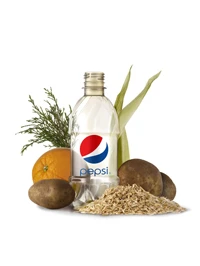
Beverage maker, PepsiCo, with headquarters in Purchase, N.Y. has developed what it is calling the world's first PET plastic bottle made entirely from plant-based, fully renewable resources. The company says this new bottle enables it to manufacture a beverage container with a significantly reduced carbon footprint.
The new bottle is 100 percent recyclable. It is made from bio-based raw materials, including switch grass, pine bark and corn husks. In the future, the company expects to broaden the renewable sources used to create the "green" bottle to include orange peels, potato peels, oat hulls and other agricultural byproducts from its foods business. PepsiCo says this process further reinforces its "Power of One" advantage by driving a strategic beverage innovation via a food-based solution.
"This breakthrough innovation is a transformational development for PepsiCo and the beverage industry, and a direct result of our commitment to research and development," says PepsiCo Chairman and CEO, Indra Nooyi. "PepsiCo is in a unique position, as one of the world's largest food and beverage businesses, to ultimately source agricultural byproducts from our foods business to manufacture a more environmentally-preferable bottle for our beverages business – a sustainable business model that we believe brings to life the essence of Performance with Purpose."
Combining biological and chemical processes, PepsiCo has identified methods to create a molecular structure that is identical to petroleum-based PET (polyethylene terephthalate), which results in a bottle that looks, feels and protects its product identically to existing PET beverage containers.
PepsiCo will pilot production of the new bottle in 2012. Upon successful completion of the pilot, the company intends to move directly to full-scale commercialization.
"As You Sow applauds PepsiCo's innovative packaging design," says Conrad Mackerron, Senior Program Director of As You Sow, a San Francisco-based foundation, which promotes corporate social responsibility through shareholder engagement. "By reducing reliance on petroleum-based materials and using its own agricultural scraps as feedstock for new bottles, this advancement should deliver a double win for the environment and PepsiCo."
With this development, PepsiCo says it continues its leadership position in environmental sustainability and driving progress against the global goals and commitments it announced in 2010 to protect the earth's natural resources through innovation and more efficient use of land, energy, water and packaging. Other steps PepsiCos says it has made in its commitment to the environment include:
· SunChips developing the world’s first fully compostable bag and using solar power at the Modesto manufacturing facility to take some of the plant off the electrical grid;
· light-weighting Aquafina’s bottles with the introduction of the Eco-Fina bottle in 2009, the lightest bottle of its size among U.S. bottled water brands;
· Naked Juice transitioning to a 100 percent post-consumer recycled plastic bottle with the introduction of its reNEWabottle™ - the first beverage, distributed nationally in the U.S., to do so;
· achieving "positive water balance" in India in 2009 – through direct seeding initiatives, the company replenished nearly six billion liters of water across India, exceeding the total intake of approximately five billion liters of water by its manufacturing facilities;
· introducing the Dream Machine recycling initiative, to provide greater access to on-the-go recycling receptacles and help increase the U.S. beverage container recycling rate from 34 percent to 50 percent, by 2018;
· launching a groundbreaking pilot program, using low-carbon fertilizers that drastically reduce Tropicana’s lifecycle carbon footprint; and
· Walkers becoming the first company in the world to display a carbon reduction logo on a consumer product, representing a commitment to become more sustainable and transparent.
More information is available at www.pepsico.com.
Latest from Recycling Today
- U.S. Aluminum Co. explores aluminum fabrication plant in Oklahoma
- Sonoco completes portfolio transformation
- Eriez Shred1 data demonstrates scalable copper control
- RCI selects CurbWaste as exclusive operational management platform
- Updated: Supreme Court strikes down IEEPA tariffs
- Recycling Today Media Group launches Scrap Expo Lunch & Learn Webinar Series
- LyondellBasell scales back recycling target
- Former Liberty UK mills eyed by 3 suitors