Photo courtesy of Pellenc ST
Pellenc ST says it has provided optical sorting devices that are helping Eslava Plásticos create clean streams of low-density (LDPE) plastid scrap at its plant in Quart de Poblet, Spain.
Eslava Plásticos is a family business founded in 1974 and was a pioneer in polystyrene (PS) recycling that now has a net capacity of 45,000 metric tons of recycled-content plastic granulate per year.
In addition to PS and LDPE, the Spanish company prepares recycled-content high-density polyethylene (HDPE) and polypropylene (PP) plastic, making it among the top companies with the highest multimaterial recycling capacity in Europe, according to France-based Pellenc ST.
At its Quart de Poblet facility in the Valencia region of Spain, Eslava Plásticos processes and recycles HDPE and other materials harvested from streams collected from various industries, including the packaging, automotive and agriculture sectors.
Pellenc ST says it has been cooperating with Eslava Plásticos for nearly 25 years, providing optical sorting machines to the Spanish recycling firm.
Optical sorters that use near-infrared (NIR) are used in numerous applications, although in some material streams there are contaminants that emit the same infrared signal on NIR device spectrometers, according to Pellenc ST.
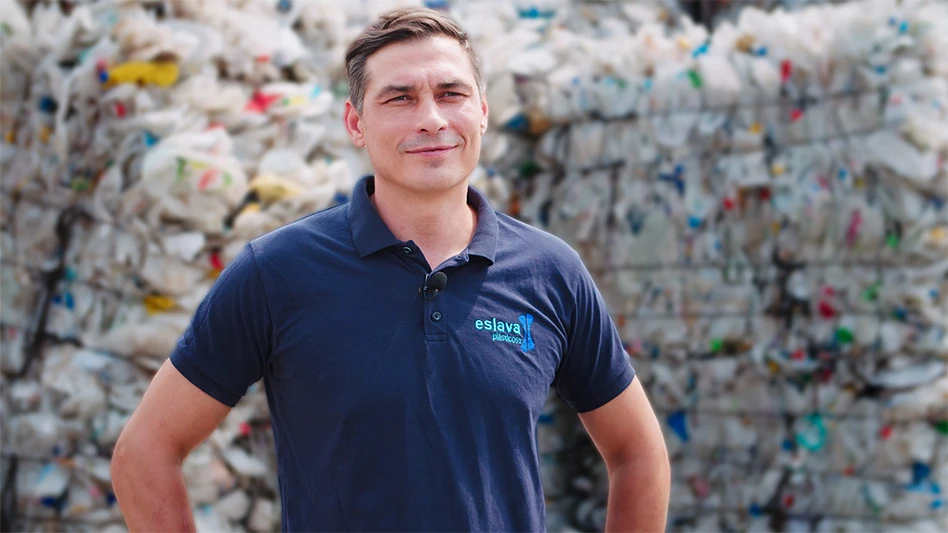
“We needed additional technologies to go further in our HDPE stream cleaning and improve the quality of our pellets and guarantee our end customer the highest level possible of purity,” says Javier Ballesteros Magadán, plant director for Eslava Plásticos in Quart de Poblet.
For such cases, Pellenc ST has developed artificial intelligence (AI) or machine learning modules that can be added as options to existing machines. Using these modules, optical sorters gain in analysis speed while also engaging in complex sorting tasks, according to Pellenc ST.
The neural network programmed via machine learning is trained using millions of images so that it can identify the unique characteristics of objects, such as their shape, size or other visual differences.
Eslava is the first recycling firm to deploy Pellenc's new AI-based sorting modules and has been able to test and validate them directly on its HDPE stream.
The module, called CNS Brain, performs without any additional energy consumption and can separate silicon cartridges and nasal spray from a polyethylene (PE) stream, according to Pellenc ST.
The module branded AISort is a computer vision system that can separate food packaging from nonfood items. As one example, the technology provider says it can remove contaminants such as flip-flops or diving fins from a food-grade HDPE stream.
“Thanks to the artificial intelligence modules implemented by Pellenc ST, the quality of our final products has improved significantly without additional personnel costs while increasing production throughputs,” Ballesteros Magadán says.
Latest from Recycling Today
- SSAB finishes 2025 with decreased revenue
- Vecoplan appoints CFO
- Aurubis raises full-year forecast
- Levitated Metals adds LIBS sorting technology
- Redwood Materials closes on $425M in Series E financing
- Updated: Wieland Chase expands northwest Ohio facility
- Recovered paper traders report lukewarm market
- SHFE trading expansion focuses on nickel