A growing middle class population throughout much of Asia is leading to increased global paper usage, providing paper recyclers on other continents with a strong, steady seller’s market
Paper and board production has stabilized or declined since 1997 in Europe and North America, but in those same years it has soared in China, India and Southeast Asia, said Bill Moore of United States-based consulting firm Moore & Associates, speaking at the 2017 Paper Recycling Conference India, which took place in February in Mumbai.
That has led to a ceiling on how much scrap paper can be collected in Europe and the U.S. at the same time that new and expanded paper mills in Asia are seeking recovered paper as furnish.
Recovered fibre is the furnish of choice at as much as 60% of the world’s paper mills, but a limit on the supply of scrap paper means “you to start to hit some walls in terms of growing that number,” said Moore.
Globally, some 250 million tonnes of recovered paper were consumed in 2015, up from around 130 million tons in 1997. On the supply side, exports of scrap paper from North America appear to have stabilized at around 20 million tons while Europe is shipping out closer to 7.5 million tonnes, said Moore.
The global supply limit has been a factor in the rising value of old corrugated containers (OCC) and other scrap paper grades in late 2016 and early 2017, said Moore. “OCC prices are going to be strong” throughout 2017, he predicted. “There will be a lot of incentive to source locally” in India and other Asian countries, Moore added.
Abilfazal Jani of United Arab Emirates (UAE)-based Paper Link International said the Gulf Cooperation Council (GCC) region is poised to offer more supply. The GCC, consisting of Saudi Arabia, the UAE and four neighbouring nations, currently collects about 1.8 million tonnes of recovered fibre.
Jani characterized what is collected as high-quality OCC with a low moisture content. “Outthrows are not a major concern. It’s mainly industrial collection,” he commented.
Nishant Sahney of Switzerland-based VIPA Group said 93% of the recovered fibre exported from Europe goes to Asia. He said the European Union provides India with 18% of its imported scrap paper.
Sahney described India as “a price-sensitive market. Buyers will look for alternatives when prices rise.”
Markus Ocklind of the Sweden-based Ekman Group, which has recycling and trading operations in both North America and Europe, portrayed the differences in paper grades from 2007 to 2017, noting that the old newspapers (ONP) grade has become increasingly scarce, and sorted office paper (SOP) is beginning to follow in its footsteps.
Ocklind said Ekman used to ship 10,000 tonnes per month of SOP to India, “but the grade has changed.” He said bales may now have “up to 100% shredded paper, and there is more colour” in the average bale.
Such changes in supply, along with seemingly unceasing demand for scrap paper from China, sometimes makes recovered paper “unaffordable for the Indian market,” said Ocklind.
The panelists combined to portray a 2017 market that is likely to give sellers leverage in the market and just as likely to create challenges for buyers.
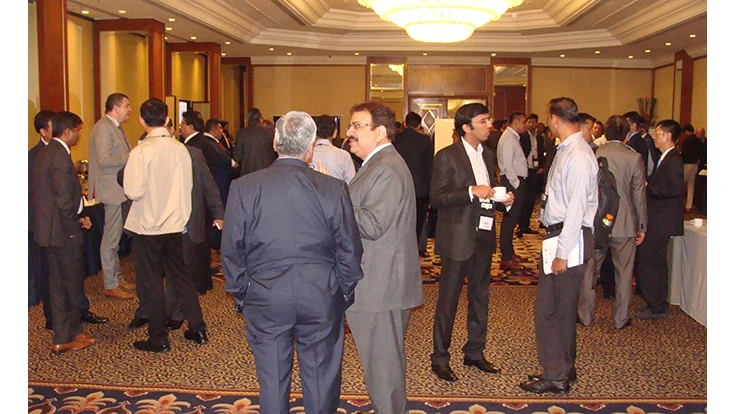
The 2017 Paper Recycling Conference India was 6 and 7 February at The Leela Hotel in Mumbai.
Latest from Recycling Today
- U.S. Aluminum Co. explores aluminum fabrication plant in Oklahoma
- Sonoco completes portfolio transformation
- Eriez Shred1 data demonstrates scalable copper control
- RCI selects CurbWaste as exclusive operational management platform
- Updated: Supreme Court strikes down IEEPA tariffs
- Recycling Today Media Group launches Scrap Expo Lunch & Learn Webinar Series
- LyondellBasell scales back recycling target
- Former Liberty UK mills eyed by 3 suitors