Through most of this century, the recycling landscape has been dominated by small, family-owned companies. But in recent years, the trend has been toward consolidation. One company that has been at the head of this trend is Smurfit Recycling Co., St. Louis.
The company had its beginnings in 1974 when Ireland-based Jefferson Smurfit bought a U.S. company and formed Jefferson Smurfit Corp., the recycling company’s parent. JSC grew quickly through acquisitions, and the recycling division was born when the company bought Container Corp. of America and Publishers Paper, both of which had recycling facilities. Even more acquisitions and expansions resulted in the company growing to its present size.
Today, the recycling company has a total of 30 recycling facilities and 13 sales offices nationwide, and employs about 800 people. Annual sales in 1995 were about $500 million.
Initially operating only recovered fiber plants, the company has branched out into other post-consumer commodities, including aluminum cans, plastics, and glass. As a result, SRC’s newest facilities are built on a material recovery facility model rather than a traditional paper plant model, according to David Stevens, vice president and general manager of Smurfit Recycling.
“All of our new facilities are material recovery facilities, not just paper plants,” he says. “We upgraded three plants on the West Coast last year, and we put new plants into San Diego and San Jose. These facilities are all much larger than the old ones and they’re all material recovery facilities. I would say 50 percent of our plants are now MRFs, and all of our new plants are going that direction. In addition, some of our existing plants are being converted over to that from basically recovered fiber collection plants. We’re putting sorting conveyors into almost all our facilities, so pretty soon about 80 percent of our plants will be MRFs.”
There are more than 70 grades of recovered fiber in the market, and Smurfit Recycling handles most of them. But SRC’s five principal grade categories are old newspapers, old corrugated containers, mixed papers, high-grade deinking papers and pulp substitutes. And in addition to the cans, plastics and glass processed in a number of company facilities, SRC’s Columbus plant also handles scrap metals.
Smurfit Recycling processes more than 4.6 million tons of recyclables annually, says Stevens. The bulk of this is recovered fiber, but it also includes commingled recyclables. “They’re a minor part of the volume from a tonnage sense, and we don’t break that out,” he explains.
The recycling plants do a variety of processing, including sorting commingled recyclables and the various paper grades to specifications. Equipment mainly includes conveyors, sorting systems and balers, says Stevens. “All of our plants have at least one baler, and some of them have two,” he says. “We also have equipment for sorting aluminum cans and densifiers to compact them. And all the facilities have magnets on the baling systems to separate out any steel.”
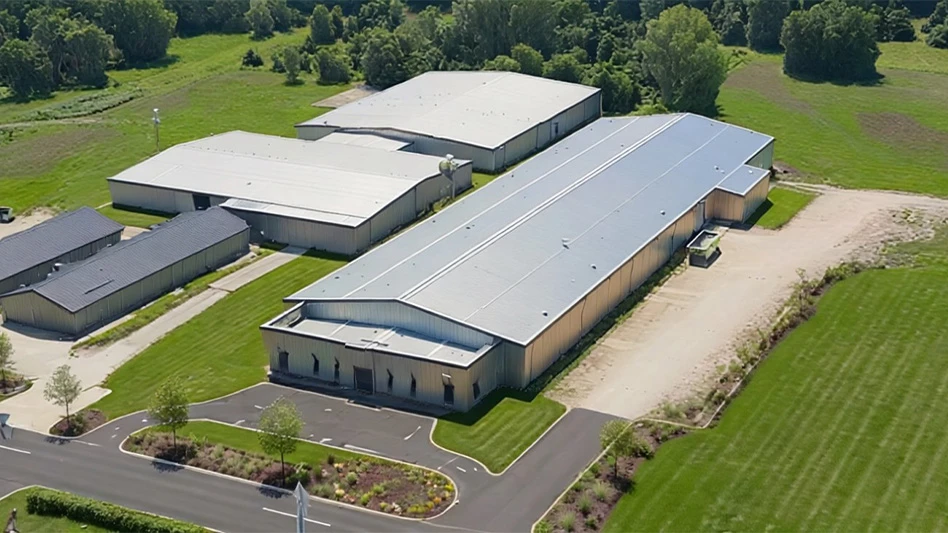
An exciting development is the new St. Louis facility, which is being built to replace a smaller existing plant, says Stevens. The facility is scheduled to be completed by the end of the year. “It’s on 12 acres of land, and will be approximately 110,000 square feet under roof,” he says. “It will be the largest plant we have by the time we get through with it. It’s going to have sorting lines for all the products that we handle.”
The new plant will include high-tech baling systems and computer controls from Lindemann, Charlotte, N.C. According to the equipment supplier, the controls package alone consists of 70 different components including conveyors and compactors. The system is capable of producing computer printouts on 10 different grades of material.
Currently, Smurfit offers its customers computerized order tracking and a hotline number to call for information. At the end of the year, the company will start offering a system through which customers will be able to dial in to the company’s computers and track their own orders. “Our customers will have total access soon,” says Stevens, “It’s going to be installed within six months and then it will take about a year to get all of our plants up and running on it.”
In addition, SRC recently created an internet Website which offers information on the recycling company, its parent company, its most recent stock quotes, and the paper recycling industry in general. The address is http://j-src.com .
|
Irish Parent |
|
Jefferson Smurfit Corp., St. Louis, the parent company of Smurfit Recycling Co., was founded in 1974 when Dublin, Ireland-based Jefferson Smurfit Group acquired 40 percent of a small paperboard and packaging products group in the U.S. Jefferson Smurfit has grown primarily through acquisitions, and today is one of the most broadly based paper, paperboard and packaging companies in the U.S., according to company officials. JSC owns and operates more than 150 production facilities in the U.S., Canada, Mexico and Puerto Rico. Net sales for total operations, employing approximately 16,000 people, are in excess of $3.2 billion. The company is made up of the following divisions: Consumer Packaging, Container, Containerboard Mill, Folding Carton and Boxboard Mill, Industrial Packaging, Smurfit Newsprint Corp., and Reclamation. JSC has 18 paper and paperboard mills, 1 million acres of timberlands, 105 converting plants, and 43 recycling facilities and sales offices. |
SERVICING ALL SECTORS
Smurfit Recycling provides collection and marketing services for recycling customers in all sectors – commercial, municipal, private and residential. Sources include national and regional grocery and retail chains, printers, publishers, and a wide variety of consumer and industrial products companies, as well as urban and suburban communities and civic interest groups. Overall, the company has more than 10,000 customers and community sources, says Stevens.
“We manage curbside collection programs in selected areas, including one in St. Louis,” he says. “We also have arrangements with some cities that bring materials to us. In general, we prefer to work with other haulers for the actual collection of curbside materials, but if it’s necessary we will use our own trucks.”
Although a certain amount of recovered paper from Smurfit Recycling is used in the parent company’s mills, that amount has now decreased to less than half the recycling company’s overall tonnage, says Stevens. “Our division is growing faster on outside sales because we haven’t sited any new mills or paper machines recently that require recovered fiber,” he explains. “That doesn’t mean we won’t in the future.”
And while SRC benefits from the support of its large parent company, this does not necessarily provide more security than if it were an independent paper stock company, says Stevens. “Obviously, we have the security of the basis of tonnage for our own company,” he says. “But we sell them at market prices, so we don’t get any preferential price or price supporting.”
Still, SRC does enjoy access to Jefferson Smurfit resources, such as the Smurfit Research Center. The center is involved in research in the paper and paper processing areas, and works to develop innovative products. “Some creative packages have come out of there, but it hasn’t been a great deal of help to us on the recycling side yet,” Stevens admits. “But that doesn’t mean it won’t be. We may be able to develop an innovative sorting system or fiber collection process.”
Export is also a growth area for SRC. According to company officials, Smurfit is the largest recovered fiber exporter from the U.S., selling materials into 30 different countries in North America, Central America, South America and Europe.
TOTAL SERVICE
In an effort to compete with major waste haulers who can provide both waste hauling and recycling service, SRC has developed a solid waste consulting business, says Stevens. For some customers, the company handles collection for garbage as well as for recyclables, although SRC subcontracts with waste haulers for the actual garbage pickup in those situations.
“One goal behind this segment is not only to gain more fiber, but also to provide a total service to our customers,” he explains. “People often want one company to handle everything. We analyze their business and find ways to handle their materials while saving them money or even making money for them. This is a growing business with us.”
The company conducts waste stream analyses, and then customizes comprehensive solid waste management programs designed to meet customer needs, lower disposal costs, increase efficiency and divert more recyclables from landfills.
A related service that SRC also supplies involves designing and implementing office paper recycling programs. As part of that service, the company supplies offices with bins, balers and any other equipment needed, says Stevens. Although the market for mixed office paper has been poor of late, Smurfit is confident that it will grow in the long term.
“The deinked pulp mills coming onstream require more office paper,” he says. “There have been some glitches in the business with the pulp industry operating in a market downturn. When virgin pulp can compete with recovered fiber and the prices drop this fast it’s difficult for the new guys to be cost competitive. But in the long term, we think that it will come back.”
Discounting reports that mills are having difficulty using the mixed office grade successfully, Stevens says that cleaning systems for fiber will result in a “very acceptable” pulp.
But SRC has felt the pinch of depressed paper markets as much as anybody in the industry. “We’re like everybody else – when demand drops, prices drop, and then our margins are compressed,” he says. “Recovered paper is a basic commodity, so you don’t maintain price levels when demand drops off. That can be positive, because it is a fairly steady business. In 1994 and part of 1995 the market prices spiked up because of increased demand. That was helpful to suppliers and collectors, but it was a market distortion. If there’s a shortage, mill buyers don’t want to run out, so they start buying more, which creates more of a shortage.”
ENVIRONMENTAL
Recovered paper plants that handle source separated recyclables face some of the same basic environmental regulations as other recycling plants – stormwater permitting, spill control and prevention, and handling of special wastes such as oily rags, according to Ed Hurley, Smurfit Recycling’s manager of legislative affairs. Another issue that is currently emerging is the inadvertent introduction of medical waste in incoming materials.
But even before these, says Hurley, there is the often the basic battle to assure that the paper processing plants are classified not as waste handling facilities, but as recyclers of non-hazardous materials. As such, they should not require the same type of permit as solid waste facilities.
“We successfully faced this issue in California, but it was a two-year fight,” he says. “They ended up with a tiered permitting scheme, and recovered paper plants that handle only source separated material are considered outside the regulatory framework.”
The company also faced a similar issue in Florida, which had a positive outcome as well, he adds.
Finding medical waste mixed in with recovered fiber is not a huge problem, says Hurley, but it is one for which paper plants must be prepared. “You’ve got to be a little sensitive to it and plan for what you’re going to do,” he says. “The typical scenario is getting it from medical centers and hospitals where they have one dumpster for medical waste and another for OCC, and sometimes they get switched.”
If possible, SRC crews note the contamination before materials have been unloaded, which makes it easy to turn the truck around and send it back, says Hurley. But if the material makes it onto the tipping floor, it must be handled carefully.
“If there is medical waste in there, you have to get a medical waste transporter,” he says. “There is no minimum threshold – you have to follow a similar procedure as you do when faced with hazardous waste.”
Stormwater regulations require the most changes in how new plants are built and old ones are refitted, says Hurley. “It’s costly, but that’s how you have to do it,” he says.
NEW SPECS
Stevens notes the trend in the industry for the new deinked pulp mills as well as high-grade mills to demand a specific pack from paper processors, and says that getting those contracts will depend on how closely processors can match that pack.
“They’re the customer and we’re going to develop systems to support them,” he says. “It means an investment in sorting equipment, and being specific on where we collect. Someone’s got to pay for those things and they’re well aware of it. The price of the fiber will react accordingly.”
Mills processing the basic industry grades such as OCC probably won’t change their specifications, he says. “It’s only on some of these new processes where a customer will develop their grade and we’re going to have to supply those grades to them if we’re going to be a supplier. And the people that are prepared to do that will reap the benefit.”
This will result in more long-term contracts between processors and consumers, says Stevens. “Mills want to be assured of long-term quality sources,” he says. “They want to be able to rely on a supplier to meet their quality demands.”
Long-term agreements also benefit processors such as Smurfit, especially if the processors invest in new equipment in order to meet quality specifications. “If you have a long-term agreement, you can put the resources in place to take care of a good customer,” he says.
Success in the secondary fiber processing business depends on a number of factors, according to Stevens – appropriate facilities that can meet customers’ and suppliers’ needs, a high degree of integrity, service and quality, and a reasonable price for materials based on commodity prices and freight costs, he says.
“You need to have well-maintained, well-run facilities, and, as much as possible, employee dedication to the customers’ needs,” says Stevens. “It can’t just be the employees that run the plant, it has to be all the way through the organization – management, sales, and plant personnel. Also, we try where we can to form alliances with our customers where our employees meet with mill operating personnel to determine how we can best meet their needs. We need to properly understand our suppliers’ and our customers’ needs and work with them. It is a combined effort between both the suppliers and customers.”
Despite the current paper market downturn, the outlook for recovered paper demand is very positive, according to Stevens.
“This business is going to grow in the future as collection volumes increase,” he says. “There is going to be an increase in worldwide demand for fiber. The United States has high quality recovered fiber and it will be a natural supplier to the emerging markets in Asia, Central and South America, and even in Eastern Europe.”
To meet this demand, Smurfit has plans to expand its involvement by upgrading its existing facilities and making appropriate acquisitions.
Recent figures show that SRC is handling a slightly larger volume of material this year than it was last year, although margins are down due to the poor markets. Stevens points to the company’s lack of plant closures and layoff during the down market as evidence of its efficient operations.
“We do a lot of work on appropriate strategic planning and market analyses,” he says. “And we’re a very lean company from an overhead standpoint – probably the leanest in the industry. I haven’t had to reduce staff because of the recent downturn in the market, for example. Because we keep overhead at a minimum, we can withstand downturns in the business cycle.”
In the future, SRC will probably get involved in more curbside recycling programs, doing more of the actual collection, says Stevens. He predicts a worldwide shortage of some grades of fiber in the future, as China and other emerging markets step up their demand.
“We see OCC being a shortage grade and, long term, possibly ONP as well,” he says. “Right now, obviously there is no shortage, but we predict there could be in the future, and we want to be there to service our customer’s growing needs and our own company’s needs. We are well positioned to do that.”
The author is editor of Recycling Today.
Latest from Recycling Today
- SDI, SGH submit revised final offer to acquire BlueScope Steel Ltd.
- Republic Services spends big on acquisitions, reports growth for 2025
- 2026 Circular Steel Summit: The view from Nucor
- Minespider launches digital marketplace for circular batteries
- SWANA, Fire Rover develop fire incident reporting tool
- Recycle BC launches flexible plastics recycling carts in Vancouver
- Shapiro continues leadership appointments
- Iron Crest forms waste equipment manufacturing platform