Exporters to India are commissioned to “try to work through a lot of the challenges of shipping to India [and] none of them are easy,” Michael Belus of United States-based GP Harmon Recycling told attendees of the 2015 Paper Recycling Conference India event, held in New Delhi in late January,
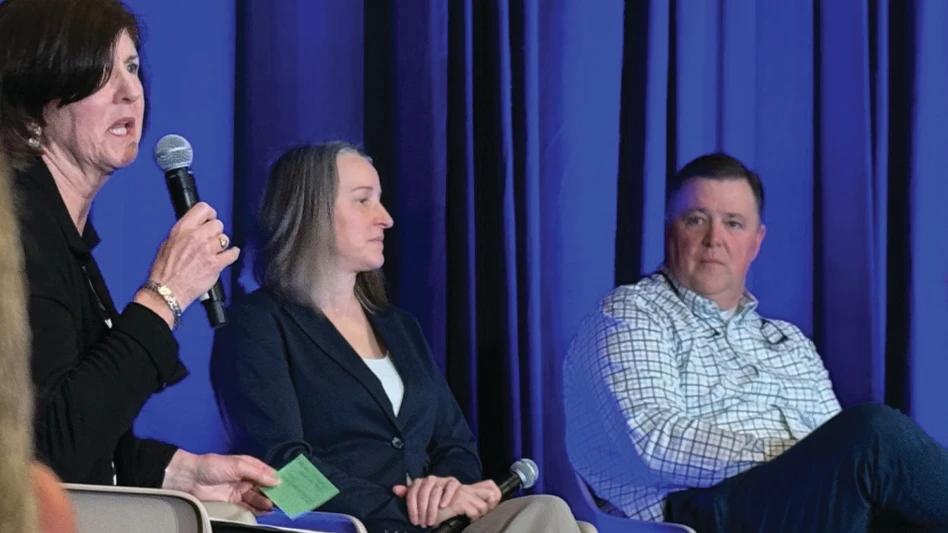
At a session focusing on logistics management in India, Belus and his fellow panelists described several of the considerations that importers and exporters of recovered fiber face when they conduct business in India.
Session moderator Atul Kaul of Saudi Arabia-based WARAQ Arab Paper Manufacturing Co. Ltd. commented that some 40 million tons of recovered fiber were traded across a national boundary in 2014, and that logistics and shipping are critical factors in all such transactions.
Belus, who as senior director of international business at GP Harmon helps oversee the company’s business in India, said GP Harmon’s challenge begins with the fact that the company trades with “224 active [mill] customers in India, which gives you a sense of how fragmented the market is.”
Locations near ports and rail sidings “area a strategic advantage” for mills, said Belus, as this helps them avoid India’s “high inland transportation costs.”
In addition to being costly, inland transportation in India can add considerable time to an already long journey for a shipment of scrap paper there. Belus said some container vessels may take from 30 to 60 days to go from the U.S. to the receiver’s designated port in India, depending on the number of stops on the way. Then, after arriving in India, it may take another 8 to 17 days for a container to travel from the port to its inland mill destination.
Recovered fiber bound for India leaves the U.S. predominantly from the Atlantic Coast, said Belus, saying the most active ports are: New York City/Northern New Jersey; Savannah, Georgia; Norfolk, Virginia; Baltimore; and Charleston, South Carolina.
Panelist Ranjit Baxi of J&H Sales International, London, said because of scrap paper’s relatively low value, freight and delivery charges represent some 40 percent of the cost of a transaction. This compares to an industry average of 12 percent.
The better news for recovered fiber traders, said Baxi, is that “freight is no longer a black box. It maybe was 30 years ago, but now it’s transparent.”
Also providing good news is that despite recovered fiber’s low value, “Shipping lines like scrap paper as a backhaul,” stated Baxi. “It helps them reposition their boxes” as a “guaranteed cargo” for containers returning to Asia after having brought finished goods from Asia to Europe or North America.
That hasn’t made holding down shipping costs easier, Baxi added, with the multiple considerations in play including the rates of the shipping alliances, currency fluctuations and global economic factors such as volatile oil prices.
Among India’s challenges will be upgrading its ports to handle ever-larger container ships, noted Baxi. The nation will also need to upgrade its road and rail networks to handle a growing amount of global trade as it strives to become the world’s third largest economy by 2020, he added.
Paper Recycling Conference India was held Jan. 29-30 at the Taj Palace Hotel in New Delhi.
Latest from Recycling Today
- Greenwave raises revenue but loses money in Q2 2025
- Recycled steel prices hold steady
- EY says India’s need for scrap imports will continue
- Coming full circle
- Amcor, DCM introduce fertilizer packaging with 35 percent recycled content
- Comstock Metals gets closer to commissioning commercial-scale solar panel recycling facility
- Washington selects Circular Action Alliance as PRO
- Smurfit Westrock expands in Latin America