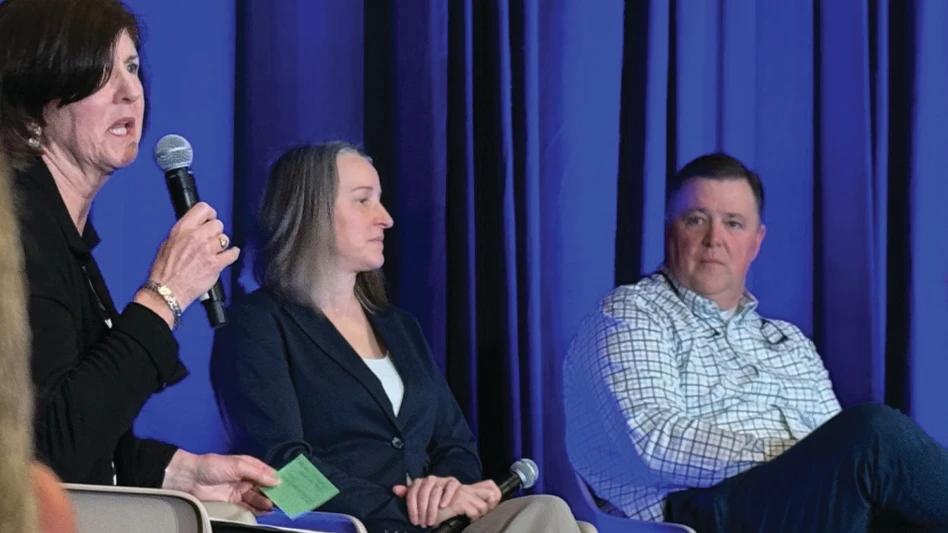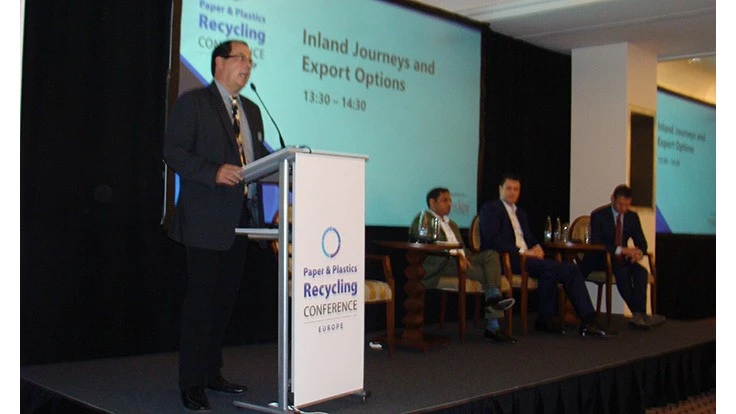
(Photo, left to right: Dan Sandoval of the Recycling Today Media Group; Ved Prakash of Gemini Corp.; Sebastian Reiner of Rhenus Port Logistics; and Dennis Korn of Peute Recycling.)
Consolidation is supposed to bring with it efficiency, but fewer shipping companies operating larger container ships that can only berth at a handful of ports may be having the opposite effect. Those were among the concerns expressed at a session focused on freight at the 2018 Paper & Plastics Recycling Conference Europe, held in Prague, Czech Republic in early November.
Global overcapacity has created major financial losses for shipping lines in the past 10 years, with these firms responding in part by creating alliances or merging with each other.
Ved Prakash of Belgium-based scrap trading firm Gemini Corp. estimates shipping lines are still at “about 7 percent overcapacity” globally, with alliances and mergers further reducing that figure. “This is going to be your problem,” he told his audience of recyclers. “The consolidation of shipping lines is putting them in the driver’s seat.”
Container ship operators also face low-sulfur fuel mandates that will lead to surcharges for customers, said Prakash, further adding to the predicted future cost of sea freight.
The move toward large container “mega-ships” has increased port traffic in Antwerp, Rotterdam and Genoa, making Europe’s busiest ports even busier, said Prakash. This has led to congested port facilities and “overworked” truck, rail and barge systems in those three regions. “It’s a mess at the moment,” stated Prakash.
Plastics recyclers continue to face backlash from the rerouted and orphaned containers created by China’s sudden restrictions on baled plastic scrap in 2017, he added. Only two shipping lines remain that will accept some of the plastic scrap grades traded by Gemini, according to Prakash.
The global shipping woes for plastic scrap and mixed paper are likely to keep causing changes, said Sebastian Reiner of Germany-based Rhenus Port Logistics. “It is a chance for Europe to rethink its way of recycling, and keep resources in Europe,” he commented.
Within Europe, freight woes include “a shortage of thousands of truck drivers,” said Reiner, and the need for both freight providers and customers to invest in upgraded IT systems.
Dennis Korn of Netherlands-based Peute Recycling said freight costs absorb some €40 million of the €210 million in annual sales of the recycling firm. “We see the costs rising every year,” he stated.
An additional headache in 2019 anticipated by Korn will be a reduction to just 18 port terminals in Europe capable of conducting pre-shipment inspections mandated by governments in China and some other Asian nations. The situation could well lead to increased demurrage charges for European scrap exporters.
The 2018 Paper & Plastics Recycling Conference Europe event was Nov. 6-7 at the Corinthia Prague Hotel in Prague, Czech Republic. The 2019 conference will be in Barcelona Nov. 5-6, 2019.
Latest from Recycling Today
- Greenwave raises revenue but loses money in Q2 2025
- Recycled steel prices hold steady
- EY says India’s need for scrap imports will continue
- Coming full circle
- Amcor, DCM introduce fertilizer packaging with 35 percent recycled content
- Comstock Metals gets closer to commissioning commercial-scale solar panel recycling facility
- Washington selects Circular Action Alliance as PRO
- Smurfit Westrock expands in Latin America