Concerns about the availability of recovered fiber as well as the quality of the material available were among the challenges Steve Silver, president and CEO of FutureMark Paper, based in Alsip, Ill., and Jim Porter, president of corrugated packaging and recycling at RockTenn, Norcross, Ga., saw for the paper industry.
Silver and Porter participated in the session, “The Mill Viewpoint,” which was moderated by Kevin Duncombe, president of Western Pacific Pulp & Paper, Downey, Calif., and Jim Keefe, group publisher of the Recycling Today Media Group, Richfield, Ohio, at the Paper Recycng Conference & Trade Show. The event was Oct. 23-25 at the Marriott Downtown Chicago Magnificent Mile.
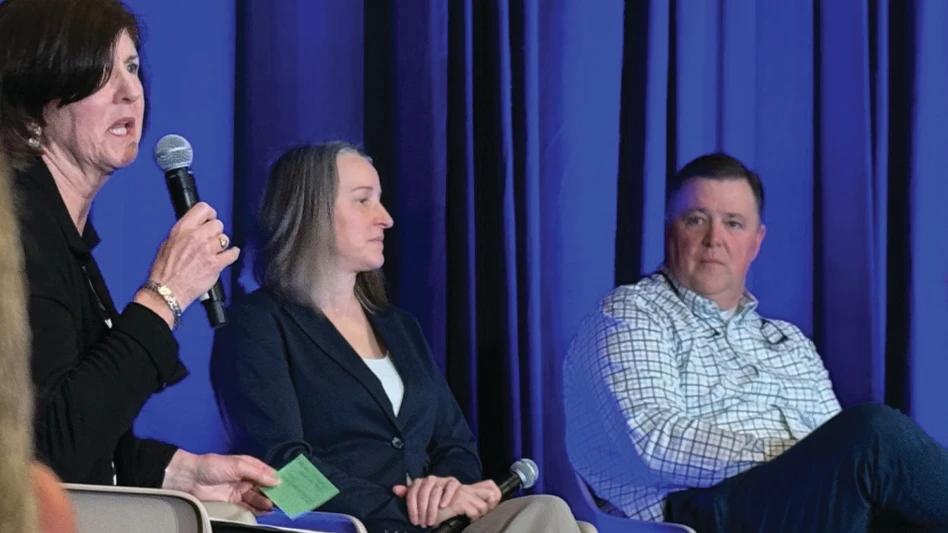
 Steve Silver of FutureMark PaperPorter said concerns about recovered fiber availability led RockTenn to invest in virgin fiber with its acquisition of Smurfit-Stone. The acquisition helped provide balance to RockTenn’s raw material supplies, which had been heavily weighted toward recovered fiber. In 2010 recovered fiber accounted for 82 percent of RockTenn’s raw material. Following the acquisition, virgin fiber accounts for 55 percent of RockTenn’s raw material, while recovered fiber accounts for 45 percent, according to the company.
Porter described supply concerns regarding recovered fiber as an “infeasible problem to solve.”
Silver said it was unfair to say the United States suffers from low recovery rates for fiber, noting that tissue production needed to be taken out of the equation, as it cannot be recovered for recycling. In 2009, the most recent year the American Forest & Paper Association (AF&PA), Washington, D.C., has reported recovery figures for, 63.4 percent of the paper consumed domestically was recovered for recycling.
Silver said when FutureMark was first established in November of 2009, it was 100 percent reliant on brokers for material. Since then, the mill has been developing its own collection system in an effort to lessen price volatility and have more control over quality, he added.
Silver said most companies were not willing to pay more for recycled content in their paper, meaning FutureMark needs to be able to compete with paper made from virgin sources. This can be a challenge, particularly since the company’s recovered fiber costs increased by 45 percent from Christmas 2010 through June 2011, he added. “I can’t put a surcharge on my product if my competitor doesn’t do it when it consumes virgin material.”
Recovered fiber quality would become a bigger issue in the future, Porter predicted. “As pressure for recovery increases and demand increases, that is going to have a negative effect on quality,” he said. To combat this decline, RockTenn performs quality assurance inspections on incoming raw material and provides feedback to its suppliers. “Mills need a good quality assurance process,” he added. RockTenn also is making capital investments at its mills to address quality issues in its incoming recovered fiber stream.
Porter said each of the company’s 37 recycling facilities produce secondary commodities of varying quality. “The industry is trying to do the best it can to recover fiber at the lowest cost and provide what the mills need,” he said of the recycling industry.
Porter said RockTenn’s reject amount ranges from 8 to 10 percent on average, while Silver said FutureMark’s contamination levels range from 10 to 12 percent.
However, when asked about their biggest concerns going forward, neither Silver nor Porter sited the availability of quality recovered fiber. Instead, Silver cited the U.S. economy and the lack of good jobs available. “Unless the government focuses on helping industry, that is not going to change,” he added.
There is such a thing as too much government involvement, in Porter’s view. He claimed too much government involvement disrupts the business landscape.
When it comes to opportunities for paper mills, Silver cited the growing trend toward sustainability among businesses, while Porter said process improvements and related innovations will help to improve operating efficiencies and lower operating costs.
The 2012 Paper Recycling Conference & Trade Show will return to the Marriott Downtown Chicago Magnificent Mile Oct. 14-16.
(photo is of Jim Porter, RockTenn)
Latest from Recycling Today
- Greenwave raises revenue but loses money in Q2 2025
- Recycled steel prices hold steady
- EY says India’s need for scrap imports will continue
- Coming full circle
- Amcor, DCM introduce fertilizer packaging with 35 percent recycled content
- Comstock Metals gets closer to commissioning commercial-scale solar panel recycling facility
- Washington selects Circular Action Alliance as PRO
- Smurfit Westrock expands in Latin America