Photo by Chris Voloschuk
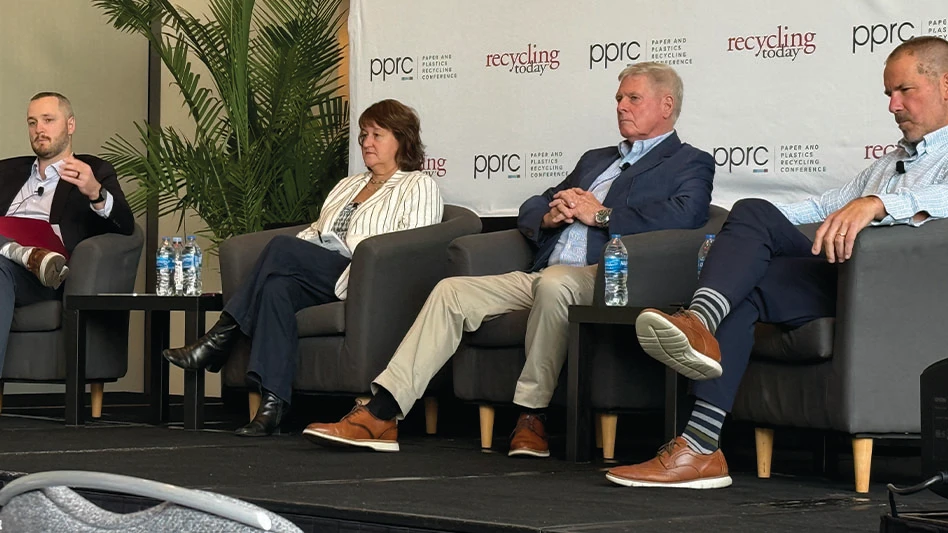
Markets for a variety of recycled resins have struggled this year, and a diverse panel at the annual Paper and Plastics Recycling Conference (PPRC) in Chicago dove into the causes as well as potential solutions Oct. 16 in the Recovered Plastics Markets session, which was moderated by Daniel Emmerich, senior account manager at Kalamazoo, Michigan-based Schupan & Sons Inc.
Greg Janson, president of St. Louis-based Triton Group, which primarily recycles polyethylene (PE) and polypropylene (PP) into composite railroad ties, said available supply isn’t an issue, though a lack of demand certainly is.
RELATED: Deep ties | Indorama calculates reaching 150 billion bottles recycled
“We could probably buy three times more material than we are today,” he said. “But we’re impacted by what we can sell. It’s about demand, demand, demand, and if you don’t have it, there’s no reason to buy it. There’s plenty of supply.”
Doug Miner, vice president of sales and marketing at Chino Hills, California-based Polyfit Inc., which works with a variety of resins such as low-density and linear low-density polyethylene (LDPE, LLDPE), high-density polyethylene (HDPE) and PP, noted that little of the film his company specializes in is actually being collected and there appears to be little drive to do so. He said material recovery facilities (MRFs), in particular, might lack the incentive to invest in film recovery.
“MRFs are struggling,” Miner said. “You’ve got glass, metal and cardboard, which are making money, and with plastics, it’s like you’re losing your shirt sometimes.”
The polyethylene terephthalate (PET) market presented a different perspective in the eyes of Hannah Martinez, head of advocacy for the U.S. and Latin America at Thailand-based Indorama Ventures, one of the largest PET manufacturers and recyclers in the world. She said demand for the material remains high, but supply actually has been an issue. She noted that 90 percent of the bales Indorama sources for its Alabama recycling facility, for example, are imported.
Martinez pointed out the need for more robust recycling infrastructure to recover more material domestically, and the panelists agreed that federal extended producer responsibility (EPR) legislation could be a helpful solution for recycled plastic markets if it helped to create demand for recycled plastics as well.
“We think that consistency in demand would come from a policy solution nationally,” Martinez said. “Prices would be stabilized.”
Janson added, “You can’t force demand for the price. You need consistent pricing, floor pricing, and contracting people can invest in.”
The need for solid commitments
The panel agreed that consumer packaged goods (CPGs) companies and brand owners needed to stick by their recycled-content commitments for packaging.
“Recycled [resin prices] can only go so low, and you’ve got to cover your costs,” Janson said. “The petrochemical industry is just dumping material on the market at prices so low it’s hard to see how they’re making money on it. Then you have off-spec, which is even lower.
“CPGs need to actually stand by their commitments. I’m tired of being politically correct. We’ve been gaslighted by CPGs for years that recyclers are the problem. Commitments are the problem.”
Martinez said policy and regulation would create the level playing field for recycled resins against virgin types. “We can’t depend on the CPGs and the brands to change their minds every couple of years on what the demand’s going to be,” she said, adding that for companies like Indorama, plastic recovery is a business.
“We’ve invested in infrastructure, facilities, and we want to have a circular economy. The only way we can see it working is legislation with PCR [postconsumer resin] requirements, with collection and recovery infrastructure to support it. Policy is the only solution to create that demand.”
Indorama works with a number of beverage brands that Martinez said want to reach their recycled-content goals, though there are obstacles. “There is a legitimate sentiment and legitimate business goals to meet that. They also have demands and shareholders, a bottom line. Because rPET is more expensive than virgin, they’re having to keep delaying and delaying their sustainability goals, and that’s impacting all of us. In the U.S., we don’t have the infrastructure to source that for them.”
Janson pointed out that recyclers also need to present realistic end-use cases for resins. “There’s not a whole lot of package-to-package applications for PP,” he said. “We need minimum [recycled] content not just for package-to-package but for other durable goods.”
Despite potential roadblocks for brands and CPGs, Miner said they should try to stop buying virgin material.
“We have the sourcing and feed streams available,” he said. “They’ve got to do the right thing eventually. Some are doing it, some aren’t. Some major players are not, or they’re delaying it. That doesn’t mean anything for this industry or the ecology of it.”
Legislative help?
Martinez reiterated that a national EPR program could boost domestic markets for recycled plastics, adding that the seven states that have passed EPR legislation have different plans.
Miner said that while initial EPR plans represent a good effort, they lack teeth when it comes to collection and fines for producers who commit program violations.
“Five cents a pound [for a violation] is nothing [for large packaging producers],” Miner said. “A $5,000 fine a month [for a violation] is nothing. Now, they’re talking to the next set of states coming in [with legislation] and they need some teeth to this, so when we do collect [material], it forces people into collection.”
Janson said that while EPR potentially can be effective, it needs to focus on responsible end markets. “HDPE bales are trading 2-3 cents per pound, so what happens when we collect those bales? Where do they go? We tend to put the collection cart before the demand horse. EPR needs to focus on those responsible end markets so they can pull that demand with them.”
The look ahead
When discussing the biggest opportunities ahead for the industry, Martinez pointed to the continued rollout of EPR legislation for packaging and suggested MRFs and processors seek grant funding from organizations like The Recycling Partnership to help build out infrastructure and optimize facilities.
Miner also looked at things from the MRF perspective, noting that plastics are a challenge to process.
“[Plastics are] the low end, bottom of the totem pole [for MRFs],” he said. “They don’t get a lot of profit from them. The challenge is in how to collect it more efficiently. Currently, many of them are not set up to collect flexibles. Why make the investment when I don’t get a return on it? Somehow, that’s got to be addressed. If we do that, my bale price is going to go up, and prices are going to go up.”
Janson suggested the entire supply chain come together, from brands and CPGs to MRF operators, to educate each other and look at product use cases that recycled plastics can go into. “It’s grassroots, and we can vertically integrate it like that. They can see it more holistically than just if they can move their bales or not.”
PPRC was Oct. 15-16 in Chicago.
Latest from Recycling Today
- Fleetio launches AI capability to accelerate fleet maintenance approvals
- The Metals Agency receives approval for export credit insurance
- Recycle Ann Arbor extends drop-off station operating hours
- Sybilion seeks to help manufacturers confidently address volatility
- Rio Tinto, Prysmian partner on low-carbon aluminum solutions for data centers
- Unilever criticized for plastics approach
- USTR to study additional steel, aluminum tariffs
- Electrified Materials adds processing capacity