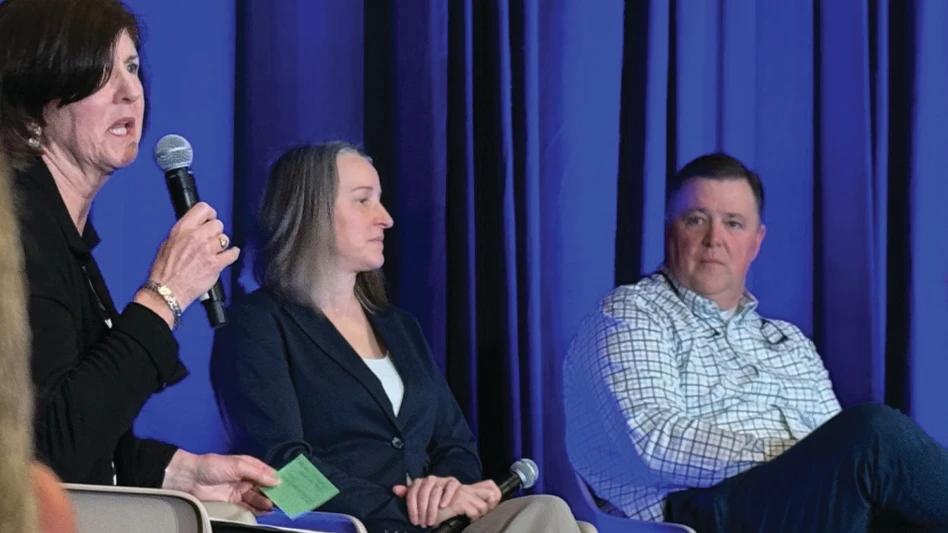
Navigating the legalities associated with hiring employees was the topic of a workshop during the Paper, Plastics and Electronics Recycling Conferences & Trade Show, organized by the Recycling Today Media Group, June 22-24 in
Amy Nice, a lawyer with the firm Dickstein Shapiro LLP, with offices in
Phillips said there were a number of ways to go about properly hiring an employee, but also many ways to do it improperly. She stressed that the interview process should focus on questions specific to the task rather than the applicant. Therefore, she said, the hiring process should always begin with a job description and the tasks involved as well as the personality traits that could prove helpful in that position. Correct interview questions would focus on the candidate’s ability to meet the tasks required of the job, while illegal questions would focus on the characteristics of the applicant that could be considered discriminatory. To minimize the employer’s liability risk, Phillips suggested implementing a structured interview process that minimizes the opportunity for an interviewer’s biases to affect the applicant while also maximizing the amount of lawful job-related information communicated.
Phillips also stressed the importance of behavioral interviewing in addition to task-based questions. She said behavioral interview questions explore characteristics such as leadership and integrity and allows the interviewer to use past job performance to predict future job performance.
Background testing, physicals and drug testing should not be part of the interview process, Phillips said, but the job offer should be contingent upon the satisfactory completion of such tests.
She also suggested that employers make an interview checklist or worksheet that is consistent for all applicants for the same position. Phillips also reminded attendees that their notes are discoverable and admissible in court; therefore, all notes should be related to the job function.
Nice provided an overview of immigration law throughout the decades. She noted that U.S. immigration law always has made it illegal for illegal immigrants to work in this county, however, it was not until 1986 when the Immigration Reform and Control Act was approved that employers were held liable for hiring illegal workers.
The current E-Verify electronic verification system has been in use in some states since 1996. In 2004 the system, which employers can use to check the authenticity of Social Security numbers, was made available to all employers throughout the
Nice detailed the requirements of IMAGE, or the Immigration and Customs Enforcement (ICE) Mutual Agreement between Government and Employers, which requires that employers use IMAGE best hiring practices and E-Verify, as well as a number of other protocols regarding no-match letters generated though E-Verify.
ICE is working with federal prosecutors to prosecute employers who are harboring illegal immigrants. Nice said the federal government was sending a wake-up call to employers and ICE’s actions indicated that it was time to clean house. She suggested recyclers verify they had policies in place to ensure the immigration status of their employees.
Next year’s Paper, Plastics and Electronics Recycling Conferences will be in
Latest from Recycling Today
- Charter Next Generation joins US Flexible Film Initiative
- Vecoplan to present modular solutions at IFAT 2026
- Terex Ecotec appoints Bradley Equipment as Texas distributor
- Greenwave raises revenue but loses money in Q2 2025
- Recycled steel prices hold steady
- EY says India’s need for scrap imports will continue
- Coming full circle
- Amcor, DCM introduce fertilizer packaging with 35 percent recycled content