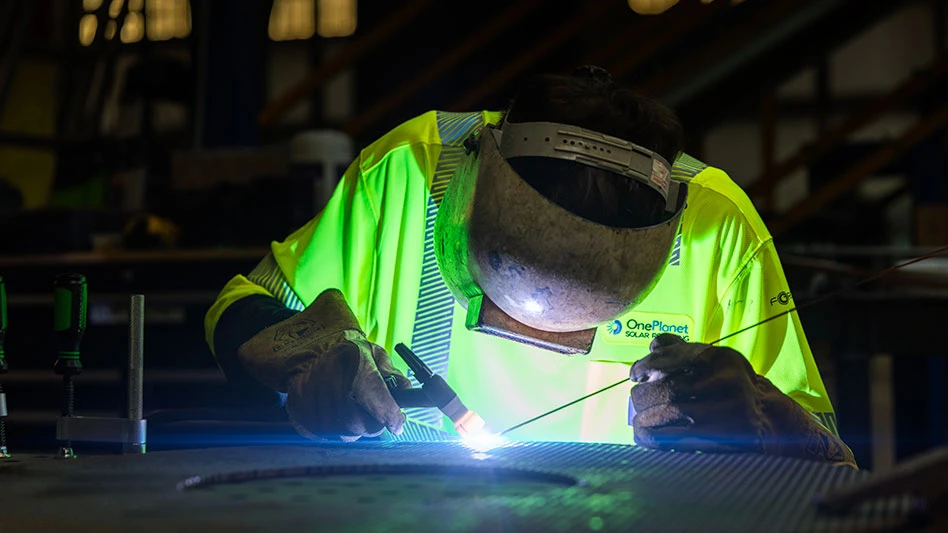
Photo courtesy of OnePlanet Solar Recycling LLC
OnePlanet Solar Recycling LLC’s pilot recycling facility in Green Cove Springs, Florida, has been certified to R2v3 Appendix G, which applies to recyclers that handle photovoltaic, or PV, modules. With this certification and using its internal capabilities, the company, which was founded in 2023, seeks to bring transparency to the solar panel recycling sector as it expands its processing capacity.
"The industry has a responsibility to implement verifiable mechanisms to guarantee that solar panels are being recycled and processed responsibly, yet as we speak with various stakeholders, it is clear that these expectations aren't being met," says André Pujadas, CEO of OnePlanet. "At OnePlanet, we are committed to ensuring that the materials and metals extracted can be definitively traced to compliant, responsible end-users."
To secure the R2v3 Appendix G certification, Jacksonville, Florida-based OnePlanet says it tracks every material that enters and leaves its facility to establish verifiable traceability and certify that the company is properly recycling the PV modules.
The importance of certification
Pujadas says obtaining R2v3 certification was important for multiple reasons.
“Firstly, R2v3 certification demonstrates to our stakeholders, asset owners, utilities and investors that we as a recycler are extremely committed to responsible recycling practices from incoming receipt of PV modules through the final disposition of the commodities when we sell them,” he says.

“Secondly, the certification process has a very structured and disciplined approach, and this helps us in our operations in terms of how we view things, how we track materials, how we quantify them. … I think the certification process positions us as a trusted partner for large-scale projects, particularly for entities where there is some level of ESG [environmental, social and corporate governance] commitments.”
Finally, Pujadas says, the certification provides a foundation for OnePlanet Solar as it builds out its capabilities for comprehensive data tracking coupled with enterprise resource planning, or ERP, integration, providing real-time visibility into material flows and enhancing certainty around downstream traceability.
Ensuring traceability
“Traceability is something that has been quite important for us from day one,” Pujadas says. “Before even embarking on R2v3, we secured ISO 9001, 14001 [and] 45001 certification. And this is just a final piece of the puzzle in terms of the traceability.”
The company is developing its next-generation, industrial-scale "River City" Project in Green Cove Springs to process 6 million solar modules per year once fully operational.
“It is being engineered with the intent of being able to record all the operational data, all the recovery data, all the concentration data, all the purity data, specifically, that we believe is important, not just to us as operators but also important to the asset owner,” he says.
Pujadas acknowledges that this data can be cumbersome to manage if tracked manually, particularly as the company’s operations scale. “As volume grows, manual tracking systems will fail. We are preparing now and building for what we believe the future is. … So, this entire process, the entire certification, in parallel with some of the other things that we are doing, ensures traceability. It ensures our ability to perform. It ensures some level of confidence that asset owners should have in OnePlanet.”
Those “other things” the company is doing include using sophisticated algorithms to capture high-quality data from its instrumentation, enabling OnePlanet to track operating process variables. That data is combined with artificial intelligence, imaging, bar coding and other tools, Pujadas says, to provide the desired visibility and high-quality auditable data.
The company’s certification comes as the solar industry reaches an inflection point where the green energy option needs a responsible end-of-life solution for damaged, defective or retired PV panels.
The process
OnePlanet specializes in processing monofacial and bifacial monocrystalline silicon PV modules, which Pujadas says comprise roughly 90 percent of the PV modules approaching end of life. He also describes these panels as easier to recycle than modules made from cadmium telluride, for example.
OnePlanet has developed what it describes as an advanced materials recovery process to leverage aging and damaged solar panels as sources of critical materials, primarily aluminum, copper and silicon, which are needed by the broader energy, manufacturing, mobility and semiconductor industries.
He says OnePlanet is focused on producing high-quality output by providing consistent operations that can support utilities at scale with availability and dependability at the plant level.
OnePlanet’s pilot plant has been integral in outlining where the challenges lie and what problems must be addressed, Pujadas says, whether it be process problems or equipment problems. “We have taken these lessons, leveraged our technological operational expertise and relationships with best-in-class OEMs [original equipment manufacturers] that I may have or others may have had through exposure in the traditional recycling business for over many years, and it has evolved into a quite robust design for the River City project.”
Pujadas says the company uses a highly mechanical process that avoids much of the environmental and cost challenges that come with chemical and thermal alternatives. “There's no hazardous waste streams, no emission concerns and invariably low operating cost.”
OnePlanet recently announced the close of a $7 million seed financing round, led by Khasma Capital, to develop its next-generation industrial-scale "River City" Project in Green Cove Springs. The River City plant will be constructed in phases, with the first phase enabling the company to process 2 million PV modules, or 800 megawatts, per year before ramping up to 6 million modules over two additional phases.
Pujadas says the initial phase of the River City project will be completed before the end of 2027, with the project fully operational by 2030.
The company will track the performance metrics from that initial phase to determine if any improvements can be made in the subsequent phases.
Seeking a diversity of consumers
OnePlanet is looking to build a diverse network of consumers for the products it produces from the River City Project.
“We are in advanced discussions with several strategic partners across different commodity streams,” Pujadas says. “Our strategy here is to have somewhat of a diversified off-take base rather than depend on a single buyer for any sort of mature fraction, so it reduces our commodity price risk and ensures that we maintain some level of operational flexibility and leverage spot market pricing dynamics, which is very important in the commodity business.”
OnePlanet says it is proving that solar recycling can be environmentally responsible and economically viable. Its R2V3G certification is a credential that demonstrates its commitment to transparency and accountability in building the circular solar economy America needs.
Latest from Recycling Today
- Fleetio launches AI capability to accelerate fleet maintenance approvals
- The Metals Agency receives approval for export credit insurance
- Recycle Ann Arbor extends drop-off station operating hours
- Sybilion seeks to help manufacturers confidently address volatility
- Rio Tinto, Prysmian partner on low-carbon aluminum solutions for data centers
- Unilever criticized for plastics approach
- USTR to study additional steel, aluminum tariffs
- Electrified Materials adds processing capacity