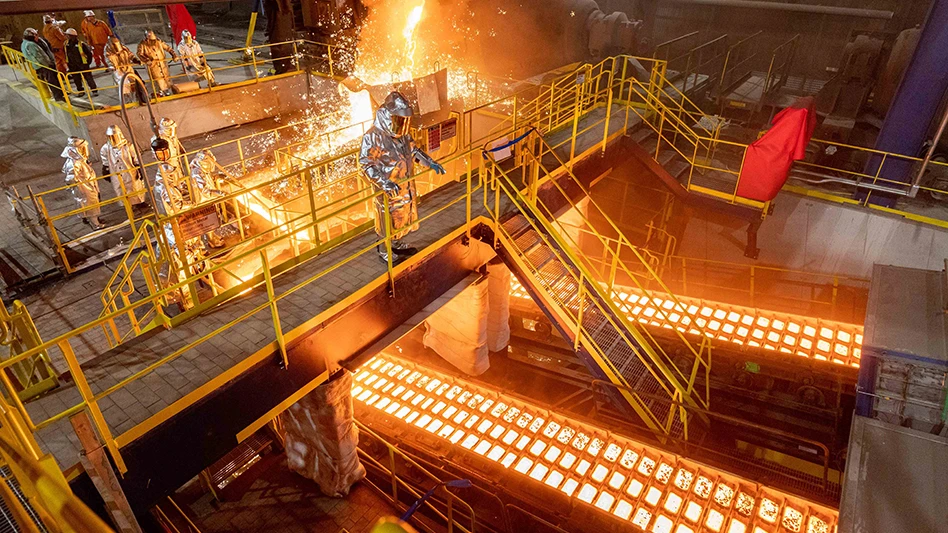
Photo courtesy of United States Steel Corp.
A statement issued by the vice chairs of the Steel Committee of the Organization for Economic Cooperation and Development (OECD) portrays a steel sector in much of the world that is suffering from steel exports pouring out of China at an even higher volume than in previous years.
“Delegates exchanged information on the pervasive use of nonmarket policies and practices by some countries that are distorting steel prices, reducing the steel market shares of member countries, creating severe trade disruptions, and leading to national and economic security risks," Steel Committee Vice Chairs Sheryl Groeneweg and Lieven Top write, summarizing the committee’s early November meeting in Paris.
“Concerns are intensifying amid a continued surge in Chinese steel exports, which have increased by a further 10 percent this year, reaching new record levels after doubling between 2020 and 2024."
The result is that steel workers and businesses in market-oriented economies are being displaced, according to the committee, with the ripple effect of the postponement of up to one-fifth of new lower-carbon emissions projects that were planned in member countries.
The committee says global steel demand appears to be bottoming out in 2025 and predicts a rebound in finished steel demand of around 1 percent for next year.
Demand in China is expected to decline sharply in 2026. A gradual rebound in nations with developed economies is anticipated, while in India, the Association of Southeast Asian Nations (ASEAN) region and in other countries with developing economies, "relatively strong growth prospects” are possible.
“Global steel excess capacity is increasing this year at its fastest pace since the 2009 global financial crisis and could surpass 680 million metric tons [mmt]," the committee says. (That description excludes 2022, when a post-COVID-19-restrictions rebound occurred.)
Global steelmaking capacity has risen for seven consecutive years, and the OECD—which consists of 38 nations with economies considered highly developed—projects it to reach more than 2.5 billion mmt by the end of 2025.
In addition to China, capacity has been added rapidly in India, the ASEAN region and the Middle East.
“Severe disruptions in steel trade due to global excess capacity continue to affect steel producers, despite the increased use of trade measures,” the committee says. “The structural decline in Chinese steel demand is pushing its domestic steel producers to export record volumes of steel rather than undertake market-oriented reforms and remove such capacity, thereby reshaping international trade flows via different channels.”
After reaching a then record-high level of 118 mmt in 2024, the further 10 percent increase in Chinese steel exports in the first half of this year has depressed financial conditions for most steelmakers worldwide, according to Groeneweg and Top.
If met with tariffs on finished steel, Chinese mills have responded by expanding shipments of semi-finished and lower-value products, including to what the OECD says are less protected markets, particularly in Asia, Africa and Latin America, that are more vulnerable to displacement and price competition.
“Nonmarket policies and practices continue to severely distort steel markets and are the source of the steel trade disruptions occurring around the world," the committee says. "These subsidies blur market signals, keep less profitable and cost-efficient firms in the marketplace, and crowd out the needed private investment that member economies’ industry needs to remain viable.”
Latest from Recycling Today
- Fleetio launches AI capability to accelerate fleet maintenance approvals
- The Metals Agency receives approval for export credit insurance
- Recycle Ann Arbor extends drop-off station operating hours
- Sybilion seeks to help manufacturers confidently address volatility
- Rio Tinto, Prysmian partner on low-carbon aluminum solutions for data centers
- Unilever criticized for plastics approach
- USTR to study additional steel, aluminum tariffs
- Electrified Materials adds processing capacity