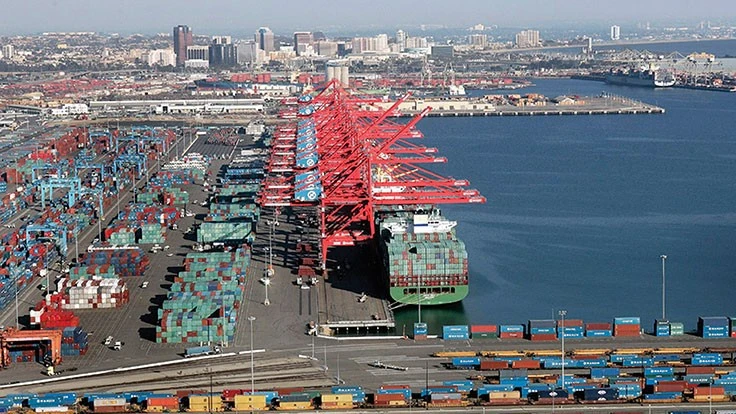
Photo courtesy of the Port of Long Beach
The Ocean Shipping Reform Act, bipartisan, bicameral legislation designed to help fix supply chains and ease shipping backlogs, passed the House by a bipartisan vote of 369-42 June 13, heading to President Biden’s desk to be signed into law.
The Senate passed its version of the bill unanimously March 31, while the House last passed its version of the bill March 29 as part of a broader legislative package that authorizes Coast Guard programs, marking the third time the House has passed the legislation. The House initially passed the companion bill in December of last year as a stand-alone measure and as a part of its version of a China competitiveness bill in February, the America COMPETES Act of 2022.
Differences between the versions of the bill passed by the House and Senate stalled further progress until recently, when House leadership decided to proceed with a vote on the Senate version of the bill because that would be “the most expeditious route to adoption,” according to The Maritime Executive, which cites a Bloomberg article, despite the Senate version being weaker than the House version.
Biden has voiced his support for the legislation, releasing a statement that reads in part: “In my State of the Union address, I called on Congress to address ocean carriers’ high prices and unfair practices because rising ocean shipping costs are a major contributing factor to increased costs for American families. During the pandemic, ocean carriers increased their prices by as much as 1,000 percent. And, too often, these ocean carriers are refusing to take American exports back to Asia, leaving with empty containers instead. That’s costing farmers and ranchers—and our economy—a lot of money.”
He says the legislation will ensure “fair treatment” for American businesses, adding, “I look forward to signing it into law.
The legislation will grant the Federal Maritime Commission (FMC) the authority to regulate ocean carriers and will establish new authority for the FMC to register shipping exchanges. It authorizes the FMC to self-initiate investigations of ocean common carrier’s business practices and apply enforcement measures.
Additionally, the act will require ocean carriers to certify that late fees, or detention and demurrage charges, comply with federal regulations and shifts the burden of proof regarding the reasonableness of these charges from the invoiced party to the ocean carrier.
Under the legislation, ocean carriers are prohibited from unreasonably refusing cargo space accommodations for U.S. exports and from discriminating against U.S. exporters. It also requires ocean common carriers to report to the FMC each calendar quarter on total import/export tonnage and 20-foot equivalent units (loaded/empty) per vessel that makes port in the United States.
The bill’s sponsors in the Senate and in the House were Sens. Amy Klobuchar and John Thune and Reps. John Garamendi and Dusty Johnson, respectively.
In a news release announcing the act’s passage, Klobuchar says, “Congestion at ports and increased shipping costs pose unique challenges for U.S. exporters, who have seen the price of shipping containers increase four-fold in just two years, raising costs for consumers and hurting our businesses. Meanwhile, ocean carriers that are mostly foreign-owned have reported record profits.”
“Nine multinational ocean shipping companies formed three consortiums to raise prices on American businesses and consumers by over 1,000 percent on goods coming from Asia. This allowed these foreign companies to make $190 billion in profits last year—a sevenfold increase in one year,” Garamendi says.
Thune says, “The common-sense improvements made by this bill will provide the FMC with the tools necessary to address unreasonable practices by ocean carriers and hold them accountable for any bad-faith efforts that disenfranchise American producers. ... Especially as Americans continue to grapple with record-high inflation, this legislation would also benefit consumers by promoting the efficiency of the supply chain.”
Johnson says, “The Ocean Shipping Reform Act is the strongest fix to our maritime laws in a generation. However, he adds, “our bill isn’t a silver bullet.”
The legislation has been endorsed by the American Association of Port Authorities (AAPA), which represents more than 130 port authorities across North and South America, and more than 300 organizations.
The AAPA says it is “pleased Congress found a moderate path to improving access and fluidity,” adding, “The Ocean Shipping Reform Act represents substantial changes to the Shipping Act of 1984 and will allow the Federal Maritime Commission to increase staff and better define the rules of engagement. As the FMC initiates a rulemaking, the port industry looks forward to telling its success story of historic throughput and the operational enhancements that have made it possible. By working with supply chain partners and cargo owners to keep cargo moving more quickly, dwell times have dropped significantly from the height of the congestion last year.”
Stephanie Casella, manager of strategic advocacy communications for the AAPA, tells Recycling Today the organization endorsed the Senate version of the bill “because it would increase Federal Maritime Commission enforcement of ocean shipping rules while preserving the crucial 'fluidity charges' that prompt cargo owners to keep their goods from piling up on severely limited terminal space.”
She adds, “Fluidity charges serve as a deterrent for cargo owners, ocean carriers and other parties to use terminals as storage space by sending or transporting too much cargo, thereby clogging these facilities that were never built to serve as storage. If the burden of proof were to, for example, transfer to ports or Marine Terminal Operators, the parties effectively causing the bottlenecking in these particular instances would have free reign to send and transport as much cargo as desired without consequence, even if ports cannot physically accommodate it. These charges are extremely important.”
Latest from Recycling Today
- U.S. Aluminum Co. explores aluminum fabrication plant in Oklahoma
- Sonoco completes portfolio transformation
- Eriez Shred1 data demonstrates scalable copper control
- RCI selects CurbWaste as exclusive operational management platform
- Updated: Supreme Court strikes down IEEPA tariffs
- Recycling Today Media Group launches Scrap Expo Lunch & Learn Webinar Series
- LyondellBasell scales back recycling target
- Former Liberty UK mills eyed by 3 suitors