STILL COUNTING ON COPPER
Orders from China for copper scrap have plummeted in late 2008, but a copper industry veteran from that nation says the long-term demand fundamentals are still in place.
Speaking at the World Scrap Metal Congress in Shanghai, Wang Ming of Zhejiang Hailiang Co. cited an analysis by consulting firm Brook Hunt that in the next 13 years, "the average annual increase of copper consumption in China will be 7.4 percent."
Acknowledging current economic woes, Wang nonetheless predicted that "a setback will not influence copper consumption too much." He added, "The continuous developing economy of mainland China is urging the consumption of copper in industries like electric power, marine engineering, electric communications, automobiles, etc."
In the power sector, Wang remarked, "The overall investment in constructing and rebuilding of the national power line in the 11th five-year period will reach RMB 1434 billion. As the electric power industry occupies about 50 percent of the national copper consumption, [China’s] overall copper consumption will be driven by the rebuilding and newly established [grid] and will be increasing for a relatively long period."
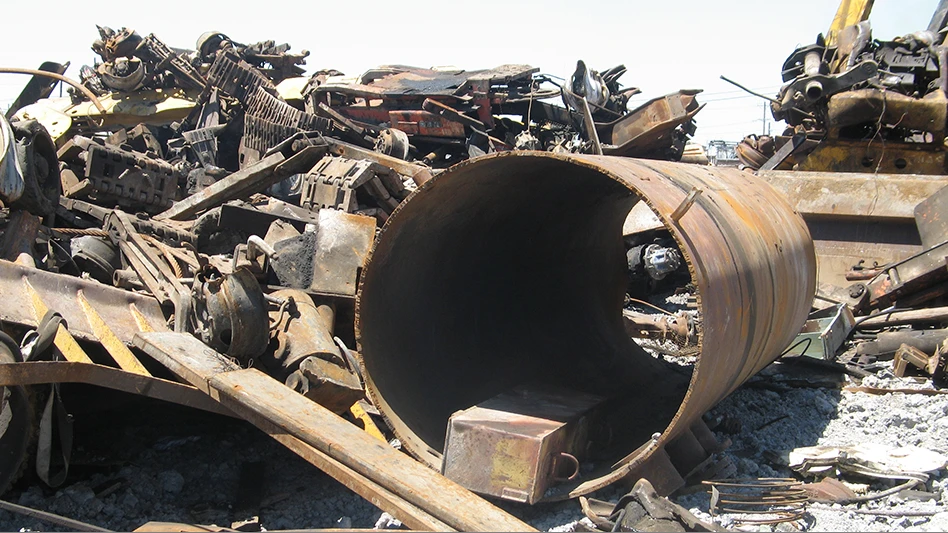
The world’s copper scrap has been helping to fuel the growth. China has nearly tripled its consumption of copper scrap in five years, according to the Beijing China Non-ferrous Recycled Metal Research Institute, from 420,000 tons in 2003 to more than 1.1 million tons in 2007.
Scrap provided one-third of the feedstock tonnage for the copper that was eventually consumed in China, said Wang, who noted that the scrap was often processed at recycling parks in cities such as Ningbo, Nanhai and Jinghai. The scrap is melted in electro-refining facilities, casting facilities and brass mills.
Economic conditions in the rest of the world were having an impact on copper pricing, according to Wang. "Rebounding of the U.S. dollar and the gloomy future of the economy in America and Europe has resulted in the recent crash of commodity prices," he commented.
Wang also referred to Chinese government policies "to prevent the overheating of the economy," such as strictly controlled bank loans.
He predicted, though, that "the high copper price will get back in a short time." Although orders declined dramatically this fall, Wang said buyers would be back. "We think that for the long term, the demand is [solid]; once the price of the vendor and the buyer [are] balanced, the demand will be released," Wang stated.
Also overseas, Norddeutsche Affinerie AG, one of the largest copper producers and copper recyclers in Europe, has announced that it will invest nearly 62.5 million euros (US $84.5 million) and add 40 jobs at its Kayer Recycling Systems site in Lünen, Germany. The announcement to invest at the site was made during a ground-breaking ceremony for a new warehouse for KRS recycling raw materials, which completes the implementation of an emissions reduction program agreed to with the authorities two years ago.
"Thanks to our leading international position in metal recycling, we are able to contribute significantly to the conservation of resources, especially in a country like Germany, which lacks raw materials of its own," says Bernd Drouven, Norddeutsche’s chairman of the board. "The KRS-Plus project will contribute substantially to ensuring that Lünen remains a viable recycling location despite drastic increases in the price of energy, and it will safeguard the jobs there for a long time to come."
The investments include a second furnace, allowing KRS to switch from batch processing to continuous smelting.
The capacity to process materials of varying quality and composition, such as metal-bearing industrial residues, copper-bearing shredded material and electrical and electronic scrap, will increase to 145,000 metric tons per year—doubling the present-day processing capacity for these materials. Once the project is complete, KRS will be able to process up to 350,000 metric tons of material per year.
The company produces roughly 1 million metric tons of copper cathodes and more than 1.2 million metric tons of copper products per year.
(Additional news about nonferrous scrap, including breaking news and consuming industry reports, is available at www.RecyclingToday.com.)
Latest from Recycling Today
- Danieli to supply shredder to Australian company
- Equipment from the former Alton Steel to be auctioned
- Novelis resumes operations in Greensboro, Georgia
- Interchange 360 to operate alternative collection program under Washington’s RRA
- Waste Pro files brief supporting pause of FMCSA CDL eligibility rule
- Kuraray America receives APR design recognition for EVOH barrier resin
- Tire Industry Project publishes end-of-life tire management guide
- Des Moines project utilizes recycled wind turbine blades