Photo courtesy of Nissan
Automaker Nissan Nissan Motor Co. Ltd. and Waseda University in Japan say they have started testing a jointly developed recycling process to recover rare-earth compounds from electrified vehicle motor magnets with the goal of enabling practical application of the new process by the mid-2020s.
According to a news release from Nissan, most motors in electrified vehicles use neodymium magnets, which contain scarce rare-earth metals, such as neodymium and dysprosium. Reducing the use of scarce rare earths is important not only because of the environmental impact of mining and refining but also because the shifting balance of supply and demand leads to price fluctuations for manufacturers and consumers.
Nissan says it has been working from the design stage to reduce the amount of heavy rare-earth elements (REEs) it uses in motor magnets since 2010. In addition, Nissan is recycling REEs by removing magnets from motors that do not meet production standards and returning them to suppliers.
Currently, multiple steps are involved, according to the company, including manual disassembly and removal. Therefore, developing a simpler and more economical process is important to facilitate recycling.
Nissan says it has been collaborating with Waseda University, which has a strong track record of researching nonferrous metal recycling and smelting, since 2017. In March of last year, the collaboration successfully developed a pyrometallurgy process that does not require motor disassembly.
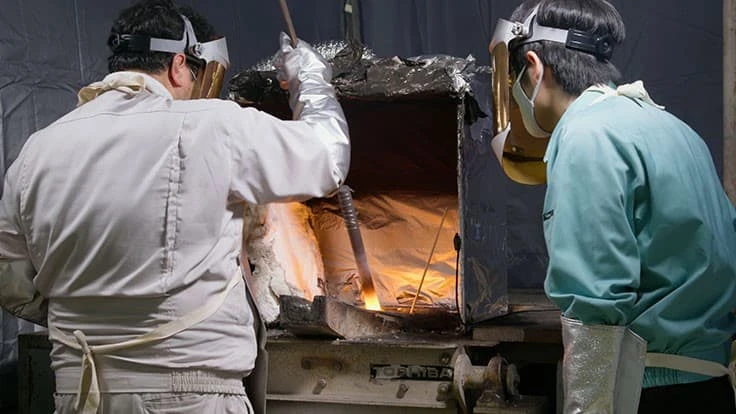
The process involves adding a carburizing material and pig iron to the motor, which is then heated to at least 1,400 C and begins to melt. Iron oxide is added to oxidize the REEs in the molten mixture. A small amount of borate-based flux, which is capable of dissolving rare-earth oxides even at low temperatures and highly efficiently recovering REEs, is added to the molten mixture. The molten mixture separates into two liquid layers, with the molten oxide layer (slag) that contains the REEs floating to the top, and the higher density iron-carbon (Fe-C) alloy layer sinking to the bottom. The REEs are then recovered from the slag.
Nissan says testing has shown that this process can recover 98 percent of the motors’ REEs while also reducing the recovery process and work time by approximately 50 percent compared with the current method because no time is needed to demagnetize the magnets nor to remove and disassemble them.
Waseda and Nissan say they will continue their large-scale facility testing with the aim of developing practical application, and Nissan will collect motors from electrified vehicles that are being recycled and continue to develop its recycling system.
Latest from Recycling Today
- Novelis resumes operations in Greensboro, Georgia
- Interchange 360 to operate alternative collection program under Washington’s RRA
- Waste Pro files brief supporting pause of FMCSA CDL eligibility rule
- Kuraray America receives APR design recognition for EVOH barrier resin
- Tire Industry Project publishes end-of-life tire management guide
- Des Moines project utilizes recycled wind turbine blades
- Charter Next Generation joins US Flexible Film Initiative
- Vecoplan to present modular solutions at IFAT 2026