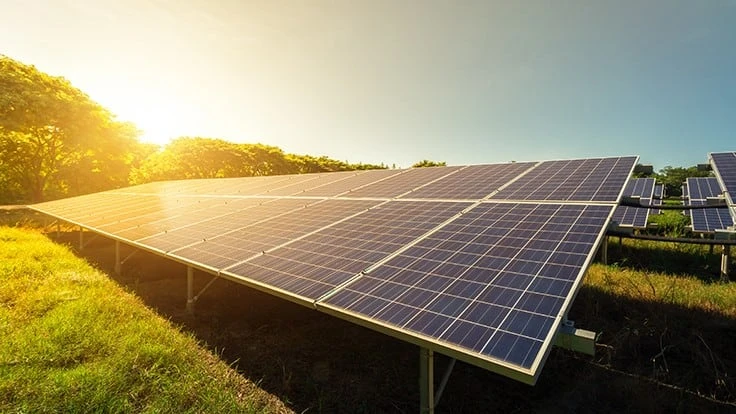
A new rule is set to take effect in California Jan. 1, 2021, that will allow generators of decommissioned solar panels (photovoltaic or PV modules) to manage them more economically as universal waste as opposed to hazardous waste under current California law.
This is the first rule in the country to identify solar panels as universal waste to reduce management burdens and facilitate recycling, according to JD Supra.
Close to 100 percent of the materials in a solar panel are recyclable or reusable, but the panels often contain heavy metals such as cadmium, copper, lead, selenium and silver. The presence of those metals could cause discarded panels to exhibit the hazardous waste characteristic of toxicity and thus be classified as hazardous waste under the federal Resource Conservation and Recovery Act (RCRA) and California’s more stringent Hazardous Waste Control Law.
This classification makes it expensive and burdensome to store, handle and transport end-of-life panels for recycling or disposal under current regulations.
Starting Jan. 1, 2021, decommissioned solar panels will be regulated like other universal wastes in California, which include batteries, electronic devices, mercury-containing equipment, lamps, cathode ray tubes and aerosol cans.
Among other advantages provided by the new rule, storage of decommissioned panels will be allowed for up to one year, and using hazardous waste manifests and hazardous waste transporters will not be required. Storage quantity limitations will not be imposed.
Other key components of the regulations for handlers include notification and annual reporting to the CA Department of Toxic Substances Control, labeling (Universal Waste–PV Modules), employee training, handling to prevent breakage and releases, response to releases, containment and recordkeeping. Universal waste handlers also are granted authority to conduct certain treatment activities, including removal of user-replaceable panel components and panel dismantling, removing or physically segregating components (glass panels, metal framing, PV cells and pockets).
Physical treatment activities, including separation, cutting, sawing, breaking, shredding, crushing, screening and compacting, also are allowed. However, the rule prohibits universal waste handlers from using or applying chemicals, including water and/or external heat, to solar panels.
Latest from Recycling Today
- U.S. Aluminum Co. explores aluminum fabrication plant in Oklahoma
- Sonoco completes portfolio transformation
- Eriez Shred1 data demonstrates scalable copper control
- RCI selects CurbWaste as exclusive operational management platform
- Updated: Supreme Court strikes down IEEPA tariffs
- Recycling Today Media Group launches Scrap Expo Lunch & Learn Webinar Series
- LyondellBasell scales back recycling target
- Former Liberty UK mills eyed by 3 suitors