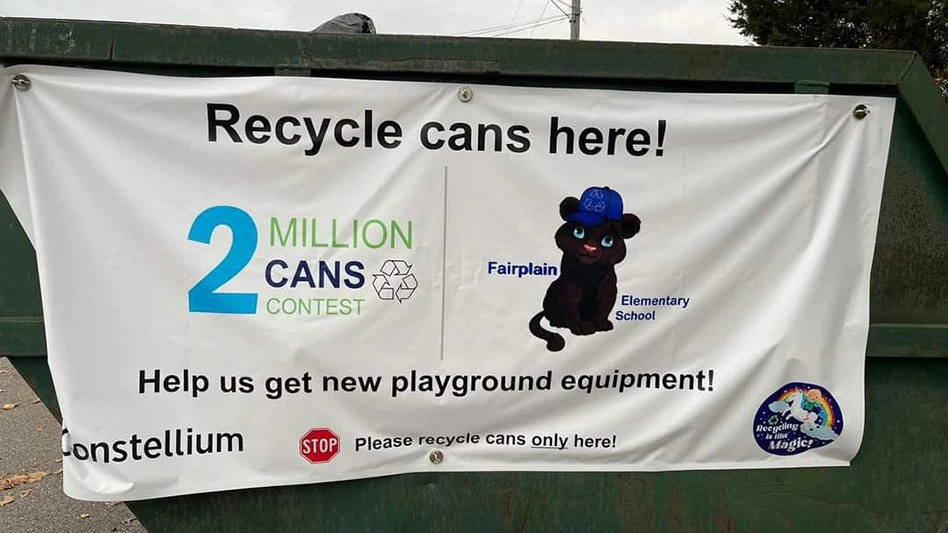
Photo courtesy of the Recycling Society
In November 2023, the Million Cans Recycling Contest kicked off for the first time with eight elementary schools across the U.S. Each school was paired up with a local scrapyard. From November to May, those eight schools recycled over 1.3 million cans.
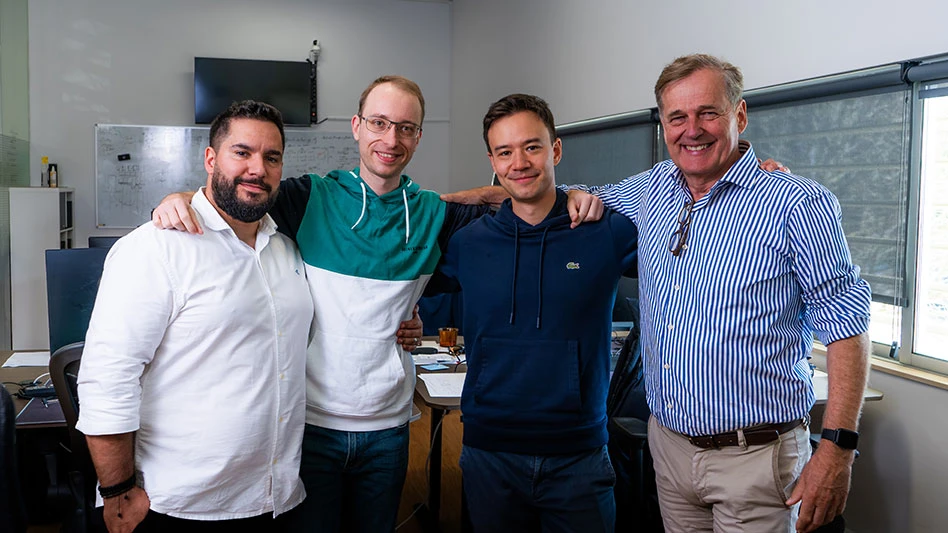
The Million Cans Recycling Contest originally was launched by Recycling is Like Magic, a team of three individuals who wanted to encourage sustainability and recycling. The team, consisting of Jessica Alexanderson, Brad W. Rudover and Shaziya M. Jaffer, wrote a book called “The Girl Who Recycled 1 Million Cans.”
In the book, a little girl named Ellie loves unicorns. She discovers that she can earn money if she recycles aluminum cans at her local scrapyard. Encouraged by this, she decides to recycle 1 million cans so she can buy a unicorn. Her friends all want a unicorn too, so they join her in her quest for 1 million cans. The entire school gets involved, and soon the goal of 1 million cans is within sight.
Recycling is Like Magic turned this story into a reality—minus the unicorn. The Million Cans Recycling Contest will enter its third year in the fall of 2025. Recycling is Like Magic has expanded into The Recycling Society, a nonprofit founded by Alexanderson and based in the state of Washington. The Recycling Society officially launched this year on Earth Day, April 22. As a nonprofit, the organization has enhanced funding opportunities.
“Our goal is to improve the aluminum can recycling rates in this country,” Alexanderson says. “Unfortunately, they’re going down. The recycling rates are only at 43 percent, and it’s a solvable problem. We’re trying to solve the problem by teaching little kids to never throw cans in the garbage and by making it super fun and easy for them.”
The Million Cans Recycling Contest takes place in elementary schools and focuses on third graders. Students from any grade can donate cans, but the third graders lead the charge.
When an elementary school joins the contest, the third graders all receive a copy of “The Girl Who Recycled 1 Million Cans.” After collecting cans, the school calls a partnering local scrapyard, which picks up the cans and weighs them. Depending on the scrapyard, the school can then earn anywhere from 35 to 95 cents per pound of cans. The scrapyard also sends The Recycling Society a copy of the scale ticket so that it can record how many cans the school recycled.
“Now that the schools know that the cans have value, it’s like the light bulb went off,” Alexanderson says. “It’s not a ton of money, but it all adds up over time. And for those little schools that need help, it’s the easiest way the community can help them.”
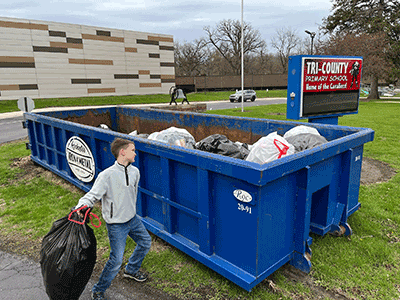
All schools participating in the contest will be divided into four regions. In each region, the school that recycles the most cans per student participating will receive $1,000. When a school reaches 75,000 cans, its third-grade class receives a pizza party. Any school that recycles 150,000 cans wins a $500 bonus. In states with three or more schools participating, the top school also receives a $500 bonus. Nationally, the top three schools will win $3,000, $2,000 and $1,000, respectively.
This prize money is in addition to the money that schools receive from their local scrapyards.
As a “thank you” to the scrapyards participating in the Million Cans Contest, The Recycling Society distributes flyers to parents detailing the scrapyards’ information and any additional metal items they are looking for.
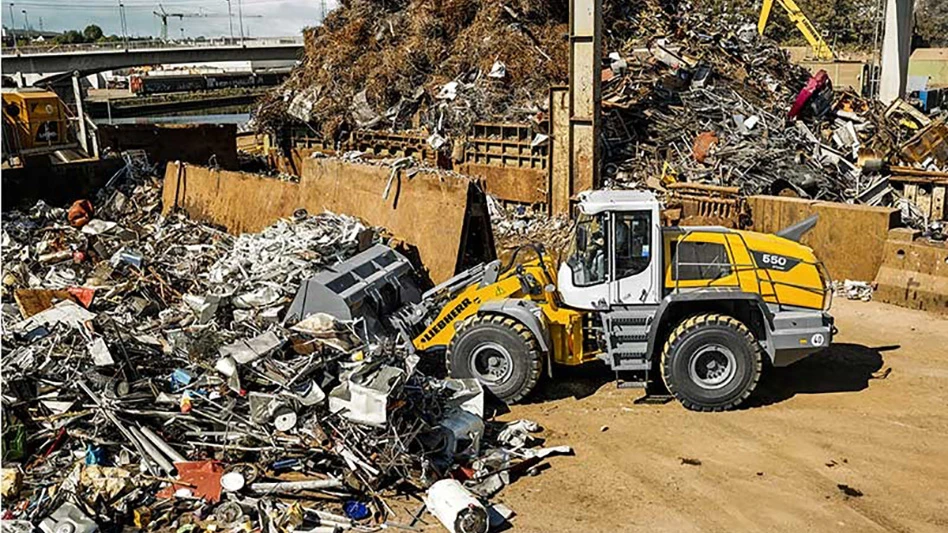
The partnerships with the scrapyards are essential to the contest, facilitating transportation for their cans and the fundraising.
“My dream would be for every state in the country and every single scrapyard helping with one or two schools,” Alexanderson says. “That’s how we would make the change.”
Donors also are crucial to supporting schools in the Million Cans Contest. They can choose to donate any amount of money or to sponsor a school, which costs $5,000 per school. The money pays for the free books, pizza party, prize money and any other expenses.
In the past two years, across 12 states and 36 schools, more than 3.5 million cans have been recycled through the Million Cans Contest. The Recycling Society’s website keeps a tally of the number of cans recycled and free books distributed to kids.
The impact of more than 3.5 million cans is significant. According to The Recycling Society, it takes 95 percent less energy to make a can out of recycled aluminum.
“We need to be proud of these cans because so many of them are made right here in the U.S.A.,” Alexanderson says. “But since everybody keeps throwing them in the garbage, we have to keep importing raw aluminum in. If we can just keep reusing all of our cans instead of putting them in a landfill, we would really cut back. That’s a huge impact.”
For the 2025-2026 Million Cans Recycling Contest, the Recycling Society is looking to expand from 36 schools to 50. As the contest continues to grow, it hopes to spread the mission of recycling aluminum cans. By making recycling convenient and attractive to students, The Recycling Society is helping raise the aluminum can recycling rate.
The Recycling Society has received support from the Can Manufacturers Institute and Ball Corp. over the last two years, including last year’s Ball Can Do Challenge. This year, these efforts are being combined into The Million Cans Recycling Contest.
With the generous support of its sponsors, which are leaders in sustainable aluminum packaging, Ardagh, Ball, Canpack, Constellium, Crown, Envases, Kaiser, Logan Aluminum, Novelis, PPG, Sherwin-Williams and Tri-Arrows, Alexanderson says the program has grown to 12 states, empowering students to recycle millions of cans, raise funds for their schools and keep aluminum out of landfills. "Every donation helps us expand and inspire the next generation of recyclers," she says.
Latest from Recycling Today
- Collective Waste Solutions acquires Alcop Resource Recycling transfer station
- Volatility continues in nonferrous metals
- Neste chemical recycling plant is ready to scale up
- Indonesia’s nickel pig iron spigot reopens
- Ecore says study backs crumb rubber use on sports surfaces
- Fleetio launches AI capability to accelerate fleet maintenance approvals
- The Metals Agency receives approval for export credit insurance
- Recycle Ann Arbor extends drop-off station operating hours