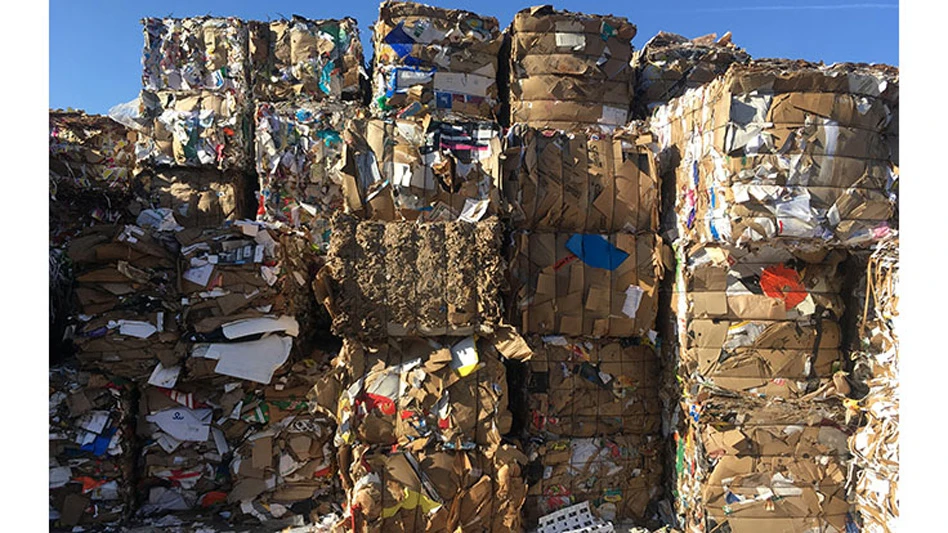
Photo courtesy of the Thommen Group
The cross-border trade of recyclable materials can take many forms, with statistics helping to portray the wider supply and demand factors that affect where ferrous and nonferrous metal scrap is heading.
Whether a transaction involves a common trade route or a “road less traveled,” people with an understanding of what recycled material grade is most suitable for a melt shop or mill are needed to produce optimal results.
The leaders of Metallum, a part of the Kaiseraugst, Switzerland-based Thommen Group, say the veteran staff they have reinforced this decade has been built to identify these opportunities, including those available to recycled materials processors and traders in the United States.
Building a broader business
The Thommen Group, consisting of three separately branded business units that operate in a combined five countries, has roots that trace back to the 1930s, when Gustav Thommen established a metal recycling business in Basel, Switzerland.
The Thommen brand has been retained on a network of 12 metal recycling facilities, all within Switzerland. The firm’s Immark brand specializes in the processing of electronic scrap and appliances, operating from three locations in Switzerland.
In 2015, the Thommen Group acquired fellow Swiss company Metallum Group, which at that time was owned by an investor with offices in the United Kingdom and the United States. Metallum subsidiaries in Germany, Italy and Belgium were part of that acquisition.
Acquired Metallum assets included both metals and electronics recycling operations. Subsequently, says Thommen Group CEO Pouyan Dardashti, Metallum also “has operated as the Thommen Group’s dedicated trading platform, connecting Thommen’s processing capabilities with international markets.”
The combined group now has nearly 30 locations in five countries, including a trading office in Shanghai.
The company lists recyclable aluminum, copper, nickel, brass, steel and special alloys as among the materials on which it focuses, with Metallum’s trading staff described by Dardashti as closely integrated with the Thommen Group’s processing operations.
“This structure enables Metallum to combine market-driven trading with industrial capabilities,” says Dardashti. The company markets the group’s internally processed recycled metals while also sourcing and placing additional volumes from external suppliers.
Although landlocked, Switzerland has a centuries-old reputation as a nation open to and focused on cross-border trade. This decade, Metallum has been making moves to reflect that traditional Swiss attitude.
Drawing sensible circles
Dardashti describes the Thommen Group as positioning itself for near-term growth by leveraging its strong international network and its specialization across materials, markets, and processing stages.
That growth is being driven by what the company calls a solution-oriented approach rather than volume expansion alone. “The focus lies on closed-loop recycling solutions for industrial customers, particularly foundries and metal producers working with aluminum, copper, nickel, brass and steel,” says Dardashti.
Such systems can help ensure consistent quality, traceability and sustainability while reducing supply risks and the carbon footprint of material flows, says the company.
“This strategy is underpinned by continued investment in processing depth, logistics flexibility and highly specialized trading expertise,” says Dardashti.
The company’s traders focus on defined materials and markets, fostering deep technical understanding, precise pricing and tailored trading structures.
Last year, Thommen Group announced the hiring of Kilian Schwaiger, former managing director of the German nonferrous metals recycling association VDM, to its corporate staff.
The company says Metallum will benefit from Kilian’s extensive network in the industry and his knowledge of the European Union and global regulatory framework built over the years through his role as managing director of VDM.
“As managing director Metallum Germany, Kilian will contribute relevant expertise, especially at the interface between regulation and market strategy,” says Dardashti.
Beyond Europe, Thommen Group and Metallum have identified trading and recycling opportunities in the United States and North America, despite the current U.S. administration’s moves to make market access more costly to overseas firms.
Getting into specifics
Melt shops in every part of the world require customized blends and specific alloys, which Metallum says can provide opportunities to buyers and sellers on both sides of the Atlantic Ocean.
“The Thommen Group provides North American exporters with structured access to European markets that would otherwise be difficult to navigate,” says Tobias Maier, chief operating officer of the Thommen Group, regarding the export opportunities available to American and Canadian processors and traders.
He continues, “One key advantage is market diversification. Rather than relying on a single buyer or destination, exporters can access a broad European customer base with a variety of specifications and demand profiles.”
Thommen Group’s processing facility network also supports the company’s presence in the cross-border trading sector, says Maier. “Through the group’s recycling and upgrading facilities, materials can be adapted to meet specific quality requirements, creating additional sales opportunities and reducing reliance on limited sales channels.”
Additionally, the maze of European Union regulations can be daunting for North American traders who do not specialize in conducting business on that continent.
“While Europe’s regulatory environment for recycled materials is complex, Metallum’s embedded position enables exporters to manage compliance efficiently and with confidence,” says Maier.
Although Europe is often considered a complex market due to its regulatory framework (and national differences within that framework), it offers significant business opportunities with the right local partners, according to Metallum.
As of early 2026, the People’s Republic of China continues to churn out more than half of the world’s semi-finished and finished metals.
Metallum says its office in Shanghai helps it get a better understanding of a business landscape that can be just as complicated as Europe’s and facilitates ongoing market dialogue with China and Southeast Asia, providing a bridge to those high-volume markets.
Dardashti says Metallum is not intimidated by headlines that can make trade seem like a threatened activity, saying instead the opportunities remain real and abundant.
“Although trade barriers and geopolitical tensions dominate the headlines, the Thommen Group is seeing growing opportunities,” states the CEO. “This is because the demand for raw materials is increasing, creating a need for companies that can organize international recycling value chains.”
Concludes Dardashti, “Dealing with complexity, uncertainty and global interdependence requires a new era of leadership. Today, leadership means providing guidance and inspiring and empowering people to embrace new ideas, ultimately building long-term partnerships rather than transactional relationships. Those who succeed in doing so will achieve circularity in people's minds as well as on paper.”
Latest from Recycling Today
- ING spells out downward copper price pressure
- Stena Recycling invests to handle EV batteries
- Amcor earns UN certification for industrial containers with PCR
- Oregon lawmakers pass battery recycling bill
- Volvo says loader updates improve efficiency
- One and One focuses on PCB recycling
- Indicators point to hiccups in steel demand momentum
- WM opens upgraded recycling facility in Southern California