Photo by Brian Taylor
The term “mission creep” originated in United States military analysis, pertaining to the stretching out of a limited strike or operation into a longer policing, peacekeeping or even nation-building exercise.
Those in the recycled materials industry could find the term useful when considering the willingness of officials in the United Nations and European Union to stretch treaties or regulations originally designed to govern hazardous shipments and apply them to more benign materials.
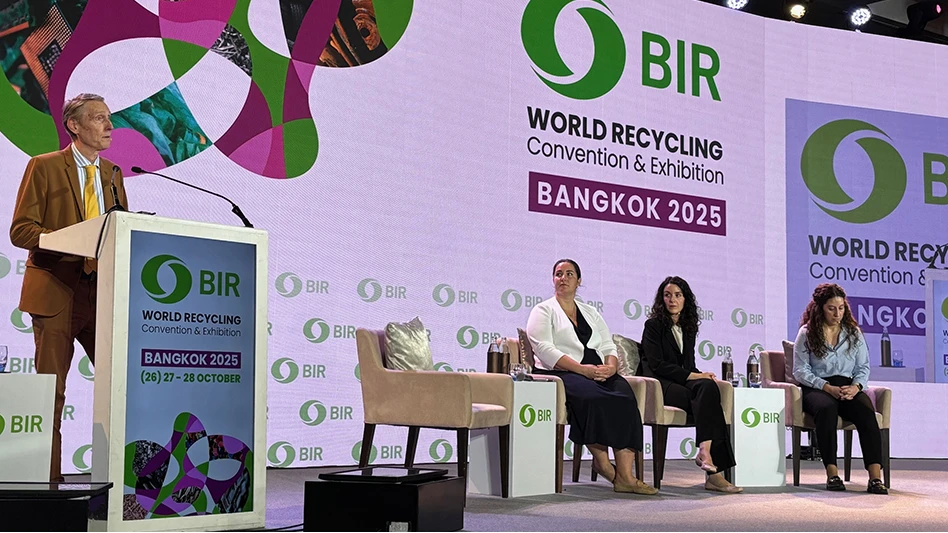
Topics addressed at several meetings of the Bureau of International Recycling (BIR) convention in Bangkok in late October dealt with trade restrictions created for environmental reasons, including scrutiny of recycled-content pulp in China reviewed at the BIR Paper Division meeting.
The BIR’s International Environment Council (IEC) focused almost exclusively on the expanding scope of cross-border shipping regulations, with much of that focus narrowed onto the United Nations Basel Convention on the Control of Transboundary Movements of Hazardous Wastes and Their Disposal treaty.
The initial rendition of that agreement was forged in the late 1980s and early 1990s, with most of the world’s nations (the United States being an exception) signing on by 1992.
The treaty established a prior informed consent (PIC) procedure for the export of hazardous waste.
In 2019, amendments expanded the Basel Convention treaty to cover plastic scrap materials. Now, commonly traded recycled metals are in the crosshairs of Basel Convention authorities.
BIR Trade and Environment Director Alev Somer said the association is seeking to stave off and eliminate unwanted consequences of amendments to the Basel Convention tied to the shipping of shredded metal from appliances, such as washing machines and dryers, that may contain trace amounts of circuit boards and thus have been placed under the electronic scrap umbrella.
Starting this January, Asian nations have been at times enforcing a PIC procedure designed to prohibit such exports unless the receiving country or countries en route for the freight vessel have agreed to the trade in advance and have satisfactory treatment facilities.
Somer said neither an end-of-life washing machine nor its motors are considered hazardous for shipping regulations. However, under the latest Basel PIC amendment, shredded metal fractions that had been listed under an acceptable Basel Convention code now are classified under an unacceptable “Y49” designation.
Consequences include reports of customs officials in Asia impounding containers of zorba, claiming they had been “misdeclared.”
“We have a very concrete example in Southeast Asia where there has been significant disruption,” Somer said. “The classification is determined according to where [the material] comes from, not according to its composition.”
The UN Basel Convention organization has established a working group to review its amended technical guidelines, and Somer noted that BIR is involved, arguing the result of the amendment goes beyond the intention of what the Basel Convention intended.
IEC Chair Olivier François said additional concern lies with the European Steel and Metal Action Plan (SMAP), which was published this March. SMAP proposes possible export restrictions on recycled metals, including steel, aluminum and copper.
“Such measures could have significant global consequences,” François said, adding that numerous regulators and legislators in Europe appear to be unaware of the EU’s bountiful annual recycled metals surpluses.
BIR Trade and Environment Policy Officer Olatz Finez Maranon said as of late 2025, SMAP has no legal standing because it had yet to be considered by the European Parliament or the European Council.
“[But] recyclers must be alert to upstream regulatory shifts in industrial and trade policy that may alter the playing field for recycled materials," she said.
Maranon said measures on exports, such as tonnage limits or fees, might be imposed in tandem with EU metals producers receiving protection on the sales side from the Carbon Border Adjustment Mechanism.
Offering some optimism, Maranon also expected EU support for clean energy and low-carbon technologies and updated EU circular economy legislation that, combined, could boost markets for recycled materials. She also said the numerous issues at the forefront provide a great opportunity for recyclers to become part of the policy decision-making in Brussels.
“We hope that we’ll be able to represent recyclers so that we’re engaged, not as something adjunct, but as co-designers of EU and global policies towards climate, industrial and circular resilience,” she said.
In the plastics sector, BIR Trade and Environment Policy Officer Bianca Mannini said as of late 2025, there is no consensus on text for a final UN Plastics Treaty, although another meeting remains in December.
She described two factions at odds in the negotiations.
“On the one hand is the ‘high ambition’ coalition, advocating a full life cycle approach to addressing plastic pollution," Mannini said. "On the other, the ‘like-minded’ group of mostly oil producing countries wants to limit the scope of the treaty to waste management and voluntary commitments rather than a legally binding text.”
She said BIR’s priorities at the Plastics Treaty negotiations center on production, design, recycling and circularity, while at Basel Convention gatherings it seeks to improve the recycling of plastics.
The BIR October 2025 World Recycling Convention & Exhibition was at the Centara Grand Convention Centre at Centralworld in Bangkok from Oct. 26-28.
Latest from Recycling Today
- Fleetio launches AI capability to accelerate fleet maintenance approvals
- The Metals Agency receives approval for export credit insurance
- Recycle Ann Arbor extends drop-off station operating hours
- Sybilion seeks to help manufacturers confidently address volatility
- Rio Tinto, Prysmian partner on low-carbon aluminum solutions for data centers
- Unilever criticized for plastics approach
- USTR to study additional steel, aluminum tariffs
- Electrified Materials adds processing capacity