Recycling Today archives
A new report from global consulting firm McKinsey & Co. examines the role of aluminum recycling in helping to meet an expected growth in demand for the nonferrous metal in the decades ahead.
The report is part of a six-part McKinsey “Materials Circularity” series, with the reports surveying the recycling landscape for basic materials overall, copper, glass, plastics and rare earth elements.
In the aluminum sector, the consulting firm predicts growing demand for the metal in part because it is “a major building block of traditional industries, such as construction and packaging,” and because of its role in “low-carbon applications, such as electric vehicles (EVs), renewable-energy technologies, solar photovoltaics (PV), wind turbines and related electricity transmission.”
With aluminum demand expected to grow by about 24 million metric tons per year between now and 2035, primary aluminum production may only account for about 30 percent of additional supply growth write report authors Peter Spiller, Vladislav Vasilenko, Toralf Hagenbruch, Madicke Embrechts, Ilana Kochetkova and Patricia Bingoto, who work for McKinsey from four different European cities. The potential exists, they indicate, for a 4 million tons per year supply deficit.
The researchers say before either industrial (preconsumer) or postconsumer aluminum scrap is collected it can be commingled, “making it difficult to recover and preserve specific alloys [which] can limit [the] recycling of mixed scrap and cast alloys.”
The report also characterizes some recycled aluminum as being “downcycled,” citing the inclusion of 6000 series alloys into the production of 7000 series cast alloys that “can handle a higher share of impurities.“
That 7000 series melt shop destination in some parts of the world may soon be less viable with the growth of EV market share, however. That, says McKinsey, will result in a greater need to improve aluminum sorting and recycling practices.
In examining how aluminum scrap is collected globally, the authors note the lower collection rate for used beverage cans (UBCs) in North America versus Europe, where mandatory deposit-return systems are more common.
While finding most industrial scrap and a healthy percentage of aluminum generated by the construction and demolition sectors is collected, the report also notes the tendency of some of this mixed aluminum scrap to be shipped from places like North America and Europe to Asia, where the alloys can be hand sorted.
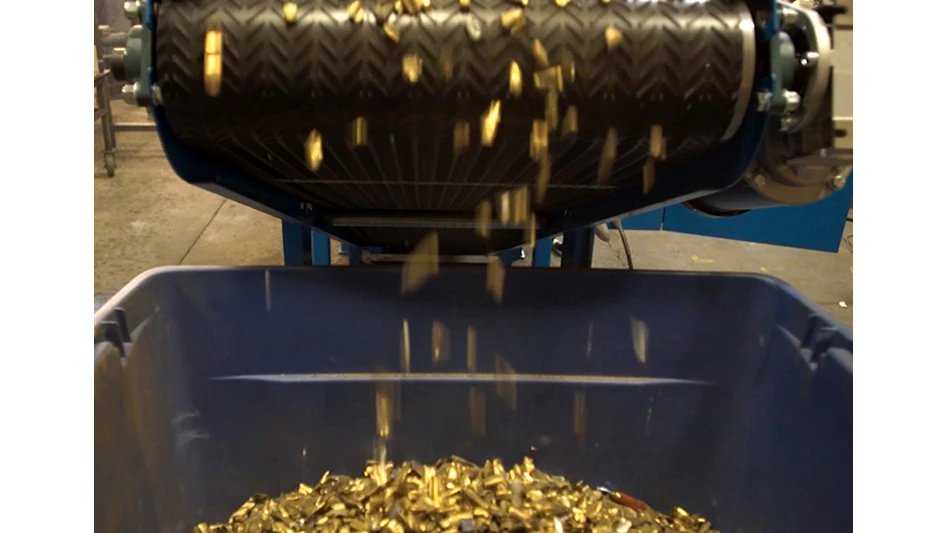
Specifically examining shredded metals streams created by processing firms, McKinsey credits X-ray fluorescence (XRF), X-ray transmission (XRT) and laser-induced breakdown spectroscopy (LIBS) technology methods for producing twitch from zorba, with the former grade being one less prone to be “downcycled.”
“With today’s technologies, a scale of 30,000 to 40,000 metric tons of scrap per annum could allow processing costs of about $200 to $300 per metric ton and create a positive business case with a margin of $50 to $150 per metric ton—with higher-value metal fractions offsetting the additional processing efforts,” write the report’s authors.
The authors also point to alliances between metals producers and recycling firms that “demonstrate the potential of partnerships to tackle these challenges.” Examples include Constellium collaborating with OSR GmbH & Co. KG in Germany and Hydro working in partnership with Padnos in Michigan.
“Such collaborations benefit all parties involved—for example, scrap collectors can gain access to better sorting technologies, recyclers can secure a steady supply of scrap, and end users can meet sustainability goals while reducing their carbon footprints through offtake volumes,” conclude the researchers.
Latest from Recycling Today
- England's Environment Agency extension provides stability for metal shredding operators
- Schupan names new chief financial officer
- NAW looks ahead to July hearing in Oregon
- Recycle Coach partners with Bartec Municipal Technologies
- EPA proposes abandoned tire cleanup plan with focus on energy recovery
- BIR welcomes new policy officer for trade & environment
- Global Recycling Foundation recognizes Recycling Heroes
- Recycling Today Media Group launches Paper and Plastics Recycling Conference webinar series