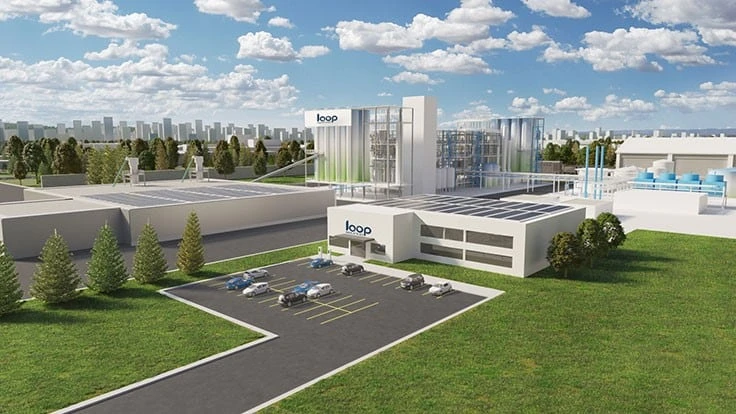
Loop Industries
In early September, Loop Industries, headquartered in Terrebonne, Quebec, and Paris-based environmental services company Suez announced their plans to build the first Infinite Loop recycling facility in Europe. The partnership is designed to combine Suez’s resource management capabilities with Loop’s technology to depolymerize end-of-life plastics to produce what the company says is virgin-quality, food-grade polyethylene terephthalate (PET) plastic.
The partners say the announcement is in response to growing demand in Europe from global beverage and consumer packaged goods (CPG) companies that have committed to aggressive targets for a high level of recycled content in their products and packaging. European law also is mandating the use of recycled content in plastic packaging.
Daniel Solomita, founder and CEO of Loop Industries, says Suez is “an equal partner” in the venture, with both companies taking a 50 percent stake in the venture.
“This will be the first of several facilities in Europe, and it is a true partnership,” he adds. “Suez plays a strategic role because they have access to all the waste plastics in Europe. They are the foundation for supplying raw material feedstock for powering our facilities.”
Solomita says a key barrier for Loop in establishing operations in Europe has been securing sufficient feedstock, and this partnership addresses that. “We are locking in long-term feedstock.”
He says Loop’s process is capable of handling a variety of PET feedstock, from opaque bottles to thermoformed containers to polyester fiber in clothing and carpeting.
The partners are looking to secure debt financing in part for the initial facility, and its location has yet to be determined, Solomita says.
He adds that while Suez has existing infrastructure to size and shred the material, the partners are still determining whether that equipment should be incorporated into the planned plant or handled in a separate facility. “We are fleshing this out,” he says, adding that site location and the nature of the feedstock will be factors that weigh into the final decision.
“Europe is a very important market,” Solomita says. “We envision one Loop facility in every European country with enough population,” he adds, noting that availability of feedstock will be the key determinate in siting the planned plants.
Regarding Loop’s technology, he says, “Chemical recycling is a broad term,” adding that he prefers to refer to his company’s technology as “enhanced recycling.” The process breaks down incoming feedstock into its base monomers, dimethyl terephthalate and monoethylene glycol, which are then purified to virgin form, Solomita explains. These monomers are then used to build new PET resins of equal or higher purity. “This is what the circular economy is all about,” he says. “It’s not about delaying end of life but creating a higher value product.”
He says Loop does this at lower temperature than some other processes employ, which results in “higher yields, better financials and a better environmental footprint.”
Regarding mechanical recycling, Solomita says it is limited in that it “can’t really purify and remove colors or handle contamination.” He adds that while it delays end of life, “It is not truly circular” and that PET can be “infinitely” recycled with Loop’s technology.
Solomita says PET produced through Loop’s process is a “premium product” with “premium pricing.” He adds that a number of companies, from L’Oreal to Danone, understand that the need to support this solution. “The best way to do that is to pay a premium for this material.”
Loop's partnership with Suez follows the company's 2018 announcement that it partnered with Bangkok-based Indorama Ventures Public Co. Ltd., a leading petrochemical company. This partnership combines Indorama Venture’s manufacturing footprint with Loop’s proprietary science and technology in Spartanburg, South Carolina.
While the companies had planned to begin commercial production in the first quarter of 2020, Solomita says the pandemic has affected that timeline.