Graphic courtesy of -Recyclingtech GmbH
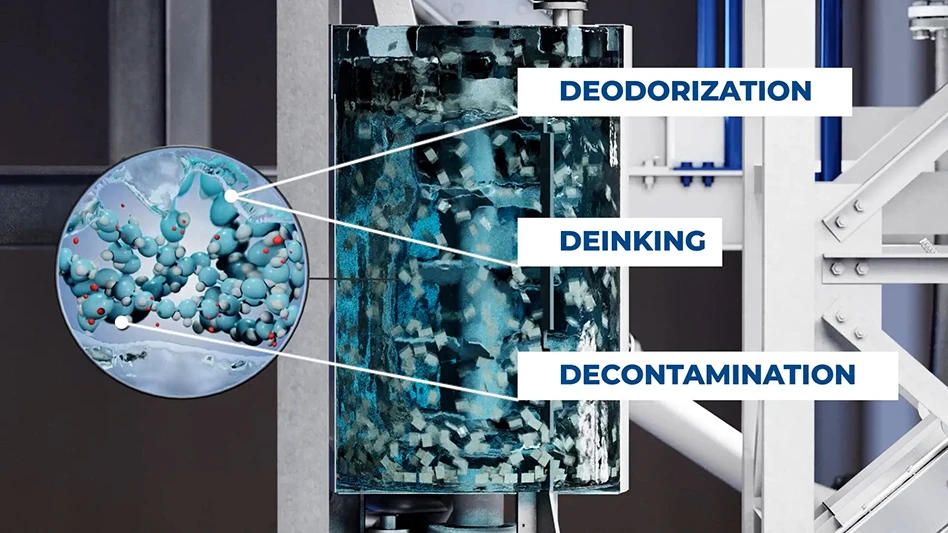
Austria-based Lindner-Recyclingtech GmbH has collaborated with global consumer products company Procter & Gamble (P&G) on solvent-based extraction process designed to remove nonintentionally added substances (NIAS), odors, adhesives and printing inks from polymer recycling chains.
The companies describe the new Flexloop process as “revolutionary mechanical recycling technology” that can boost purity levels of postconsumer recycled plastic to a point it opens up entirely new end-market options, such as in sensitive packaging applications in the cosmetics and personal care sectors.
Lindner and P&G made a presentation about Flexloop at the 2025 K Fair this October in Germany, saying the modular Flexloop system can be seamlessly integrated into existing Lindner washing and recycling systems, giving recyclers new opportunities and new sales markets.
“For us, Flexloop is a logical and necessary development in mechanical recycling and an extension of cold and hot washing,” Lindner Group Managing Director Michael Lackner says.
“Flexloop follows preliminary mechanical cleaning and provides a solvent-based extraction step. This mechanical recycling technology gives recyclers a valuable tool and helps them produce recyclates for sophisticated applications, using the mechanical recycling technology they know and trust.”
Lee Ellen Drechsler, senior vice president of research and development at Cincinnati-based P&G, adds, “We foresee a growing demand for high-quality recycled resin that is suitable for a wide range of flexible film applications, so we are excited for the introduction of Flexloop, an innovation our researchers developed as an option for upcycling a wide range of plastic materials through mechanical solvent extraction.
"The license of this plastic-to-plastic cleaning technology to Lindner is consistent with our corporate commitment to bring to scale technologies that can help address significant environmental challenges including the reduction of plastic waste and achieving a circular economy for materials.”
“The difficulty of obtaining high-quality, clean recyclate is a particular problem when handling postconsumer waste and for mixed plastics from domestic and commercial collections,” says Yannick Stanau, business development manager at Lindner Washtech. “Food packaging could come into direct contact during collection with packaging that was not originally intended for food—NIAS can diffuse into the polymer and be transferred."
The researcher says secondary resin made from postconsumer plastic often is used in applications such as park benches or rubbish bags. Chemical recycling has been held out as another option, however, the high investment and energy costs mean that this route holds limited commercial appeal, Lindner says.
“With Flexloop, we have found a solution for this problem,” Stanau says. The additional solvent-based cleaning step makes it possible to extract NIAS, odors, adhesives and printing inks out of polymers without attacking their structure. The secondary resins obtained through the method not only comply with legal requirements, they also can meet the strict specifications of many brand manufacturers, according to the equipment maker.
“It’s great to see this cleaning technology come to life,” says Gian De Belder, a technical director with P&G. “Flexloop is particularly important for a wide range of feedstocks, specifically packaging and agricultural films. The technology allows us to get a step closer to make film packaging fully circular by closing the loop, for example by producing high-quality recycled polyethylene (rPE) film grades that can be safely used in a new generation of film packaging aimed at sensitive packaging applications.”
Its modularity means a Flexloop unit can be integrated into nearly any Lindner washing and recycling line so that recyclers can use their existing infrastructure and incorporate Flexloop into the existing processes, according to Lindner. The capital expenditure and operating expenses compared with chemical recycling are low.
“The beauty of the technology is that target users are the mechanical recyclers who have an interest in upgrading the quality of their recycled resin, and they can do this simply by retrofitting their existing washing lines,” De Belder says.
Latest from Recycling Today
- Fleetio launches AI capability to accelerate fleet maintenance approvals
- The Metals Agency receives approval for export credit insurance
- Recycle Ann Arbor extends drop-off station operating hours
- Sybilion seeks to help manufacturers confidently address volatility
- Rio Tinto, Prysmian partner on low-carbon aluminum solutions for data centers
- Unilever criticized for plastics approach
- USTR to study additional steel, aluminum tariffs
- Electrified Materials adds processing capacity