Photo courtesy of Levitated Metals
Levitated Metals has added laser-induced breakdown spectroscopy (LIBS) technology to sort wrought aluminum from cast aluminum at its New Caney, Texas, facility.
Levitated Metals operates a heavy media plant that it opened in early 2021, producing low-magnesium and low-iron twitch from zorba and zorba fines that it buys from auto shredding operations. In addition to twitch, the company produces zebra heavies (a mixture of brass, copper, zinc, nonmagnetic stainless steel and copper wire) and zeppelin (a mixture of magnesium and aluminum) that it markets to smelters and processors in the U.S., Mexico and overseas.
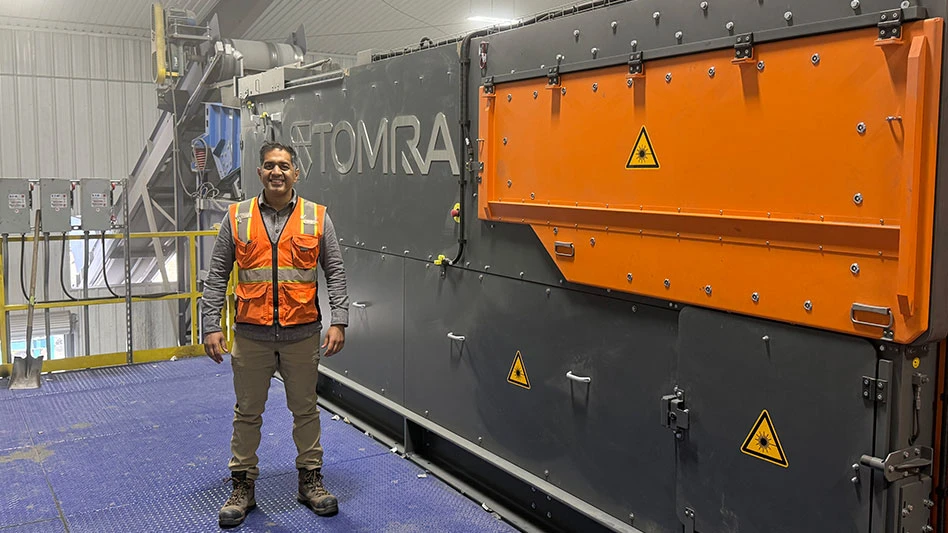
Now, with its new Autosort Pulse manufactured by Tomra Recycling of Germany and supplied by Wendt Corp. of Buffalo, New York, Levitated Metals also is marketing vesper, or aluminum sheet, extrusion and/or plate grades, that it is producing from zorba that it first upgrades to twitch using its heavy media plant.
Within two weeks of the Autosort Pulse’s installation, Levitated Metals President Ronak Shah says the line was running “and making material far better than we expected to make.”
He adds that LIBS technology is poised to transform the scrap recycling industry. “It's pretty shocking how quickly it's just leapfrogged or made other technologies simply obsolete.”
Shah credits Levitated’s operators and the company’s industry partners, including Tomra, Wendt and Integrated Shredder Technologies of San Antonio, for the success the company has seen since the installation.
High expectations
Shah says vesper consumers have high expectations regarding the quality of the material they purchase, with little room for variation.
“The quality expectations that our customers have are far beyond most things that anyone in our industry has to deal with,” he says. “We're making a lowest-common-denominator product, twitch, into a highly specialized product: low-silicon 3X shreds. It takes an absolute manufacturing quality approach to be able to make product of a quality that they would like to see, and, in our particular case, we focus a lot on that,” including polishing the material to improve its aesthetics.
“We do it because when you walk around any rolling mill, everything is very clean and nice and safe, and they have clean sheets of scrap, clean areas of scrap and RSI [remelt scrap ingot] sows that are explicitly known chemistries. If we're going to break into that world, we have to provide product of a quality commensurate with their expectation, and that's a big delta from what expectations sometimes are in our industry.”
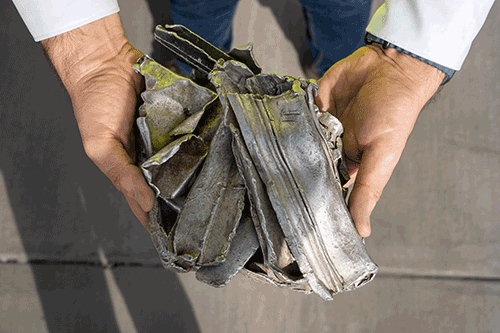
Material is polished and sized prior to entering the LIBS line, with Shah noting that bigger pieces of shredded aluminum generally are wrought, while smaller pieces typically are cast as that material tends to shatter upon impact in the shredder given its more brittle nature.
“Our goal as a company is to make the product that our aluminum customers are looking to buy from raw sources of recycled materials that are not available to them today,” Shah says.
The Tomra Autosort Pulse is the only LIBS sorter Levitated tested, he says. Shah was interested in the unit because it uses 3D targeting for each piece of aluminum, meaning the laser is firing directly on the surface of the material. “I believe that focal accuracy is fundamental to the accurate reading of the chemistry of any piece.”
He also appreciates the speed at which the lasers fire and that the unit has four of them. “I think each laser is more than capable of shooting at over 100 pieces a second, and there's four of them, and that's more pieces than I could even put on the belt per second.”
The decision to invest
In the second half of 2023, Mervis Industries, Danville, Illinois, acquired Levitated Metals, which operates as a wholly owned subsidiary of the company.
At that time, Adam Mervis said Levitated’s “cutting-edge technology and expertise in metal separation and recovery perfectly complement our existing operations. This acquisition enhances our ability to deliver high-quality products to our customers.”
“We bought Levitated Metals with the intention of segregating wrought and cast out of twitch, knowing that there was explosive growth on the horizon for mill-grade scrap aluminum,” says Brendan Beck, director of nonferrous marketing at Mervis Recycling.
When the company decided to invest in the Autosort Pulse in early 2025, he says spreads for used beverage cans (UBC), which can be replaced by 3x shred, were at historically tight levels. Since then, low-cost UBC imports and domestic demand constraints have led to significant softening in the mill-grade aluminum market.
“The mill-grade aluminum market has never seen a demand scenario like this before,” Beck says. “Some spreads are wider than they've ever been. But our intention is to proceed with this project and bring shreds to market.”
“It is our belief that having the best quality shred on the market is going to be beneficial in the future,” he says.
Advice to other recyclers
For other recyclers considering adding LIBS sorting technology to recover wrought aluminum, Shah suggests taking advantage of suppliers’ test facilities. He says Levitated was the first company to test the technology at Wendt’s facility.
“There was one single 2,000-pound Super Sack that we all became very intimate with in that we ran that material over and over again [and] looked through every piece," he says. "We had much of the testing plan already in place before we went there. We buy zorba from a wide range of suppliers. Everything we sent up there was carefully curated.
"If you're going to do a test, you really have to know what you're testing and how you're going to test it.”
For those who decide to install a LIBS unit, Shah also offers this bit of advice: “Don't underestimate the value of material preparation prior to this machine.
Latest from Recycling Today
- Fleetio launches AI capability to accelerate fleet maintenance approvals
- The Metals Agency receives approval for export credit insurance
- Recycle Ann Arbor extends drop-off station operating hours
- Sybilion seeks to help manufacturers confidently address volatility
- Rio Tinto, Prysmian partner on low-carbon aluminum solutions for data centers
- Unilever criticized for plastics approach
- USTR to study additional steel, aluminum tariffs
- Electrified Materials adds processing capacity