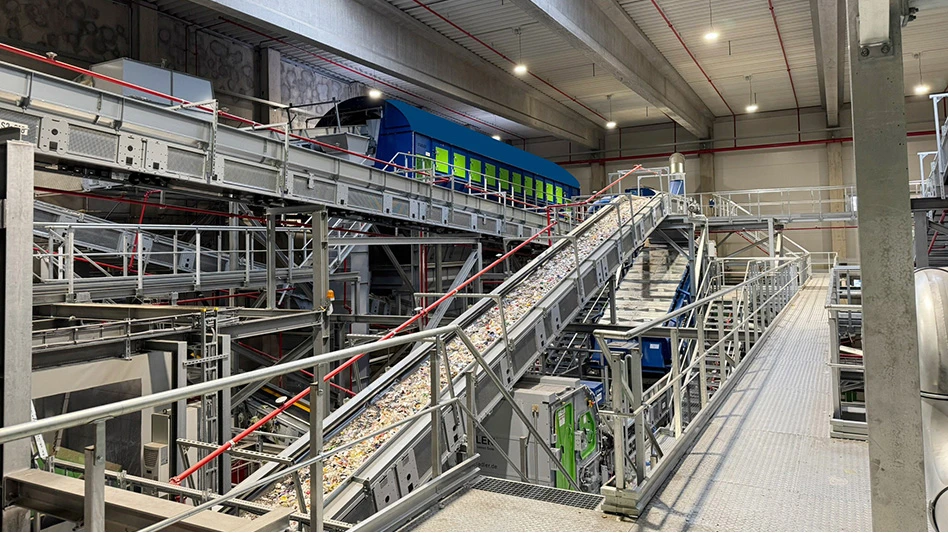
When the recycling program begins, this Deffenbaugh facility in Kansas City, Kan., will handle all of the items that are picked up.
The “Seattle stomp” is about to become the “Kansas City crush.”
We're not talking football. We're talking about curbside recycling.
When Seattle launched its recycling program years ago with strict limits on how much trash could be tossed, stuffing containers became known as the “Seattle stomp.”
Now, Kansas City — virtually the last major city in the United States to start a curbside recycling program — is gearing up for the Midwest version of trash bag stuffing. The city's new RecycleFirst program begins in 75 neighborhoods on March 1. By December, every household will be dealing with curbside recycling and new trash limits: Only two bags a week will be picked up free. Additional bags will need a tag costing $1.
Those challenges have people like Bill Franklin, an expert on solid waste, expecting to see a lot of “Kansas City crush” in the coming weeks.
Most metropolitan area cities have curbside recycling, but only one, Westwood, has a program similar to RecycleFirst that limits trash to encourage recycling.
But Franklin and others think that the new program is designed well enough to rank Kansas City among the nation's recycling leaders and that residents will adjust — eventually.
“They definitely have a shot at success,” said Franklin, whose Prairie Village company produces the U.S. Environmental Protection Agency's annual report on municipal solid waste and recycling.
Franklin thinks Kansas City's program has several things going for it.
First, it's what's known as a “pay as you throw” program. Other cities with such programs have achieved much higher recycling rates than traditional curbside programs that charge for pickups. That means more material is diverted from landfills, reducing the city's trash costs enough to pay for the extra cost of picking up the recyclables.
Franklin and other supporters think the program also has stronger neighborhood support, especially since City Manager Wayne Cauthen postponed an earlier startup date and redesigned the program to make it simpler.
The phase-in, with just 75 neighborhoods in March, with more added every three months, should allow the city to tweak the program before problems become insurmountable, said John Stufflebean, the city's director of environmental management.
The city also should benefit from other cities' recycling experiences, Stufflebean added.
“There's an advantage to going last,” Stufflebean said of Kansas City trailing other cities. “We can learn from the other programs.”
But tough challenges remain.
Among the most critical, the program's promoters acknowledge, will be winning community support, proving financial success, and controlling dumping and other illegal activities that might be spurred by the new program.
Local environmentalist Bob Mann, who has led efforts since 1990 to launch curbside recycling in Kansas City, expects some problems.
“I don't know of any program that the city has attempted that is as comprehensive as this — it affects every household, up to apartment units of six or less,” Mann said. “We'll have things that work really well, and there will be things that don't. We'll make adjustments.”
Community acceptance
With any new recycling program, especially one in a city that has resisted recycling in the past, public education is the key to winning community support.
“We're not going to force people to recycle,” Stufflebean said. “The majority of people are going to have to decide we're going to support it.”
Surveys of Kansas City residents have shown that 80 percent of respondents believe recycling is a good thing.
But that's a much different question than asking if you support the RecycleFirst program. Or if the city's two-bag limit is acceptable. Or if you mind taking time to separate trash from recyclables. Or if you mind buying additional trash tags.
What's more, Kansas City doesn't have a recycling reputation.
In 1990, Kansas City asked voters to approve a curbside recycling program that would have charged each household $1.89 per month. The proposal lost, with only 46 percent in favor of paying for recycling.
In 1992, the city proposed a curbside program similar to RecycleFirst. It would have charged only for trash, not recycling, and its trash limit would have been just one bag a week.
Voters buried that idea, too, with only 40 percent in favor.
Mann, who led that recycling campaign, said it was too complicated. Many residents were confused or worried about getting down to one bag of trash a week.
“We were never able to educate everyone,” he said.
Today, Mann believes more Kansas City residents support recycling.
“The awareness of it is much broader,” he said.
Phasing in recycling also may help educate people better, as they see exactly how the program works elsewhere, Stufflebean added.
The city also is using neighborhood leaders to promote the program. In turn, residents are being enlisted to help neighbors keep track of recycling days.
At the 49/63 Neighborhood Association meeting last month, resident Bruce Wiggins, a city employee, presented the basics of the program to his neighbors.
About half of the two dozen persons in attendance told Wiggins they already recycle. Some were looking forward to the program because it means they won't have to cart as much trash to a community recycling center.
But a few shook their heads in confusion when Wiggins explained which plastic containers will be accepted for recycling and which won't.
Plastic containers with a neck — such as a plastic orange juice bottle — will be accepted. But a plastic margarine tub will not because it has no neck.
“Sounds complicated,” one man griped.
It is, agreed Mark Carr, an employee of Bridging the Gap, which has a city contract to lead public education about RecycleFirst.
“The No. 2 (plastic) items have to have a neck. It's because they melt at different temperatures,” he explained.
Nationwide, about 4,000 communities have started “pay as you throw” recycling programs. But only one other area community operates one similar to RecycleFirst.
In Westwood, about 700 households are allotted 108 stickers a year. To have a trash bag of no more than 65 pounds picked up, a sticker is required. Unlimited recycling is allowed at no charge.
Some residents say it's an inconvenience, but worthwhile.
“It's a little bit of a pain in the neck, but having our environment totally trashed for our children and grandchildren will be a pain in the neck, too,” said Patrick Sullivant, a Westwood resident. “It's really just being a responsible human being.”
Financial concerns
Recycling is a bit of a financial gamble for Kansas City. To pay for it without dipping further into the city's dwindling budget, residents must reduce trash volumes.
Already, the city spends about $8 million a year to collect and dispose of trash from about 145,000 households. After RecycleFirst is launched, Stufflebean said, he's hoping for a 25 percent reduction in trash volumes. That would give the city enough money — about $1.7 million annually — to pay for curbside collection of recyclables every other week.
The city also projects to make $100,000 from the sale of bag tags and extra bins. But Stufflebean estimated that 80 percent of households will be able to achieve a two-bag limit and never need extra tags. And the 20 percent that may purchase tags won't need them each week, he predicted.
Also, under the proposed $1.67 million contract with Deffenbaugh Industries Inc., the city would receive some revenue from the sale of recyclables. If Deffenbaugh received more than $70 per ton, the city could get up to 4 percent of that money back. The return increases as market rates improve.
Those revenues would help support education efforts and increased enforcement against illegal dumping, bin theft and other problems, such as people setting their trash in front of someone else's house.
In addition, getting more households down to two trash bags per week should decrease future trash pickup costs.
But Stufflebean also acknowledged that limiting Kansas City residents to two 40-pound trash bags, or roughly 80 gallons, might present a problem: Too many households might achieve the limit without recycling much, which could threaten the program's finances.
Enforcement
Even if successful, recycling has a downside.
In some communities, “pay as you throw” programs experience an increase in illegal dumping and thefts of bins. Some residents even placed their trash in front of other homes for pickup.
After three to six months, the problems usually subside, Stufflebean said.
“We have unlimited trash pickup right now, and we still have illegal dumping,” he noted. “Ultimately, the problem shouldn't grow.”
To curb bin thefts, residents are encouraged to write their address on them with permanent markers.
But the city plans to step up enforcement nonetheless.
Councilman Jim Rowland, who sponsored RecycleFirst with Mayor Kay Barnes, gave assurances that the city will crack down on illegal dumping.
“We will be diligent about prosecuting,” Rowland said.
Still, some worry that illegal dumping will get worse unless the city gets tougher with scofflaws.
“We have a problem already, and that's with unlimited trash pickup,” said Jean Helene Davis, who attended the 49/63 Neighborhood meeting last month. Kansas City Star
Latest from Recycling Today
- U.S. Aluminum Co. explores aluminum fabrication plant in Oklahoma
- Sonoco completes portfolio transformation
- Eriez Shred1 data demonstrates scalable copper control
- RCI selects CurbWaste as exclusive operational management platform
- Updated: Supreme Court strikes down IEEPA tariffs
- Recycling Today Media Group launches Scrap Expo Lunch & Learn Webinar Series
- LyondellBasell scales back recycling target
- Former Liberty UK mills eyed by 3 suitors