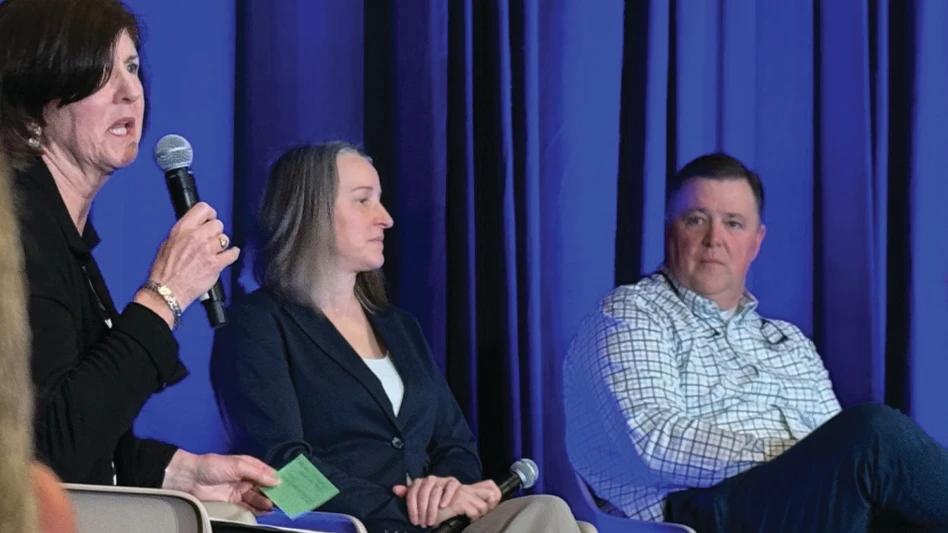
Nothing beats a good credit history to make friends with a banker. But there are additional steps scrap dealers can take to help bankers understand their operations, according to two bank officers who addressed attendees of a session held at the Institute of Scrap Recycling Industries Inc. (ISRI) Annual Convention earlier this month in Orlando.
Although banks were never in business to lose money, they are even less likely to “finance losses” by lending to a business owner trying to cover for an unprofitable time period, said Albert Sykes Jr., a lending consultant with Cornwall Management Services, St. Augustine, Fla.
“But a bank will finance assets that will help you improve your business; that’s how you have to spin it,” said Sykes.
Ideally, scrap company owners will be able to rely less on spin and more on facts once they get to know their lenders. Most banks are set up to have a loan officer act as the key contact with a business owner, but Sykes recommended that business owners also open up a relationship with someone on the underwriting or credit side of the bank. “You want to develop a relationship with these people, so they can get to know you.”
Having more than one contact—“multiple touch points,” in Sykes’ words—also helps safeguard a business owner from having to start from scratch if his or her loan officer leaves the bank. Sykes noted that developing the relationships is a continuous process, and should involve invitations to lunch and to tour the scrap facilities.
Much of the good done here, he warned, could be undone by a few poorly chosen words. While some scrap dealers may see themselves as self-made entrepreneurs who do not need to yield to “political correctness,” they may need to remind themselves that they operate in a wider world.
“Part of what you need to do is project a sophisticated and professional management style,” said Sykes. “You may not be fond of what you consider ‘political correctness,’ but most banks have highly educated female and minority staff members,” noted Sykes—staff members who are certainly not anxious to be stereotyped.
Both Sykes and fellow speaker Rob Schulten of GE Capital, Danbury, Conn., noted that scrap dealers would ultimately benefit when their lenders understand the industry, even though this will take some time and effort on the scrap company owner’s part.
A professional-looking business plans with projections that can be met by the scrap company are keys to securing financing, they both noted.Latest from Recycling Today
- Charter Next Generation joins US Flexible Film Initiative
- Vecoplan to present modular solutions at IFAT 2026
- Terex Ecotec appoints Bradley Equipment as Texas distributor
- Greenwave raises revenue but loses money in Q2 2025
- Recycled steel prices hold steady
- EY says India’s need for scrap imports will continue
- Coming full circle
- Amcor, DCM introduce fertilizer packaging with 35 percent recycled content