The dilemma occurs every few years. Just as the steel industry begins receiving more orders and is increasing its revenues, scrap prices head upward and cut into the profit margins of the steel companies.
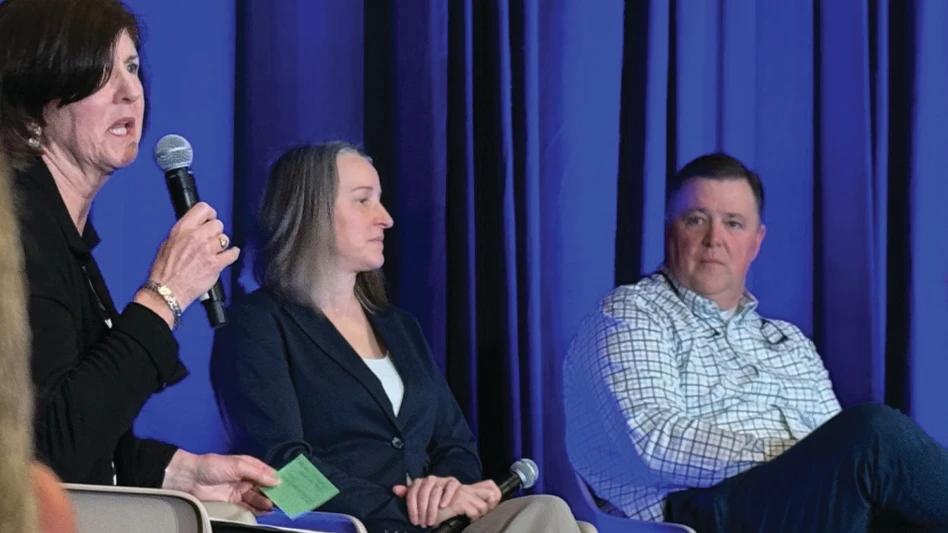
But just when do scrap prices affect steel mill profitability? James F. King of Spoutwell House, Corbridge, U.K., tried to find the answer to that question and presented his findings to attendees of the Ferrous Spotlight session at the Annual Convention of the Institute of Scrap Recycling Industries Inc. (ISRI) in April.
King found that scrap prices tend to closely track finished steel prices, but acknowledged that there is a chicken-or-egg quandary as to where the cause and effect lies.
Using hot-rolled coils as a benchmark, King determined that “the prices of steel scrap and hot-rolled coil follow each other,” as well as finding that hot-rolled coil and other major steel products move together in price.
With scrap prices almost always moving upward first, the two commodities follow each other in a range that in recent times is at a three-to-one price ratio. That is, if ferrous scrap is roughly $100 per ton, than hot-rolled coil will sell for $300.
The next question that rises is at what point do high U.S. scrap prices begin making domestically made electric arc furnace (EAF) steel non-competitive with imports.
King concluded that scrap prices need only reach $88 per ton before overseas integrated mills (with their low labor and overhead costs) can begin to sell steel at less than U.S.-based EAF mills.
“Without import tariffs, a scrap price of under $90 per metric ton is needed for U.S. EAF steelmakers to compete with low-cost overhead producers,” stated King.
Although EAF steelmakers can turn to alternative iron units to keep their prices down, even these commodities cannot consistently be found for $88 per ton. “At scrap prices above $100 per metric ton, existing capacity for merchant pig iron and HBI (hot briquetted iron) in low-cost countries will take business from the U.S. scrap trade,” King nonetheless concluded.Latest from Recycling Today
- Vecoplan to present modular solutions at IFAT 2026
- Terex Ecotec appoints Bradley Equipment as Texas distributor
- Greenwave raises revenue but loses money in Q2 2025
- Recycled steel prices hold steady
- EY says India’s need for scrap imports will continue
- Coming full circle
- Amcor, DCM introduce fertilizer packaging with 35 percent recycled content
- Comstock Metals gets closer to commissioning commercial-scale solar panel recycling facility