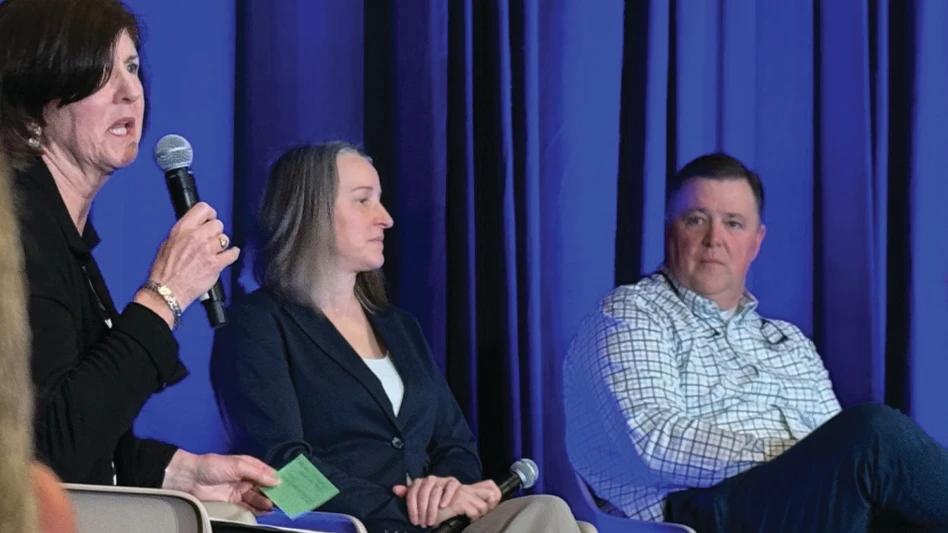
During the ISRI National Convention, a standing room only crowd heard three speakers discuss various aspects of the scrap copper market.
The sentiment from the three speakers: Stan Shanker, Warrenton Copper; Leanne Baker, North Investor Resource Ltd.; and Robert Stein, Alter Trading, all discussed various aspects of the copper market.
|
|

Shanker, addressing the audience from the perspective of a consumer of scrap copper, spent a significant amount of time covering how the company was closed and then reopened under new owners.
With the reopening of the plant, after being purchased by the owners and operators of American Iron and Metal, Montreal, as well as the changing dynamics of the marketplace, the reopened smelter had to adjust its raw material intake.
Shanker pointed out that in the past the company took in high grades of copper. However, with less domestic manufacturing and more copper scrap being shipped overseas Shanker noted that the company has had to adjust its product mix.
“As recently as 2003 Warrenton Copper’s scrap mix remained as it was for the previous 20 years; a steady diet of bare copper chops, enamel copper wire, and Warrenton grade #2 copper.”
However, due to the changing marketplace, the company is having to take in more “birch/cliff” copper, which is of lower quality.
In closing his presentation, Shanker stressed the importance of coming up with a consistent grade standard. By eliminating ambiguous language “it is my belief that by clearly identifying acceptable definitions of scrap it will bring greater dollars to the supplier and lower operating costs to the consumer.”
In her presentation, Baker highlighted the past year, calling the copper market “A Raging Bull Market.” Prices reached 16-year highs, while a supply deficit only widened throughout the year, with inventories near an all time low. Adding fuel to the upside, “China’s official policy reverts to growth after some slowing in 2004,” Baker adds.
As upbeat as the past year has been, Baker was quick to point out that there are signals that a top might be at hand. Some of the factors that are moving Baker into a more cautious mode are the following:
Mines are re-starting;
Copper suppliers are more plentiful;
Merchant and producer premiums are down from their highs;
Inventory declines are nearing an end; and
There may be a slowdown in demand from both the United States and Europe, which may balance out the strong demand from China.
While these potential negatives cast a bit of a dark cloud on the scrap copper market, Baker sess three potential scenarios taking place: a commodity “super cycle” where the industry sees years of above-average pricing; a conventional cycle with pricing falling to below $1 per pound; and, most ominously, the end of a global credit bubble, which could lead to a prolonged period of depressed demand and pricing.
For each of the potential trends that may develop Baker laid out evidence. For the super cycle period she pointed out that during most of the 1990’s, the lack of new exploration projects is reducing the opportunities for existing mines to meet demands. Inventories are low, and China is expected to continue its strong buying patterns.
For a more conventional cycle, along with the lack of new developments, many of the new projects are large, high cost, low grade operations; and a spike in energy prices, as well as softer dollar, will keep a higher floor on scrap copper.
Finally, the most worrisome scenario is the confluence of a massive U.S. trade imbalance, a mortgage bubble that bursts, high debt levels, and the growing clout of hedge funds and derivatives add to a sharp decline in copper markets.
In concluding her presentation, Baker forecasts that the scrap copper prices that is averaging around $1.40 per pound this year, will dip to around $1.20 per pound next year; and around the $1.00 mark by 2007.
In his presentation, Robert Stein, vice president of Nonferrous Trading for Alter Trading, took the opportunity to discuss some issues that have been playing a key role in the scrap copper market. While starting off by pointing out that 2004 was a dynamic year for the scrap copper industry, he also said that many contentious issues also cropped up last year.
Stein called last year “the beginning of a long, troublesome relationship. We are on a collision course. Both sides (consumers and processors) are failing to meet the other side’s expectations.”
He also characterized last year as a time of “scrutiny,” including two domestic industry groups filing a petition to restrict the export of scrap; the development of China’s AQSIQ policy, which aimed to regulate who and what could be shipped to China; and the European metals industry also filing a petition with the EU over scrap exports from the EU.
A cornerstone of Stein’s presentation was the growing contentious attitude on the domestic side between the processors and the consumers of scrap copper. Acknowledging the importance of maintaining and working with domestic consumers was an important issue, because, as he put it, “Without them we lose the home court advantage.”
While seeking to help domestic consumers, Stein added that the two sides are on a collision course that is “sourced in the economic realities of the day.”
“Every impediment on the ease of delivering copper or brass scrap to an American consumer costs somebody something to implement, and that something isn’t getting any cheaper. Regardless of who bears the costs, if our scrap can’t be economically prepared, shipped and used in the United States for whatever reason, it’s going elsewhere.”
Getting to the heart of his presentation, Stein added that while the industry has been able to improve and innovate to meet the increased quality expectations for consumers. However, “the copper and brass strip, rod and tubing manufacturers will in the future find it more difficult to source adequate supplies of scrap at prices they deem viable.”
As this evolves, “Our ability to succeed economically and still be able to sell our scrap to the domestic consuming industry will be a challenge.”
Entering into this mix, China continues to grow as an important market for scrap copper and scrap brass. While bringing in more raw material to feed its growing demands, the introduction of AQSIQ is a step to improve the accountability of shipments.
As for the attempts by the Copper and Brass Fabricators Council to halt the export of scrap copper, Stein pointed out that “The primary producers in this country almost universally gave up using scrap a long time ago, and the secondary copper producers couldn’t justify the expense of production in relation to received value.
“It goes back to simple economics, and we are all bound by the economic realities in which we live.”
Latest from Recycling Today
- Greenwave raises revenue but loses money in Q2 2025
- Recycled steel prices hold steady
- EY says India’s need for scrap imports will continue
- Coming full circle
- Amcor, DCM introduce fertilizer packaging with 35 percent recycled content
- Comstock Metals gets closer to commissioning commercial-scale solar panel recycling facility
- Washington selects Circular Action Alliance as PRO
- Smurfit Westrock expands in Latin America