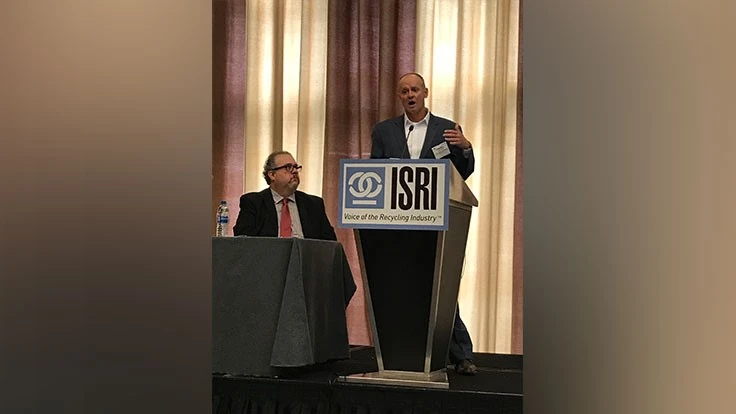
Copper is suffering from a lack of confidence, said Darrel Fletcher, senior managing director of commodities at Huntington Bank, Columbus, Ohio. Fletcher was part of the panel assembled for the Copper Roundtable at the 2019 Commodities Roundtable Forum, which the Washington-based Institute of Scrap Recycling Industries (ISRI) hosted Sept. 11-13 at the Hyatt Regency in downtown Chicago. Despite this, he was optimistic about the metal going forward, as were the other panelists who joined him on the deas.
He pointed to volatility in copper pricing on the London Metal Exchange (LME) and COMEX that has been seen over the course of the last year, fueled in part by the trade war between the U.S. and China. “Today has been no exception,” Fletcher said, noting the $2 swing in crude oil and the COMEX copper price swinging by 6 or 7 cents as of the late morning of Sept. 12.
Influencing that volatility has been the trade war, the Chinese devaluation of the yuan, which Fletcher said was up for debate, and the slowing of China’s and some other emerging countries’ economies. While the U.S. economy remains strong, he added, it lacks confidence.
“The interesting thing is that forward curves are relatively flat,” Fletcher said of copper on the LME. “And copper forward curves are historically pretty flat.” This means supply and demand are pretty well matched, he said, adding, “it’s just that we happen to be at a pretty low end right now.”
The other panelists, which included a scrap processor and a scrap consumer, also were optimistic about copper looking forward.
Pat Boyle, vice president and director of purchasing at brass and bronze ingot maker H. Kramer & Co., Chicago, said, “I think copper is doing OK, even though it is at a lowish range.” His company has been able to get all the copper and all the brass scrap it wants, he said. “That hasn’t always been the case, but we’ll see what happens.”
Regarding pricing, Boyle said, “Copper at this level is sustainable, and we enjoy the relative lowness of it.”
LeAnne Johnson, the Atlanta-area-based nonferrous sales director for Cleveland-based PSC Metals, said she believed the copper scrap industry to be “very healthy” and an “excellent industry to be in,” despite having seen “more downs than we have ups.”
Moderator Randy Goodman of scrap brokerage company Greenland (America) Inc., Atlanta, asked the panelists about the health of No. 2 copper scrap domestically.
“There’s an abundance of all grades of copper,” Boyle said, adding that his company is not a large consumer of No. 2.
“You can buy all you want to, but you can’t sell all you want to,” Johnson said. This means scrap processors have to put a cap on buying at some point, she added.
Johnson and Boyle agreed that the U.S. market was oversupplied with scrap. “I can turn off my phone and buy scrap,” Boyle said.
“I can lay on the beach and buy scrap,” Johnson added.
Johnson said PSC has sold its copper scrap to domestic outlets primarily, but international trade, or the lack thereof, affects the company because of the abundance of scrap available domestically.
Regarding the prospect of increased domestic consumption of copper scrap, she said, “I don’t see it.”
Boyle didn’t believe this was likely, either, saying the cost of entry is too high. “It’s not feasible between the actual cost and the cost that has to be given to the EPA (Environmental Protection Agency) and other regulatory agencies.”
Goodman said increased investment appears to be restricted to the scrap processing side of the business, with companies installing wire chopping lines to process insulated copper wire.
Johnson said that while PSC has spent a lot of money in the last year on downstream systems to extract more value from the metals its processes and to landfill less, the company has not invested in wire chopping lines because it is uncertain whether this material has a market given the oversupply.
“We hardly buy any choppings at all, but yet there are new chopping lines coming online day after day,” Boyle said. “There’s going to be an excess; there’s an excess now. But I think people want to be in control of their own destiny and know what the market is for their material.”
Latest from Recycling Today
- Interchange 360 to operate alternative collection program under Washington’s RRA
- Waste Pro files brief supporting pause of FMCSA CDL eligibility rule
- Kuraray America receives APR design recognition for EVOH barrier resin
- Tire Industry Project publishes end-of-life tire management guide
- Des Moines project utilizes recycled wind turbine blades
- Charter Next Generation joins US Flexible Film Initiative
- Vecoplan to present modular solutions at IFAT 2026
- Terex Ecotec appoints Bradley Equipment as Texas distributor