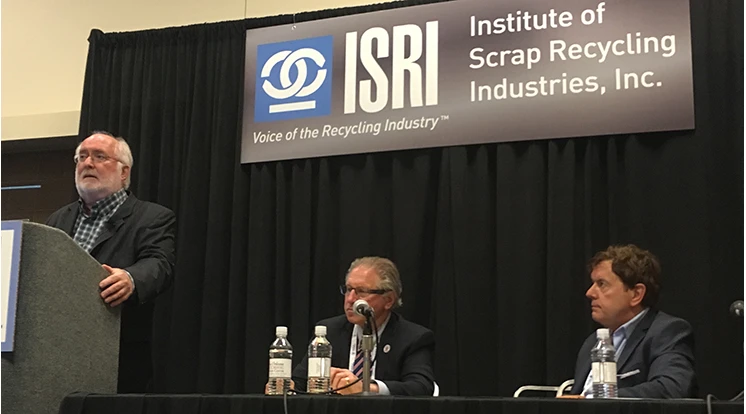
Pictured above, left to right: Robert Hunter, formerly with Midrex Technologies, David Borsuk of Sadoff Iron & Metal, and Chris Plummer of Metal Strategies Inc.
Electric arc furnace (EAF) steel mills have gained as much market share in the United States as nearly anywhere else in the world, but both in the U.S. and globally they may not dig much deeper into the market share of their counterpart basic oxygen furnace (BOF) mills. That was one of several suggestions offered during a session on the future of EAF steelmaking at ISRI2017, the annual convention of the Washington-based Institute of Scrap Recycling Industries Inc. (ISRI).
Robert Hunter, a recently retired 40-year veteran executive with Charlotte, North Carolina-based direct reduced iron (DRI) maker Midrex Technologies, said the changes to BOF steelmaking in the United States in the past 150 years have been staggering.
From a peak of some 600 blast furnace operations in the Civil War era, the number of BOF plants operating in the U.S. got as low as nine during the 2009 recession.
Hunter said 15 are operating in 2017, but “they tend to be the best, and the ones best located.”
Globally, a major factor in future BOF versus EAF market share will concern China, said Hunter, where half of the world’s steel is currently made. That nation currently makes just 6 percent of its steel via the EAF process, a number that could well rise as China begins to generate more of its own ferrous scrap.
Regarding a feared “hyper-tsunami” of ferrous scrap leaving China for the U.S. and other parts of the world, Hunter said he does not foresee that, although as China’s ferrous scrap collection rises, the global market could “be in pretty deep water for a long time.”
Hunter said much of the steel made in China the past 15 years has either left the country in exported products or is embedded in infrastructure projects that will be in place for a long time. He noted, however, that China’s generation of end-of-life vehicles (ELVs) is poised to rise significantly.
Regarding its future ferrous scrap consumption, Hunted said China’s BOF mills can consume up to 100 million tons of ferrous scrap annually if they increase their scrap charge to 20 percent. More EAFs could come online in those parts of China that have abundant and affordable electricity supplies, but such locations are minimal.
Chris Plummer, managing director of Pennsylvania-based consulting firm Metal Strategies Inc., said Turkey, India and North America are the largest scrap-intensive steelmakers by market share, but China also is a large ferrous scrap consumer for two reasons: because of its overall scale and because of “unreported” tons of steel made by smaller, scrap-fed induction furnace shops.
The financial crisis that started in 2008 has meant that overall EAF steel output in the U.S. has peaked in 2007, pending a healthier year in the future. In China, the scrap-fed induction mills are being threatened with closure by a central government anti-pollution effort.
Plummer pointed to a recent comment from Mark Millett of Indiana-based steelmaker Steel Dynamics Inc. (SDI), who said the gap has narrowed on some of the cost advantages once enjoyed by the EAF sector versus its BOF counterpart.
Plummer added that the major capital investment into new technologies at Arkansas-based Big River Steel may boost the EAF sector in the U.S. Many of the other large EAF mills in the U.S., he said, “are now 25 years old; there is only so much you can do to upgrade these facilities.”
ISRI2017 was in at the Ernest N. Morial Convention Center in New Orleans April 22-27, 2017.
Latest from Recycling Today
- Ocean freight interruptions poised to continue
- Danieli to supply shredder to Australian company
- Equipment from the former Alton Steel to be auctioned
- Novelis resumes operations in Greensboro, Georgia
- Interchange 360 to operate alternative collection program under Washington’s RRA
- Waste Pro files brief supporting pause of FMCSA CDL eligibility rule
- Kuraray America receives APR design recognition for EVOH barrier resin
- Tire Industry Project publishes end-of-life tire management guide