Photo courtesy of the University of Birmingham
The University of Birmingham in England has begun to operate a facility for separating and recycling rare earth magnets it says will help to reduce the United Kingdom’s reliance on imports of rare earth elements (REEs), alloys and magnets.
Rare earth magnets have been identified by numerous governments as a critical mineral since they form a core building block in technologies such as wind turbines, electric vehicles, medical equipment, pumps, robotics and electronics.
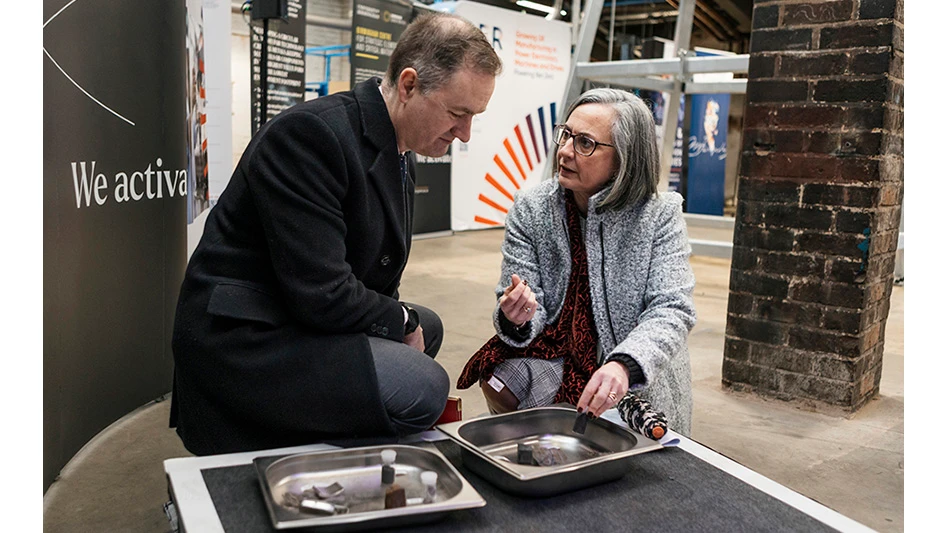
A press event featuring a visit from Chris McDonald, the U.K.’s Minister for Industry in the Department for Energy Security and Net Zero and the Department for Business and Trade, was held at the magnet recycling facility, which the university says uses a groundbreaking hydrogen-based process developed by researchers there.
“Hydrogen processing of magnet scrap (HPMS) technology is an extremely efficient method to extract rare earth magnets from end-of-life products without the need to fully disassemble them,” the university says.
Researchers at the University of Birmingham say HPMS can convert discarded materials into a sustainable source of rare earths that can be used to manufacture new metals, alloys and magnets while reducing supply chain risk.
“This new facility is great news [that] will help create hundreds of well-paid local jobs and is testament to our world-leading expertise in rare earth recycling,” McDonald said.
“This is our Critical Minerals Strategy in action, bringing sintered magnet manufacturing back to the U.K. for the first time in 25 years and backing innovative projects to boost our critical minerals supply chains and power the green industries of the future."
The facility at Tyseley Energy Park in Birmingham scales the HPMS process to commercial production levels, according to the university.
Its previous proof of concept facility handled smaller batches of material while the new plant can recover more than 400 kilograms (kg, or 881 pounds) of rare earth alloy per batch. In a full year, the new plant can produce from 100 to 300 metric tons of recycled-content sintered magnets per year, depending on how many shifts it operates.
According to the university, the plant will recycle end-of-life items including hard drives, electric motors, wind turbines, robotic actuators, pumps, filters and other electronics.
Recycling technologies developed by the Magnetic Materials Group at the University of Birmingham have been exclusively licensed to Birmingham-based Hypromag Ltd., which is now 100 percent owned by Canada-based Maginito Ltd, a subsidiary of publicly traded Mkango Resources, which also is based in Canada.
”This is a landmark achievement and transformational for rare earth supply chains, bringing back magnet manufacturing to the U.K. after more than 20 years and underpinned by a home-grown technology, HPMS, that not only delivers a cost advantage, but one with a minimal carbon footprint,” says William Dawes, chief executive of Mkango and a director of HyProMag.
Dawes says the university’s research provides a strong platform for further scale up in the U.K. and international roll-out, already underway in Germany, the United States and other countries.
Latest from Recycling Today
- Copper analyst Gross: Have expectations exceeded reality?
- Stainless steel output rises in 2025
- 7 Steel seeks policy support
- DOWA: Center of catalytic converter recycling
- Ocean Legacy Foundation expands plastic testing laboratory services
- CMI, HCPA publish aerosol recycling guide for MRFs
- 2026 Plastics Recycling Conference: A look at PCR contracts
- Remade Institute hosts Circular Economy Tech Summit & Conference in March