While some forecasts indicate a modest improvement in nickel/stainless markets, others caution that the coast is not clear yet.
Vanessa Davidson, research manager special steel and alloys division, CRU International, London, estimated a 5 percent growth in stainless demand in the second half of 2002 and a 9 percent increase in output for 2003. She said it is likely that a 5 percent trend rate of growth will run until the middle of the decade, with Europe providing the main focus for melting capacity growth followed by China.
Phillip Rosenberg, executive vice president of Keywell LLC, Chicago, cautioned that nickel markets remain unstable because of consolidations, liquidations, trade tariffs and start-ups. He recommended concentrating on a primary market while maintaining awareness of the other markets.
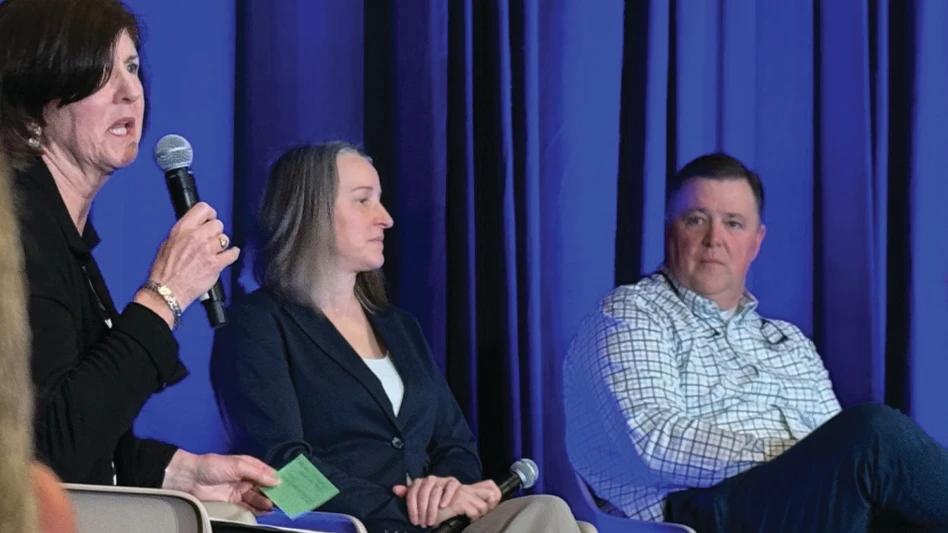
Davidson and Rosenberg addressed attendees of the Spotlight on Nickel/Stainless at the Institute of Recycling Industries Inc. (ISRI) Annual Convention in Las Vegas.
Davidson said that U.S. macroeconomic recovery is important to the market as a whole. While signs appear to be encouraging, she warned against the prospect of a “double dip,” in which the market pulls itself up only to drop again.
She said that nickel prices fell sharply from 2000 levels, though not as low as in earlier downturns because of the limited stock.
Davidson added that the last 13 out of 14 months saw a decline in stainless melted production, with the exception of China, whose melt rates increased by 20 percent.
Scrap currently provides 50 percent of the nickel used in stainless production, Davidson said, though its availability is volatile. She estimated that primary nickel ratios would rise in the future as Russian scrap exports stabilize.
In Rosenberg’s assessment, specialty steels will be promoted over commodity grades and U.S. mills can and will be low cost producers.
“Lack of action can be painful, if not fatal,” he said.
Latest from Recycling Today
- Greenwave raises revenue but loses money in Q2 2025
- Recycled steel prices hold steady
- EY says India’s need for scrap imports will continue
- Coming full circle
- Amcor, DCM introduce fertilizer packaging with 35 percent recycled content
- Comstock Metals gets closer to commissioning commercial-scale solar panel recycling facility
- Washington selects Circular Action Alliance as PRO
- Smurfit Westrock expands in Latin America