Photo by DeAnne Toto.
José Cayuela Avilés founded Grupo Ferromolins, which is headquartered in Barcelona, Spain, in 1988 after more than 40 years of experience in the metals recycling sector. Under his leadership, Ferromolins prioritized continual improvement and innovation. That tradition continues today at the family-owned company under the leadership of his daughter, Lidia Cayuela Lopez, who serves as president.
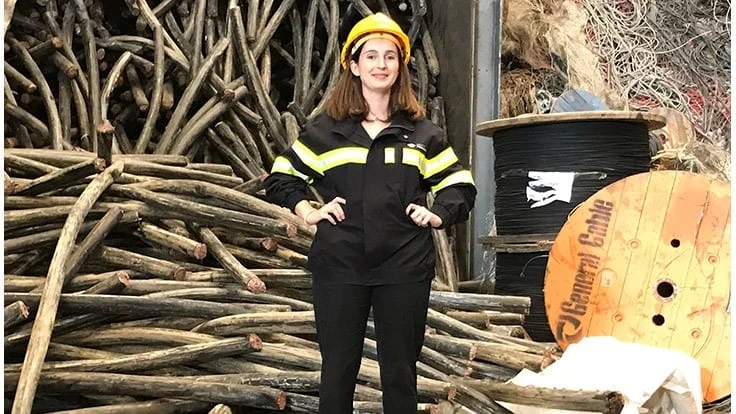
Natalia Cruz Cayuela, Lidia’s daughter and José’s granddaughter, is the third generation of the family to work in the business. She joined Ferromolins two years ago and serves as purchasing and sales manager for ferrous and nonferrous metals.
Natalia says she grew up in the family business but sought additional education and experience outside Ferromolins before officially joining the company, helping to lead Ferromolins into its next decade. “I studied business administration, learning different languages and working in several companies, always in the international sales area, before joining Ferromolins.”
In her experience outside the company, Natalia says she learned that a good team is essential to a company’s success. “And that’s what I found when I joined the company.”
In addition to a well-established team, Natalia inherited her grandfather’s relationship-focused approach to business. “My grandfather used to say, ‘We want to build solid, long-lasting relationships with our customers.’”
Natalia also says Ferromolins is not afraid of failure, adding that the company understands failure ultimately can lead to success, particularly today, when the pace of change necessitates quickly responding to suppliers’ and consumers’ new and evolving needs. “It’s important to fail often so that you can succeed sooner,” she says. While it is important for Ferromolins to be strategic in its new endeavors, she says the company learns from its mistakes, which makes it “sustainable and flexible.”
Modern methods
Ferromolins has modernized along with the larger scrap industry over the last three decades and considers itself a pioneering company within Spain’s ferrous and nonferrous recycling sector, Natalia says. Its recovery and recycling plants are equipped with modern infrastructure and next-generation technology to manage large volumes of material quickly.

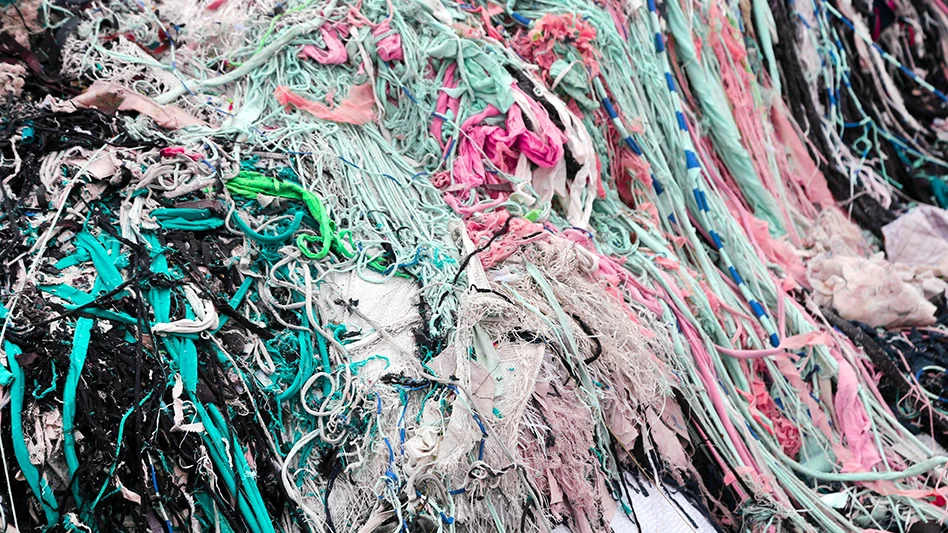
The company operates six facilities. Its Barcelona headquarters focuses on processing aluminum and copper wires and cables. “We have three production lines working 24 hours per day with an average production of 1,200 metric tons per month of granules,” Natalia says.
Ferromolins’ other processing facilities are in Seville, Castellbisbal and Zaragoza, Spain. The company also operates logistical centers in Mallorca, Spain, and on the Canary Islands, a Spanish archipelago off the coast of northwestern Africa.
It offers logistical services throughout Spain, the south of France and Portugal, Natalia says.
Wire processing accounts for roughly 90 percent of Ferromolins’ business. Its other services include dismantling and recycling of transformers, condensers and electrical switches at its plant in Seville; ferrous and nonferrous scrap processing; and integrated management for scrapping and decommissioning of industrial plants, thermal power and hydropower plants, electricity substations and other industrial facilities throughout Spain and across Europe.
Ferromolins’ Seville location serves southern Spain and Portugal. “Besides ferrous and metal transformation, we have there located the PCB (polychlorinated biphenyl) decontamination plant for electric devices,” Natalia says. “This process is unique and offered to the main electric distribution companies in south Europe.”
The Seville location employs a proprietary technology that Ferromolins developed to handle the PCBs in the transformer oil.
All the company’s processing facilities are equipped with the shearing, packing and material handling equipment to handle ferrous and nonferrous scrap, Natalia says.
“At the end of the process, a quality laboratory ensures the grades of all the products coming out of our six yards,” she says.
The company says its commitment to the environment leads it to heavily invest in research and development. Ferromolins also has created an integrated quality, environmental and health and safety management system and has obtained ISO 45001, ISO 14001 and ISO 9001 registrations. It also complies with End of Waste criteria under EU333 (for iron, steel and aluminum scrap) and EU715 (for copper scrap), Natalia says. End-of-waste criteria specify when certain waste materials cease to be waste and become a product or a secondary raw material.
A selective buyer
Natalia says Ferromolins is “focused on quality,” adding that 95 percent of the copper and aluminum chops the company produces are considered “1A grade.” She explains, “To reach that goal, we are only sourcing directly from industrial rejects.”
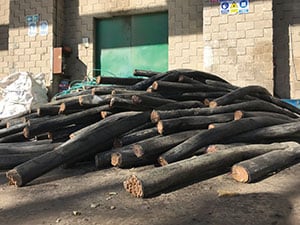
High quality is the company’s overall goal for all the products it produces. “For Ferromolins, quality is a must,” Natalia says. “It is the only way to be in the market.”
She adds that all the company’s 80 employees are trained to understand they each have roles to play in ensuring the quality of the products Ferromolins produces.
The company sources scrap globally, though Natalia says the quality of the incoming material is more important than the country of origin. That being said, she adds, “[The] U.S. market is nowadays very important for us in the sourcing side.”
Ferromolins’ prepared scrap is sold globally, Natalia says, though “a great part of our sales is Europe based.”
Marketing material
Despite the quality of the products Ferromolins produces, movement and pricing have been challenged given China’s restrictions on scrap imports and their effect on global trade, Natalia says. “There is strong stress on copper prices because of [the] global market situation, and secondary aluminum is also very affected locally because of low demand [from] the local automotive industry.”
She continues, “From my point of view, final consumers of recycled materials demand more and more homogeneous and high-grade qualities,” which means the recycling industry must make investments to meet those requirements. However, she adds, “Secondary materials are essential to industry’s survival.”
Natalia says, “Now are confusing times for volume forecasts and pricing.”
That already confusing situation has been further affected by the novel coronavirus pandemic, which has disrupted industrial supply chains. Prior to the outbreak, demand in Europe was low, she says, and the pandemic has the potential to worsen the situation as European carmakers temporarily cease production in response to the global health crisis.
CNN reports that three of Europe’s largest automakers, Fiat Chrysler, PSA Group and Renault, are closing manufacturing plants across the region. Even before those announcements, the auto sector in the region had been heading for a third consecutive year of falling sales.
Among the three companies, 35 manufacturing facilities across Europe will be closed in response to regional and national authorities’ imposition of restrictions on travel and public life, CNN says.
The overall effect on Ferromolins and the scrap processing sector at large has been a tightening of margins. Natalia says the company is responding the only way it knows how, by focusing on quality and productivity. “We are very confident in the future on that side since our plan for company growth is very organic and adjusted to the present situation. We have built a very professional team that assures the viability of our product based on technology, skills and service.”
Latest from Recycling Today
- U.S. Aluminum Co. explores aluminum fabrication plant in Oklahoma
- Sonoco completes portfolio transformation
- Eriez Shred1 data demonstrates scalable copper control
- RCI selects CurbWaste as exclusive operational management platform
- Updated: Supreme Court strikes down IEEPA tariffs
- Recycling Today Media Group launches Scrap Expo Lunch & Learn Webinar Series
- LyondellBasell scales back recycling target
- Former Liberty UK mills eyed by 3 suitors