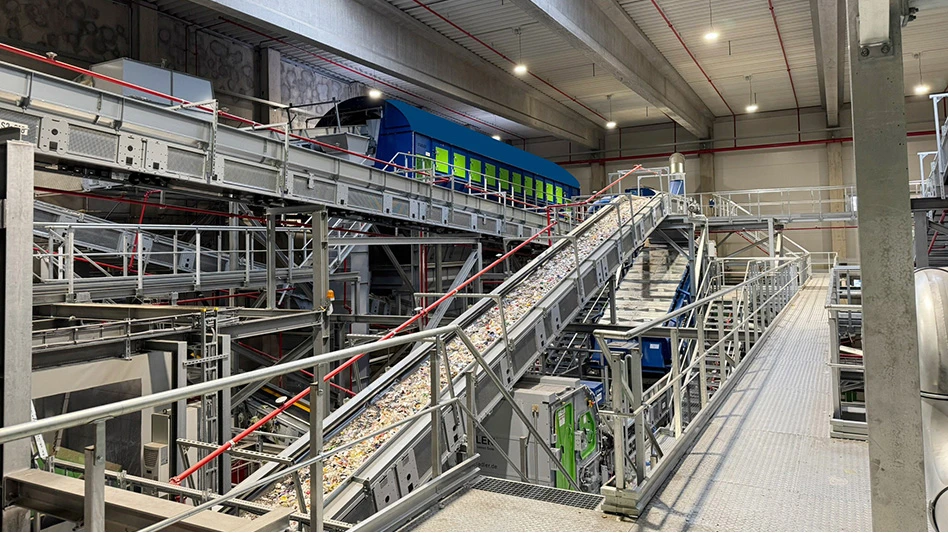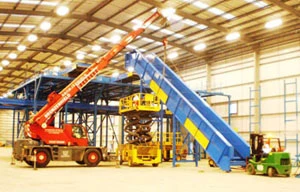
Greenstar UK, based in Aylesbury, England, has announced that equipment installation has started at its Greenstar Atlas materials recovery facility (MRF) in London. The company notes that the first of more than 70 shipping containers from CP Manufacturing, a California-based equipment firm, has arrived at the site. An additional 30 consignments of push walls were delivered early last month, together with six containers of steelwork.
The facility has been licensed to process up to 250,000 metric tons of recyclables per year, as well as to handle a further 250,000 metric tons through its waste transfer station each year, the company says.
 The facility is expected to be complete and operational by this spring, according to Ian Wakelin, Greenstar UK’s CEO. “The high speed processing capacity and output quality for Atlas will be strategically important for Greenstar and for local authorities in the capital and the southeast,” Wakelin says.
More than 1,600 metric tons of steelwork and processing equipment will be assembled by CP and contractor Ebbsfleet Engineering. When complete, Greenstar Atlas will be one of the largest and most modern MRFs in Europe, according to the company.
The three phase project comprises now-completed civil engineering work to ready the building for installation, plant installation during January and February, and then ‘dry’ commissioning and test processing in March prior to full operation in April.
The first phase consisted of contractor Volkes Fitzpatrick completing pits for conveyor and baler machinery, creating a larger vehicle yard, build office accommodation, construct a weighbridge, installing a sprinkler system and connecting the site’s power supply and other utilities.
Neil Arlett, Greenstar UK’s engineering manager, spent time with the CP design team in San Diego, working with them to customize the base Atlas design. “We added design modifications for a more linear configuration to improve access for maintenance,” says Arlett. “Any one part of Atlas can be shut down for maintenance or repair without affecting the continuing operation of other parts of the plant.” 
Arlett adds that CP Manufacturing was chosen for the $14 million order because of its advanced technology, track record, and willingness to design equipment innovations to meet Greenstar’s quality processing requirements.
According to Greenstar UK, some of the equipment innovations include: improving screen drives for the paper processing line, which included the use of a toothed rubber belt, rather than sprocket and chain, and also integrating the glass processing unit into the overall plant. Additional optical sorting technology can be installed to cater for a broader range of recyclables such as foil and plastic film, while a higher number of separators will improve both recovery and quality, the company says.
Plant supervisors will carry wireless touch screen controllers that will let them directly control every part of the plant as they walk around the site, Greenstar UK adds.
Latest from Recycling Today
- U.S. Aluminum Co. explores aluminum fabrication plant in Oklahoma
- Sonoco completes portfolio transformation
- Eriez Shred1 data demonstrates scalable copper control
- RCI selects CurbWaste as exclusive operational management platform
- Updated: Supreme Court strikes down IEEPA tariffs
- Recycling Today Media Group launches Scrap Expo Lunch & Learn Webinar Series
- LyondellBasell scales back recycling target
- Former Liberty UK mills eyed by 3 suitors