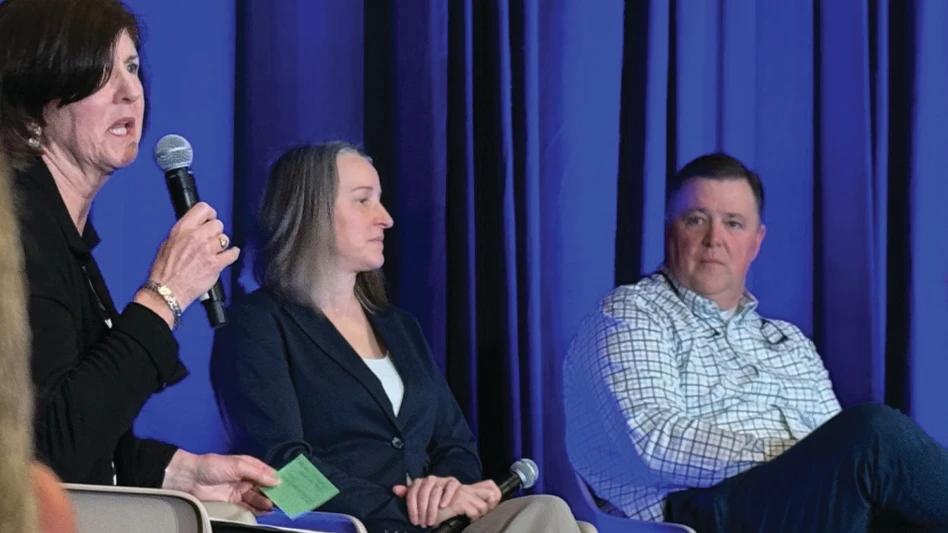
Panelists addressing attendees of the session “Electronics Recycler Health & Safety Issues” presented information on health issues associated with recovering the metals from electronic scrap; occupational risks related to electronics demanufacturing and CRT glass processing; and viability of recycling CRT glass into lead.
Theo Lehner of Ronnskar Smelter, Boliden Mineral AB, Skelleftehamn, Sweden, began his presentation on profitable and safe recovery of metals from electronic equipment by stressing that the toxicity of the metals recovered from electronic scrap must be respected and that employee safety cannot be ignored. He added, “The U.S. is three years behind Europe in the legislative mechanism and can learn and benefit from our mistakes.”
The Ronnskar Smelter recycles more than 30,000 gross tons of electronic scrap yearly.
Lehner suggested that treatment charges can help to offset the additional costs associated with using electronic scrap as smelter feed. Some of the constituent materials of electronics, such as plastics, generate excess heat in the oxidative metallurgical process, adding to the cost of the smelter’s operation. To mitigate these costs, Lehner said Bilden uses contracts that stipulate penalties, treatment charges, typical compositions, prohibited substances, such as medical contamination, and restricted substances, such as beryllium and mercury.
He added, “Smelters are not afraid of poison, but they treat them with respect. Old sayings are still true: Control the dust, and you contain the problems.”
Gas cleaning units have also been used to keep dioxin emissions well below European limits, he said. “You may have problems with dioxins,” Lehner said, “but you do not need to have [them].”
Lehner was encouraging regarding the health and safety risks associated with the processing of these materials. As evidence of this, he presented numerous charts detailing substance types and their acceptable limits, levels of lead in the blood of the lead smelter crew at the Skelleftehamn facility, dioxin deposits and the annual emissions of brominated flame retardants in the area surrounding the facility.
“Electronics can and are recyclable on a large scale without health problems,” he said.
Neil Peters-Michaud of Cascade Asset Management LCC, Madison, Wisc., presented information on occupational health and safety protocols, emphasizing the impact of operational and training improvements to mitigate exposure to potentially harmful airborne contaminants.
Cascades has been recycling electronics equipment since 1999, having processing more than 4.5 million pounds of electronics for reuse or recycling.
Peters-Michaud explained that while Cascades had previously developed a safety procedure handbook and training program, the company wanted to monitor hazardous material exposure on its shredding line and in its CRT processing facility in order to implement mitigation programs.
The testing in the CRT processing facility measured for levels of cadmium and lead, as well as heavy metals, such as calcium, barium and iron, and particulates.
Levels of particulate matter were also measured at the shredding area, Peters-Michaud said.
Shredding operations began at Cascades in November 2002. The shredder produces a plastic fraction between 4-inches and 6-inches long by 2-inches wide. “One reason for configuring the shredder to produce such a rough fraction was to minimize any dust and resulting particulate matter that would carry hazardous constituents through the work environment,” Peters-Michaud said.
Cascades worked with an environmental and safety consulting firm and the Wisconsin OSHA Consultation program (www.osha.gov/oshdir/consult.html) that took personal and ambient air sampling as well as surface wipe tests in the areas surrounding the shredder and at the CRT processing facility.
Results at the CRT processing facility revealed that both lead and cadmium at were below the OSHA PEL standards. Wipe tests at the facility revealed that the area behind the CRT cutter and the CRT prep table had elevated levels of lead based on HUD standards. Peters-Michaud said these levels were likely from spillage of water contained suspended fines from the holding tank of recycled water used to cool the CRT cutting blade. The tests at the CRT processing facility also determined that lead migrated from the processing area into the break room and washroom.
At the shredder, tests revealed that total particulate matter and heavy metal concentrations were below OSHA’s allowable levels. “One explanation for the low reading,” he said, “is that the shred size is too large to generate much dust in the shredding process. Another is that the operators are located several feet from the shredding point.”
As a result of the testing, Cascade worked with the OSHA Consultation program to reduce detected contamination and implement procedures to reduce further contamination, Peters-Michaud reported. Actions include using a wet method to clean spills and tables; prohibiting eating, drinking and smoking at workstations; and the implementation of a regular cleaning schedule.
David Weitzman of RRT Design & Construction, Melville, N.Y., presented his thoughts on the health and environmental safety of CRT glass-to-lead recycling.
“The amount of CRT glass that can potentially be recycling will grow to over 1,100,000 tons in 2006. Only 45,000 tons was recycled into new CRT glass in 2000. The amount of CRT glass that can be consumed by CRT manufacturers in the United States will grow to only 161,000 tons per year and is not projected to increase. A gap exists that may be filled by glass-to-lead recycling,” he said.
Both primary and secondary lead smelters can use CRT glass as a silica substitute, Weitzman said.
According to proposed EPA Rule 40 CFR Part 260, CRTs and CRT glass will be excluded from the definition of solid and hazardous waste and will make no regulatory distinction between glass-to-glass and glass-to-lead CRT recycling, he added.
If accepted, this rule will remove the permitting requirements and costs associated with the handling, processing and shipping of these items.
While the CRT glass returned to the CRT manufacturing process has a higher value than the glass that goes into lead smelting, Weitzman pointed out that there is a considerable gap between the demand within this sector and the supply of CRT glass available; therefore, glass-to-lead recycling is needed to help absorb this supply. However, even with both markets, the gap between supply and demand will persist due to the limited number of smelters and CRT manufacturers within the U.S. and their skewed regional distribution.
Weitzman presented a list of the potential pros and cons of glass-to-lead recycling. Among the cons are the high capital costs and the negative value of the glass delivered to the lead smelter. However, processing costs are low, he said.
“Automated glass-to-lead recycling may present certain health and safety advantages over labor-rich glass-to-glass recycling,” Weitzman said. “The history of recycling, as it evolves in each industry segment, shows a bias over time towards bulk automated processing as the preferred, safest and most cost effective method.”
The 2003 Going Green International Congress & Exhibition was held in Boston May 19-22. The show is a combination of the IEEE (Institute of Electrical and Electronics Engineers) International Symposium on Electronics and the Environment and the IAER (International Association of Electronics Recyclers) Electronics Recycling Summit.
Latest from Recycling Today
- Charter Next Generation joins US Flexible Film Initiative
- Vecoplan to present modular solutions at IFAT 2026
- Terex Ecotec appoints Bradley Equipment as Texas distributor
- Greenwave raises revenue but loses money in Q2 2025
- Recycled steel prices hold steady
- EY says India’s need for scrap imports will continue
- Coming full circle
- Amcor, DCM introduce fertilizer packaging with 35 percent recycled content