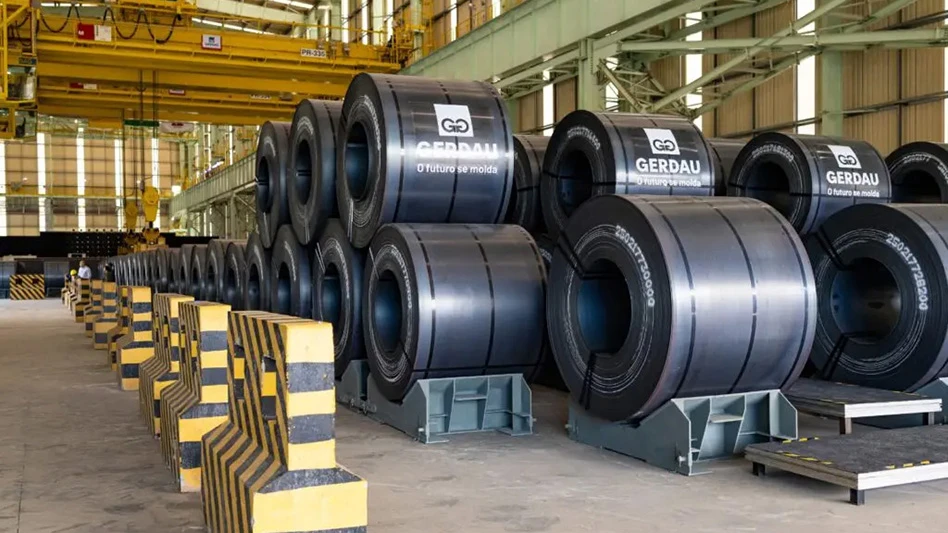
Photo courtesy of Gerdau S/A
Brazilian steelmaker Gerdau S/A has reported second-quarter 2025 adjusted earnings before interest, taxes, depreciation and amortization (EBITDA) that are 6.6 percent higher compared with the previous quarter but down 2.4 percent compared with the second quarter of 2024.
In management comments accompanying its second-quarter 2025 results, the company portrays a landscape that saw its United States operations produce more steel and generate more profits compared with activities in Brazil and the rest of South America.
From April through June of this year, the company's North American operations evidenced notable performance, contributing with 61 percent of the quarter’s consolidated EBITDA and offsetting the lower results in Brazil and South America.
Regarding mill activity—which in the U.S. and Canada consists of recycled-content electric arc furnace (EAF) mills—Gerdau produced 2.1 percent less steel in Brazil in this year’s second quarter compared with last year’s, while its mills in North America churned out 12.3 percent more steel this year compared with 2024.
Since President Donald Trump was inaugurated in January, his administration has introduced several measures to extend and increase tariff rates on inbound steel and on overall imports arriving from certain nations, including Brazil.
Reviewing the most recent quarter, Gerdau says it was able to overcome “an even more challenging business environment in Brazil” in particular because of the geographic diversification of its operations that it says once again has proven to be one of Gerdau’s key strategic advantages.
“In North America, we achieved a shipment volume in the quarter that was 2.2 percent higher than in the first quarter of 2025, driven by a decline in import levels due to the reinforcement of Section 232 tariffs and the resulting supply rebalancing," the company says. "With the market prioritizing domestic steel over imports, the order backlog remained high throughout the quarter, averaging 75 days.”
Gerdau says it operations in Brazil have been hampered not only by the loss of the U.S. export market but also because of excessive steel imports under "unfair competitive conditions," adding that the high level of imports remains a critical issue for the Brazilian steel industry’s competitiveness, reinforcing what it says is an urgency to improve trade defense mechanisms against imported steel.
“Gerdau remains well prepared to act in light of uncertain macroeconomic scenarios, such as those we have been facing in the global market," Gerdau CEO Gustavo Werneck says. "However, I would like to emphasize the importance of having fair competitive conditions in the Brazilian market to ensure the long-term sustainability of our business.”
Latest from Recycling Today
- Collective Waste Solutions acquires Alcop Resource Recycling transfer station
- Volatility continues in nonferrous metals
- Neste chemical recycling plant is ready to scale up
- Indonesia’s nickel pig iron spigot reopens
- Ecore says study backs crumb rubber use on sports surfaces
- Fleetio launches AI capability to accelerate fleet maintenance approvals
- The Metals Agency receives approval for export credit insurance
- Recycle Ann Arbor extends drop-off station operating hours