Photo courtesy of Ford Motor Co.
Ford Motor Co. has made a series of announcements that position the company to boost its production of hybrid and internal combustion engine (ICE) vehicles later this decade and reduce its presence in the electric vehicle (EV) battery manufacturing sector.
On the EV front, Ford has reached a joint venture disposition agreement with South Korea-based SK On and its SK Battery America affiliate that will see SK fully own and operate an EV battery manufacturing plant the JV partners had agreed to build in Tennessee.
Also as part of that disposition agreement, a subsidiary of Ford will independently own and operate a JV campus built in Kentucky.
In Kentucky, Ford intends to launch a battery energy storage system business to serve nonautomotive markets including data centers, utilities and large-scale industrial and commercial companies.
Ford plans to repurpose existing U.S. battery manufacturing capacity in Glendale, Kentucky, to leverage currently underutilized EV battery capacity to create a new, diversified and profitable revenue stream for Ford.
The company plans to invest approximately $2 billion in the next two years to scale the business and manufacture 5-megawatt-hour-plus storage systems. It plans to produce lithium iron phosphate prismatic cells, battery energy storage system modules and 20-foot direct current container systems in Glendale.
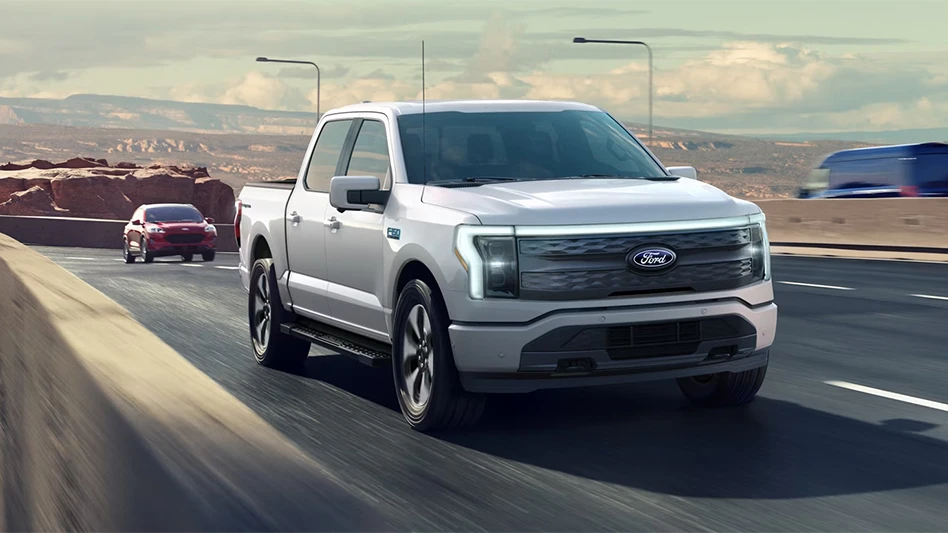
In terms of EV production, Ford has concluded production of the current generation F-150 Lightning EV pickup truck while continuing to focus on its F-150 ICE and hybrid models. The company also cites fires at the Novelis aluminum facility in Oswego, New York, (where aluminum sheet used in the Lightning is made) as a factor in the halt in production.
Ford says it is preparing to make a next-generation F-150 Lightning that will host extended-range electric vehicle architecture and be assembled in Dearborn, Michigan, as Ford redeploys employees to Dearborn Truck Plant to support a third crew as a result of the Novelis fires.
“The F-150 Lightning is a groundbreaking product that demonstrated an electric pickup can still be a great F-Series,” says Doug Field, Ford’s chief EV, digital and design officer. “Our next-generation Lightning EREV is every bit as revolutionary. It keeps everything customers love—100 percent electric power delivery, sub-5-second acceleration—and adds an estimated 700-plus mile range and tows like a locomotive.”
Other Ford announcements also focus on manufacturing capacity for ICE and hybrid vehicles, as well as smaller EV models.
Ford is renaming its Tennessee Electric Vehicle Center in Stanton, Tennessee, to the Tennessee Truck Plant. The renamed facility will produce all-new Built Ford Tough truck models with production starting in 2029, according to the automaker, saying the ICE vehicles made in Stanton will expand Ford’s market share in that sector.
The company's Ohio Assembly Plant in Avon Lake, Ohio, will become the assembly site for the Ford Pro, an ICE- and hybrid-powered commercial van to be manufactured starting in 2029.
“This is a customer-driven shift to create a stronger, more resilient and more profitable Ford,” Ford President and CEO Jim Farley says. “The operating reality has changed, and we are redeploying capital into higher-return growth opportunities: Ford Pro, our market-leading trucks and vans, hybrids and high-margin opportunities like our new battery energy storage business.”
Ford says its actions will require it and its subsidiaries to hire thousands of people across the U.S., reinforcing the company’s leadership as the top employer of U.S. hourly autoworkers.
In one more business diversification step, Ford says it will use its BlueOval Battery Park campus in Marshall, Michigan, to produce smaller amp-hour cells for use in residential energy storage systems.
That plant remains on track to begin manufacturing LFP prismatic battery cells in 2026 to power Ford’s upcoming midsize electric truck, the first model on the new Universal EV Platform, the company adds.