Image courtesy of Far Eastern New Century Corp.
Far Eastern New Century Corp. (FENC), a Taiwan-based supplier of sustainable polyester materials, says it has converted rigid postconsumer polyethylene terephthalate (PET) bottles into recycled thermoplastic polyester elastomer (rTPEE) for use in footwear.
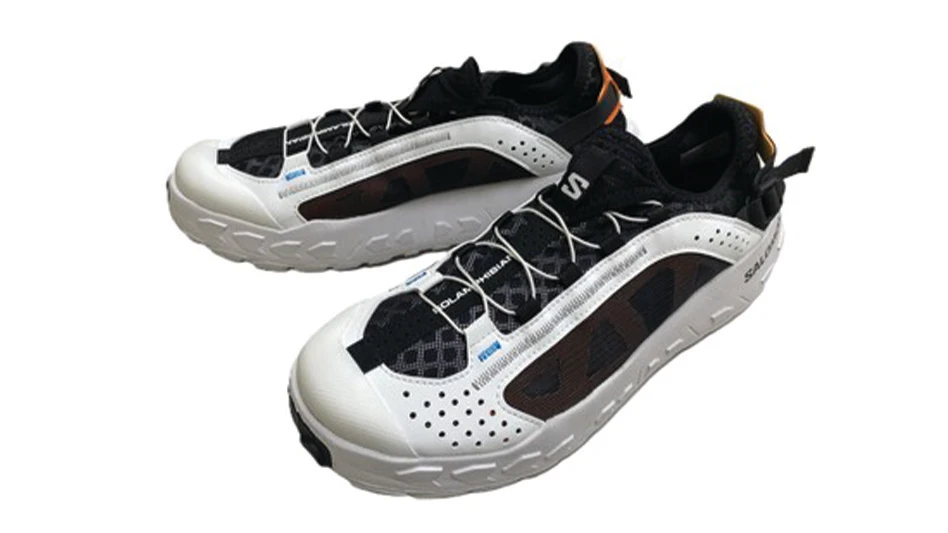
The company, which also operates out of locations in the United States, Japan, China, Vietnam, Malaysia and the Philippines, says its rTPEE material combines environmental benefits with performance, featuring “excellent” elasticity, cushioning and rebound, making it an ideal solution for footwear midsoles. The company says it already has been commercialized and supplied to French outdoor sports brand Salomon for its signature Solamphibian amphibious shoes.
FENC claims that compared to virgin TPEE, its recycled-content product reduces carbon emissions by 10-30 percent.
“The material has received strong market recognition, with multiple leading international sports brands currently in discussions to adopt it, demonstrating significant market potential,” FENC says.
Leveraging its core expertise in polyester, FENC says it has developed polyester materials in diverse specifications through polymerization and by modifying the material properties to suit the various shoe components in the attempt to address the challenge of separating shoe components for recycling. The company notes it has developed shoe uppers, laces, linings, insoles, shanks and toe cap adhesive made of rPET and midsoles from rTPEE, which is based on rPET material.
Additionally, the company says it has developed FENC TopGreen AirTek PU technology, which utilizes industrially captured CO2 as a raw material to produce high-performance elastic materials. The company adds that these materials can widely be applied in footwear, stretch fabrics, waterproof-breathable membranes and synthetic leather.
FENC says this particular product eliminates the use of phosgene and isocyanates traditionally found in conventional polyurethane (PU) manufacturing, offering a safer and more environmentally friendly production process. The company claims that compared to traditional thermoplastic polyurethane (TPU), AirTek PU achieves up to a 58 percent reduction in carbon emissions while maintaining both performance and functionality.
“FENC continues to advance sustainable materials and low-carbon innovation technologies, promoting a circular economy and driving the world toward a net-zero future,” the company says.