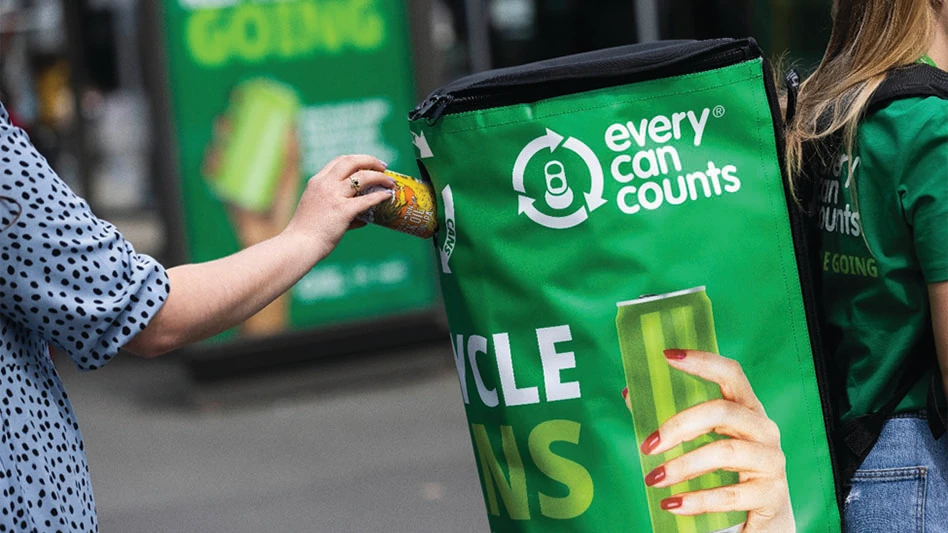
Image courtesy of Every Can Counts
A survey commissioned by United Kingdom-based awareness program Every Can Counts claims 58 percent of American participants support deposit return systems (DRS), particularly for aluminum cans.
Globally, the survey claims 71 percent of participants expressed support for DRS, with 88 percent believing containers returned through such systems are effectively recycled. Every Can Counts says aluminum beverage cans sold in the U.S. with a deposit have a 75 percent recycling rate, while cans sold without a deposit have a 37 percent recycling rate.
Globally, many DRS systems consistently deliver recycling rates above 90 percent, the organization says. The survey was conducted across 16 countries and with more than 16,000 participants.
“Deposit return systems are an effective, commonsense approach to incentivize Americans to recycle used aluminum beverage cans,” says Scott Breen, president of the Washington-based Can Manufacturers Institute, the lead organizer of the Every Can Counts U.S. chapter. “Not only does data from the United States and many countries around the world with active recycling DRS programs prove they are effective, but they are also universally popular. We hope more lawmakers will recognize and implement these programs as part of necessary reforms for recycling.”
The Every Can Counts study reinforces a 2022 survey of American voters that claimed “overwhelming support” for DRS programs. Currently, 10 states, plus Guam, use DRS programs and the organization says support among residents in those states was 90 percent.
Every Can Counts says half of global survey respondents associate circular packaging with being recycled back into the same type of product repeatedly, and only 43 percent with being reusable. At the same time, 57 percent of those polled define recyclable packaging as “designed for circularity.”
“Circularity doesn’t have to be complex,” says David Van Heuverswyn, global director of Every Can Counts. “Infinitely recyclable and already widely collected, aluminum cans are proof that truly circular packaging is possible. What’s missing is awareness.”
Meanwhile, 87 percent of respondents say that, to protect the environment, all single-use drink packaging—from beverage cans to glass and polyethylene terephthalate (PET) bottles—should be included. The survey claims nine in 10 people worldwide see plastic waste as a key environmental issue, on par with climate change.
Every Can Counts says its finding reveal that convenience and incentives are key to influencing change in recycling habits, with 71 percent of respondents supporting adjusting deposit fees by container size.
Additionally, the survey shows that support for DRS rises steadily with age—59 percent among Gen Z, 67 percent among Millennials, 74 percent among Gen X and 80 percent among Baby Boomers. “This suggests near consensus among older generations, while younger audiences see promise but want education and targeted engagement to build buy-in,” Every Can Counts says.
According to Every Can Counts, the study positions DRS as more than a collection mechanism, a bridge between consumer behavior and true circularity, while revealing an awareness gap. The survey notes that only 17 percent of people identify aluminum cans as “the most recyclable” beverage packaging, despite a 71 percent global recycling rate, compared with 34 percent for glass and 40 percent for PET.
“As DRS adoption expands, it’s high-quality, low-contamination collection will further increase aluminum’s recycling performance, keeping valuable material in circulation, enabling more drink cans to be recycled into new ones, and preventing the 29 percent still lost to landfill each year,” says Alexandra Williams, chair of Every Can Counts.
Of those surveyed, 71 percent say they would recycle more if the process were fun or interactive, highlighting a need for increased engagement.
“The data show what we see at Every Can Counts every day: people do care, they just want to feel part of the change and understand why true recycling matters,” Van Heuverswyn says. “Deposit return systems are the start, not the finish, and Every Can Counts is working across 21 countries to keep educating consumers about the remarkable sustainability credentials of the aluminum drink can.”
More from our latest newsletter
- SPE now part of the Plastics Industry Association
- PACK Act introduced to Congress
- Phoenix Technologies closes Ohio rPET facility
- Proposed bill would provide ‘regulatory clarity’ for chemical recycling
- Emerald Packaging replaces more than 1M pounds of virgin plastic
- New York county installs robotics at MRF
- Fairfax County, Virginia, expands textile recycling pilot
- Greyparrot report highlights improving recycling efficiency
- Alberta Ag-Plastic pilot program continues, expands with renewed funding