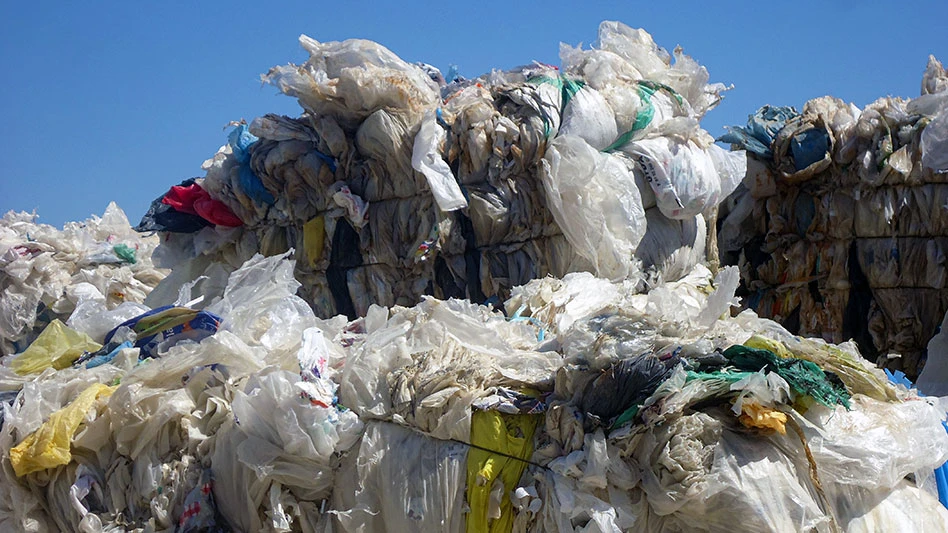
During the recently concluded BIR Autumn roundtable, attendees at the association’s Plastics session discussed the problems with the regulatory environment BIR Autumn Round-Table Sessions
Surendra Borad, chairman of BIR’s Plastics division, said, that the imposition of multiple rules and regulations on recyclable plastics" made it difficult to operate in Europe. He told delegates in Brussels: "I strongly feel that we in the plastics industry are being over-regulated in Europe. The feeling is more intense when we find that our fellow North American and Australian businessmen are not subject to so many strict rules."
A report submitted by Michael Lion of the Sims Group provided delegates with a brief overview of market conditions in Australia where annual consumption of plastics is around 1.6 million metric tons and is growing at around 2 percent a year. The recycling rate currently stands at 15 percent, but a target of 30-35 percent has been set for 2008; most of the 210,000 metric tons recycled each year is currently exported to China.
As for the Chinese market itself, Borad reported that checks on imports of low-grade plastics were becoming ever stricter. The higher costs of recycling had put substantial pressure on margins, he added.
Turning to the Indian market, Borad confirmed that 30 factories had finally been successful in obtaining five-year renewals to their exclusive licenses to import plastics scrap. India’s imports of recyclable plastics amounted to around 100,000 metric tons per year - making the country "a very small player" when compared to China’s annual import total of nearer 3 million metric tons, he said.
Borad also reported on the findings of a three-man delegation facilitated by Gemini Corp. to examine environmental and child labor practices within India’s plastics recycling sector. He observed: "There is absolutely no scope for dumping or illegal incineration. Plastics reprocessing is fully regulated and hence there is absolutely no child labor."
Trading conditions in some of the key European markets were summarized by Peter Daalder of Daly Plastics BV in the Netherlands and by Jacques Musa of Soulier in France. The former pointed to a slight fall in price levels in the Dutch and German markets although most reprocessors were reportedly optimistic owing to the strength of regranulate sales.
Meanwhile, shipments to Asia had dropped 25 percent since the spring of this year. According to Musa, there had been an upturn in the availability of secondary PET on the French market owing to increased collection levels and the withdrawal of some Chinese buyers.
In the report from Spain, it was suggested that quality controls imposed by the Chinese inspection and port authorities were proving increasingly difficult to meet. And in Italy, customs authorities were being "very punctilious" about the description of goods and were treating plastic film as "non-exportable waste" because it had not been subjected to any transformation. Lieven Lagast of Matco Glas NV in Belgium warned of likely price falls in the local LDPE market owing to demand weakness.
A guest presentation from Honore Paelinck, managing director of Belgium-based Port and Transport Consulting, focused on the growth in containerized shipments in response to ever-increasing demand. He explained, "More containers need a larger capacity of shipping and larger ships result in a lower unit cost price - so ships grow bigger." Having noted that the largest such vessel afloat boasted a capacity of 14,300 TEU, he warned: "Larger ships will not offer the same frequency of departures in the limited number of ports they can call because of their size."
On a brighter note, he predicted that freight rates might fall in the longer term - perhaps two years from now - as a consequence of growth in shipping capacity.
Latest from Recycling Today
- Ocean freight interruptions poised to continue
- Danieli to supply shredder to Australian company
- Equipment from the former Alton Steel to be auctioned
- Novelis resumes operations in Greensboro, Georgia
- Interchange 360 to operate alternative collection program under Washington’s RRA
- Waste Pro files brief supporting pause of FMCSA CDL eligibility rule
- Kuraray America receives APR design recognition for EVOH barrier resin
- Tire Industry Project publishes end-of-life tire management guide