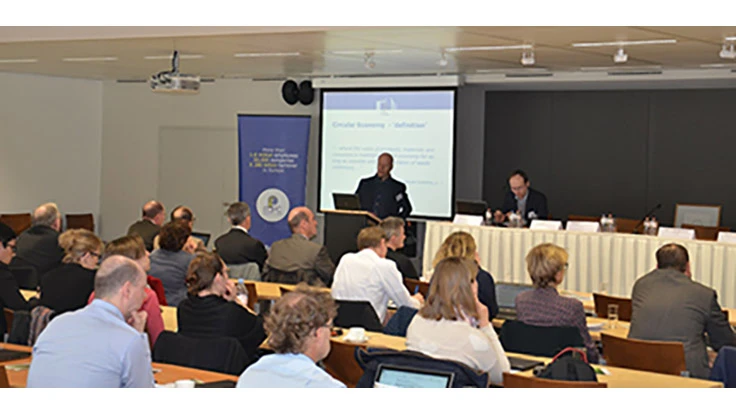
Pictured: Urban Boije of the European Commission presenting during the EuPC REACH Workshop.
The European Plastics Converters (EuPC), Brussels, in association with Polymer Comply Europe (PCE), also based in Brussels, hosted and event titled REACH Workshop: The Plastics Industry State of play 17-18 March 2016 in Brussels. The two-day workshop brought together participants from across Europe representing all levels of the supply chain and included lively debates, wide-ranging presentations and a networking event, according to a news release from EuPC.
EuPC says it has been actively involved in the development of REACH, or Registration, Evaluation, Authorisation and Restriction of Chemicals, legislation that aims to improve the protection of human health and the environment through better and earlier identification of intrinsic properties of chemical substances.
One of the goals of the workshop was to focus on key lessons from past challenges brought on by REACH. The event also was an opportunity to keep SMEs (small and medium-sized enterprises) in the plastics value chain up to date on the latest developments regarding REACH, including practical tools and solutions developed by EuPC to facilitate the fulfilment of REACH obligations. So far the implementation of REACH has covered the registrations of big and medium volumes chemicals, the first authorisations and restrictions, but new challenges lay ahead that will need to be faced, EuPC says.
Geoffroy Tillieux, EuPC technical department director & PCE regulatory compliance director, opened the workshop 17 March, saying, “In order to be successful and manage raw materials in a strategic way, plastics converters, masterbatchers and their downstream users should early on identify the key substances that may be under scrutiny and should exchange information on their uses and exposure
Dr. Bernhard Mahlberg from the Institute for Industrial Research, Austria, evaluated the impact of REACH on the affected industries and Austria’s economy, a report commissioned by the Austrian Federal Ministry of Agriculture, Forestry, Environment and Water Management.
Various aspects of REACH registrations were covered by industry experts such as Roger Van Der Linden, PlasticsEurope REACH Committee chairman, who discussed the notifications of nanomaterials. Registration in 2018 and orphan substances were presented by Karine Van de Velde, secretary general of the REACH Orphan Substance Consortium. Venelin Marinov, advisor to the Bulgarian Association Polymers, explained the duties of importers and their representatives. Furthermore, Patrick de Kort of PCE demonstrated the Plastics Exposure Scenario Tool (PESTOOL) developed by the plastics industry to best understand risk management measures.
Urban Boije, policy officer of the chemicals unit at DG Environment, began Thursday’s session on recycling and the circular economy by presenting the European Commission’s vision for integrating recycling within the circular economy.
Maurice Funcken of Nissan discussed the challenges of recycling automotive applications in relation to the latest REACH developments.
Closing the session, Eric Vandevijver from Inovyn/VinyLoop, Belgium, shared past experiences with application for authorisations for uses of soft PVC (polyvinyl chloride) recyclates containing legacy DEHP (Di[2-ethylhexyl]phthalate).
The second day of the workshop was dedicated to risk management options for substances and enforcement. Klaus Berend, head of the REACH Unit at DG Grow, presented how to implement REACH in a streamlined way, covering steps such as risk management option analysis (RMOA), authorisation and restriction. He said, “The authorisation process has proven to improve safety and encourage substitution. On the other hand, the commission works on improving predictability, clarifying requirement and reducing burdens by simplifying in specific cases such as low volume and legacy spare parts, and making application dossier and fees fit for purpose.”
Dr. Jochem F. M. van der Waals from the Netherland’s Ministry of Infrastructure and Environment shared that country’s experience on risk management for chemicals, saying, “The RMOA aims at finding a policy option which is effective, proportionate, practicable and regulatory consistent to improve protection of health and the environment. Availability of exposure data at an early stage is key in making the right choice.”
During the workshop, European Chemicals Agency (ECHA) Scientific Officer Denis Mottet shared knowledge gained from past experiences with authorisation applications. In addition, Christian Schmitt, REACH substance coordinator, Performance Chemicals Division, of BASF, who presented a risk management option analysis of a UV absorber. Sabine Dröge, legal assessor and deputy managing director of PolyComply Hoechst addressed risk management options for substances used exclusively in industrial settings and already subject to workplace legislation.
Finally, Michel Baumgartner, secretary general of EUROPUR and EURO-MOULDERS, and Ronal Van den Bosch, PU, EHS, sustainability & compliance of Dow Benelux, presented a new approach on REACH restriction based on the example of diisocyanates.
EuPC says it will organise a follow-up event in the fourth quarter of 2016.
Latest from Recycling Today
- Equipment from the former Alton Steel to be auctioned
- Novelis resumes operations in Greensboro, Georgia
- Interchange 360 to operate alternative collection program under Washington’s RRA
- Waste Pro files brief supporting pause of FMCSA CDL eligibility rule
- Kuraray America receives APR design recognition for EVOH barrier resin
- Tire Industry Project publishes end-of-life tire management guide
- Des Moines project utilizes recycled wind turbine blades
- Charter Next Generation joins US Flexible Film Initiative