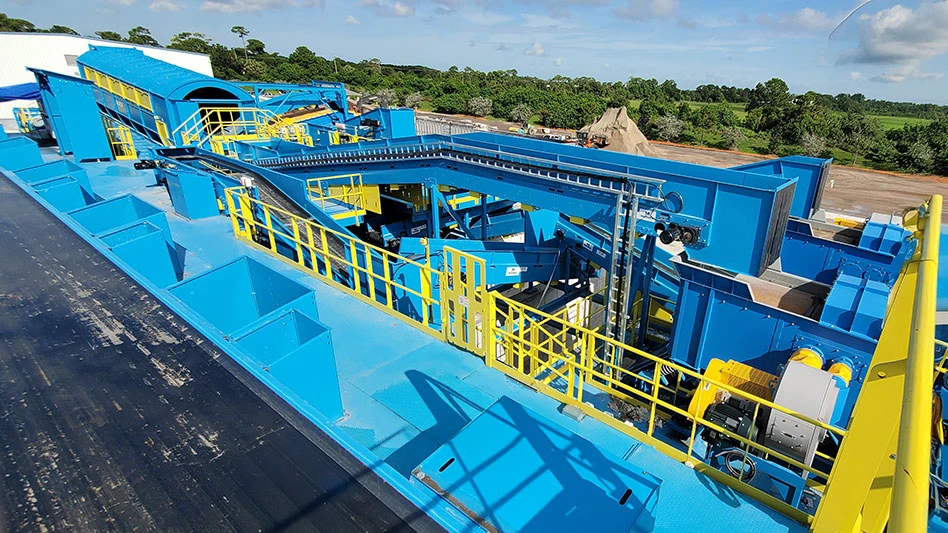
The United Kingdom has witnessed a “building boom” when it comes to material recovery facilities (MRFs), and those plants will likely remain busy as the U.K. strives to help reach landfill diversion targets of 50 percent in England and 70 percent in Scotland and Wales.
Presenter David Sher of the Environmental Services Association (ESA), London, told attendees at a session at the RWM Exhibition in Birmingham, U.K., in mid-September that MRF operators are working hard to hit national recycling targets, while also maintaining quality standards.
“We’ve made enormous progress,” Sher told his audience, “but I think there are still real entire step changes [remaining].” He added, “I think we took the low-hanging fruit, which is the right approach—you do the easy things first.”
Sher said recovery rates for paper, metal food and beverage cans and the most common plastic bottles have increased dramatically in the U.K. But, “as you start getting into foils, films, yogurt pots . . . this is really the challenge.”
The challenge came not necessarily in the form of finding end markets for such materials, said Sher, but in sorting out an increasing array of objects passing through automated sorting systems and people on picking lines. “I’m going to argue that it has an impact on quality,” he commented.
Although Sher said the situation posed challenges, he also remarked that “technology moves at a rapid pace if you put the right incentives in place.”
Rewards in the form of end markets that will pay for materials and plant operators who are compensated for quality shipments can provide those incentives and increase diversion rates. “That’s why I think MRFs have a larger and larger role to play,” said Sher.
The RWM in Partnership with CIWM Exhibition, was in Birmingham, England, Sept. 13-15, 2011.
Latest from Recycling Today
- Greenwave raises revenue but loses money in Q2 2025
- Recycled steel prices hold steady
- EY says India’s need for scrap imports will continue
- Coming full circle
- Amcor, DCM introduce fertilizer packaging with 35 percent recycled content
- Comstock Metals gets closer to commissioning commercial-scale solar panel recycling facility
- Washington selects Circular Action Alliance as PRO
- Smurfit Westrock expands in Latin America