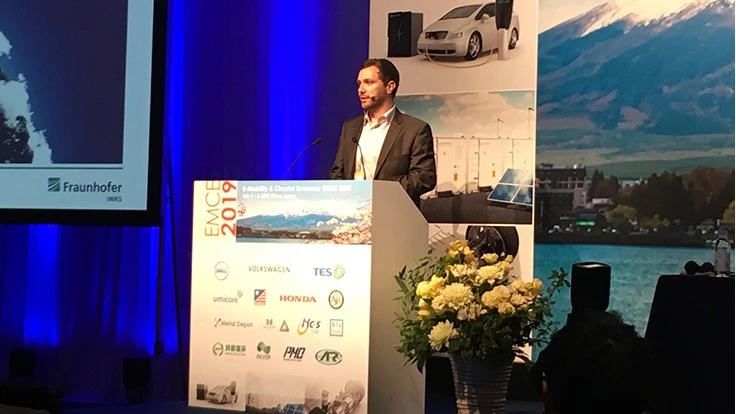
As more electric vehicles (EVs) enter the end-of-life vehicle (ELV) stream, the battery packs that power them can supply “valuable raw materials,” according to several presenters at the 2019 E-Mobility & Circular Economy (EMCE 2019) conference. That event, organized by Switzerland-based ICM AG and held in Tokyo July 1-3, included presentations on how “active materials” that can re-enter the battery manufacturing process are being harvested from EV battery packs.
Daniel Horn of the Fraunhofer Research Institution for Materials Recycling and Resource Strategies (IWKS) in Hanau, Germany, said his institute has been engaged in research that has as its premise that end-of-life EV batteries “constitute an important source of raw materials.”
Some of that research looks at alternatives to what Horn called “the old way” of recycling such batteries, which involves a high-temperature furnace and considerable slag. Fraunhofer is instead developing physical and mechanical separation techniques to prepare active materials (such as cobalt and lithium) for a hydrometallurgical process at the tail end.
A pilot plant set up by Fraunhofer IWKS involves an “electrohydraulic fragmentation” machine, or a wet shredding process that uses pressure to waves to “crush battery cells at their weakest points” to undertake “component-specific fragmentation of the batteries.” What is ultimately produced includes a plastics stream, a metals stream and the “active ingredients” stream of elements such as cobalt and lithium.
Initial results, said Horn, indicate the process can capture “up to 90 percent” of the value in some battery cells via a process with one-third the carbon footprint of competing processes.
In the conference’s host nation of Japan, JX Nippon Mining & Metals is a long-time smelter operator that is exploring how to best handle EV lithium-ion batteries (LIBs). Unlike the Fraunhofer pilot plant, JX Nippon starts with an incinerator step, and follows with crushing, screening and leaching steps to separate the active materials.
According to the company’s Hirotaka Ariyoshi, JX Nippon is able to extract marketable manganese carbonate, nickel sulfate, cobalt sulfate and lithium carbonate via its process. Ariyoshi described the cobalt sulfate produced as a “high-purity” product that can be used to make new batteries.
Professor Kenichi Togawa of Kumamoto University in Japan described two cases where companies have been refurbishing larger battery packs in Japan. One company is remanufacturing nickel-metal hydride forklift batteries while another firm has opened a plant to remanufacture the batteries used in the Nissan Leaf EV.
EMCE 2019, which featured plant tours, workshops, conference sessions and an exhibit hall, was July 1-3 at the Westin Tokyo.
Latest from Recycling Today
- Equipment from the former Alton Steel to be auctioned
- Novelis resumes operations in Greensboro, Georgia
- Interchange 360 to operate alternative collection program under Washington’s RRA
- Waste Pro files brief supporting pause of FMCSA CDL eligibility rule
- Kuraray America receives APR design recognition for EVOH barrier resin
- Tire Industry Project publishes end-of-life tire management guide
- Des Moines project utilizes recycled wind turbine blades
- Charter Next Generation joins US Flexible Film Initiative